Zombies: The Undead Among Us

Contemplative Chef Zombie by Andrew Braithwaite 

Alas, I didn\’t review World War Z for my day (and sometimes night) gig at Plugged In. Thus, I cannot tell you whether humanity fended off the zombie plague, whether Brad Pitt was zombified or, if he was, how his hair looked post-mortem.
Which might be a good thing, given that I\’d be forced to write about the actual movie instead of discussing the walking dead on a wider scale. Because really, in a faithy-like forum such as this, there\’s quite a bit to say about zombies. After all, people are coming back to life in the Bible all the time.
Sometimes, these resurrections get a little help from a pious man of God: The prophet Elijah brought a boy back to life with heartfelt prayer and some strange calisthenics (“he stretched himself out on the boy three times,” we’re told in 1 Kings 17:20). Elisha, Elijah’s understudy, resurrected two people—including one after the prophet was just a pile of bones himself. (“When the body touched Elisha’s bones, the man came to life and stood up on his feet,” according to 2 Kings 13:21). Peter and Paul both successfully brought people back to life. Jesus, of course, returned no less than three folks to the land of the living—and, as an encore, He engineered His own resurrection for good measure.
Of course, none of those people qualify as \”zombies,\” as we understand the word. These folks actually lived again: They weren\’t just pretending, as the walking dead do. And they certainly weren\’t chewing on people\’s brains.
     
But the Bible talks about things that sound an awful lot like real zombies, too.
In Revelation—as an apocalyptic book as there is in the Bible—a couple of hombres are killed and are left in the middle of town, presumably to feed the local magpies. But then, after three-and-a-half days of lying in the sun or rain or what-have-you, they get up and scare the stuffing out of passers-by (Rev. 11:1-14). The Bible doesn’t say they ate anyone’s brains or grunted a lot, but neither does it say they were “normal,” either. And given the fact they had a good few days to decay before they rose again and were snatched up into heaven, I can\’t imagine they looked too pretty by then.
     
Or then there’s this charming vision of the future, courtesy that hip prophet of yore, Zechariah:
     
\”This is the plague with which the Lord will strike all the nations that fought against Jerusalem (when Jesus comes for a second time): Their flesh will rot while they are still standing on their feet, their eyes will rot in their sockets, and their tongues will rot in their mouths.\”  (Zechariah 14:12-13)
     
If you didn’t remember Zechariah lived a good 3,000 years ago, you might’ve thought Zechariah just finished watching Day of the Dead or something. And these shambling, decaying mounds of flesh arrive just in time for the second coming. A true zombie apocalypse, if you will.
There\’s a third sort of \”living dead\” the Bible talks about, too: Us.
Jesus was pretty adamant that life without Him wasn\’t much of a life at all. \”Very truly I tell you, whoever hears my word and believes him who sent me has eternal life and will not be judged but has crossed over from death to life,\” he says in John 5:24. And as my pastor tells it, Jesus isn\’t just talking about eternal life, but life in the here and now—\”life with a capital L,\” as my pastor tells it.  
Paul and other New Testament authors bought all that, and repeated it to anyone who might read one of their letters. \”As for you, you were dead in your transgressions and sins,  in which you used to live when you followed the ways of this world …\” wrote Paul to the Ephesians. \”But because of his great love for us, God, who is rich in mercy, made us alive with Christ even when we were dead in transgressions—it is by grace you have been saved.\”
But these biblical authors sometimes flipped the whole death-and-life metaphor around, too. Forget shambling around in our living death of sin. Sometimes we need to die and then be animated by another, more mysterious power—but instead of the weird virus in World War Z, it\’s Jesus. \” I have been crucified with Christ and I no longer live, but Christ lives in me,\” Paul writes in Galatians 2:20.
So, if you shuffle off to a local theater this weekend to check out this $200 million epic zombie movie, think about some of these more theological zombies while you\’re there. Personally, I think they\’re worth (ahem) chewing on.

Man of Steel: Did It End Well?

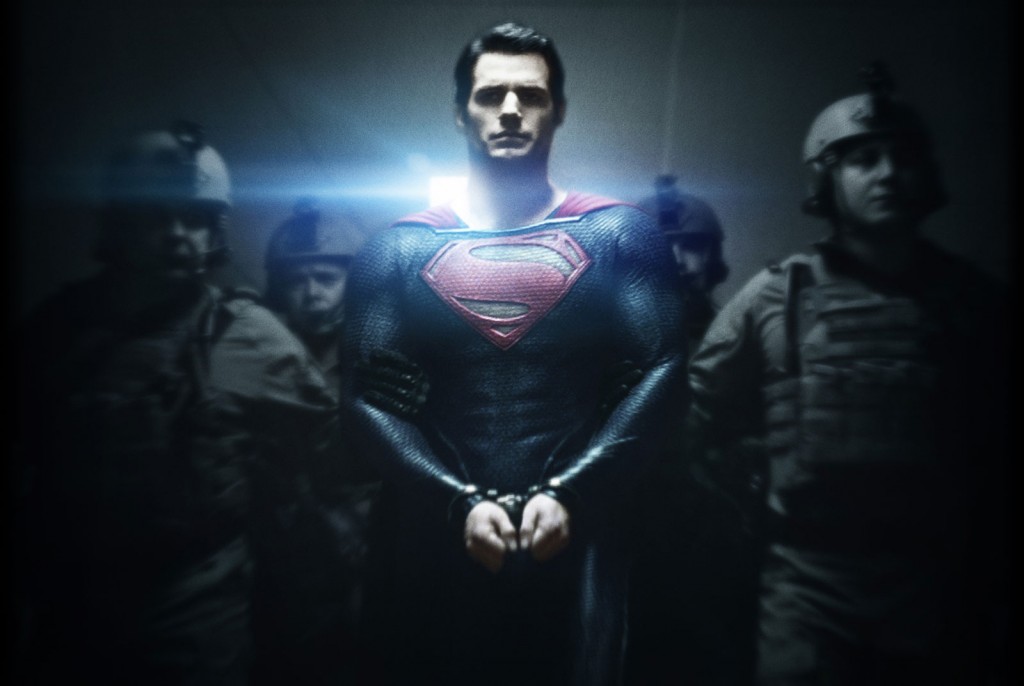
Man of Steel did just (ahem) super at the box office this weekend, cashing $116.6 million over the weekend and, including some special Thursday screenings, $128.7 million overall. That\’s great—mostly. It\’s great for Warner Brothers, which now has an honest-to-goodness franchise in play again the year after The Dark Knight series concluded last year. It\’s great for Henry Cavill, who plays Superman and will have a chance to flash his chin cleft for years to come. It\’s great for pop-culture-centric Christian writers like me, who\’ll have more opportunity to write about the themes in play.
But I am bothered by the ending. Not horrified, necessarily, but bothered.
WARNING: The rest of this post will get very spoilery.
To recap (and I really hope you took that warning right above this sentence seriously), Superman and his nemesis General Zod have it out on Planet Earth—right in the heart of Metropolis. Much of the city is destroyed during their melee. And in the end, a furious and still defiant Zod turns his newly discovered heat-ray peepers to an innocent family, obviously intending to fry them. Superman does his best to stop Zod, but Zod\’s just as strong as he is and Superman knows that Zod will never stop and— and—
Well, Superman kills the guy.
Repeat: Superman kills.
Now, if we get all theological and say that Superman is a straight-up Christ figure and Zod is the devil or the epitome of evil or something, we can navigate this. As much as Jesus wants us to be good to one another, He doesn\’t have a problem crushing evil. And Zod certainly feels about as evil as it gets (in his own strangely principled way).
And sure, he seems broken up about it at the end. The movie suggests Superman didn\’t have a choice: It was either Zod or the innocent family. Given that either-or scenario, you gotta go with Zod.
But Superman doesn\’t kill people. He just doesn’t. That\’s not part of his character. And that bothers me. In fact, he didn’t just kill Zod. He fought the guy in the heart of Metropolis, destroying half the city it seemed. The Superman I grew up with, I think, would’ve led Zod out of town—never mind director Zac Snyder’s need for crashing buildings and explosions.
One of the things that I respected so much about Christopher Nolan\’s Dark Knight trilogy was how true he stayed to Batman\’s long-held mythos. Yes, they were dark stories. But he never fired a gun. He never killed anyone. Yes, he was a flawed, complex character. But he held firm to the central tenants of his own internal morality.
Superman is a better person (albeit alien person) than Batman. Everyone says so—even Batman. He\’s an optimistic, glass-half-full kind of guy compared to Batman\’s dour skeptic. While Batman slinks in the shadows, Superman\’s a hero of light. The movie even suggests that Superman\’s super powers are fueled by the sun (its youth and vitality mixing with Supes\’ genetic makeup with impressive results). He\’s powered, literally, from a light from above.
Moreover, Superman\’s supposed to be an example—a guy who, in father Jor-El\’s words, \”give the people an ideal to strive towards.\” Batman doesn\’t consider himself to be a great example to anyone.
And yet Superman\’s the one who\’s killing people?
Maybe I’m off base. And perhaps it’s a little quibble in a pretty positive movie. Still, that quibble keeps me from embracing Man of Steelas much as I’d like.

Man of Steel: Longing for Superman

When I was a kid, my best friend Terry and I were obsessed with superheroes. Every day we were together, we\’d strap on our capes, hope for some wind to make them flap dramatically and run around the back yard, saving imaginary citizens from disaster.
But I didn\’t imagine that superheroes were things that really walked (or flew) among us … until one afternoon when Terry told me that Superman was real.
\”Is not,\” I said.
\”Is too,\” Terry retorted. \”He has a statue.\” Normally, that\’d clinch it. After all, he was 6. I was 5. Terry knew far more about the world than I did.
But, my innate cynicism already beginning to surface, I refused to believe him. We argued for a good 10 minutes before Terry decided he was going to prove Superman’s existence to me once and for all: He was going to stand out in his front yard and call the Man of Steel in for a visit.
And so we tromped out, and we both shouted as loud as we could. Even in my skepticism, I was hopeful. Wouldn\’t it be great if the guy wasreal?
Superman, alas, never came.
That disappointing afternoon has been bouncing around in my brain ever since I saw Man of Steel, the latest Superman reboot (landing in theaters on Friday). Because, as even as I evaluated the movie and mulled the spiritual parallels and wondered just how much they spent on explosives or whether it was all just CGI, another thought—the same thought I had when I was 5—was percolating through my noggin.
Wouldn\’t it be kinda cool if Superman were real?
All due respect to Batman and Iron Man and Spider-Man and all those other Men-Mans, Superman\’s been the guy—the ultimate superhero—for 75 years now. And while perhaps he takes a backseat in terms of popularity, to more flawed heroes, he\’s still as recognizable and, in his own way, revered, as ever. He is a true hero: charismatic, polite, sacrificial. It\’s as if someone took everyone you liked and respected, rolled them up into one buff bod and gave him the ability to fly and weld with his eyes. I mean, what’s not to like about the guy?
And let\’s face it: We could all use someone who we could embrace without reservation—someone who\’d never let us down. Someone who\’d rescue us from the disasters and terror and misery that sometimes seems to stalk us. We could all use not just a hero, but a superhero.
As I write this, much of Colorado is on fire. My house isn\’t threatened this time, as it was last summer. But plenty of others are—and their owners are nervously watching news reports, perhaps gathering up precious belongings to evacuate, perhaps unsure of whether their home is still standing. It\’s terrifying, but it\’s more than that. Disasters like this leave you feeling powerless. And feeling powerless is one of the worst feelings there is.
Superman\’s never powerless—or, at least, hardly ever. Superman will always find a way to do something. Make things better. Save us.
***
From the very beginning of his career, Superman has always had some Messiah-like attributes. His Kryptonian name (Kal-El) has been translated to mean \”Voice of God.\” He was of another world, yet became a \”human\” under the care of good but fairly nondescript mortals. He was meant to be a “savior.” In Man of Steel, those subtle nods become explicitly religious and Christ-like: This movie is as Christian a mainstream movie as maybe I’ve ever seen: Almost a Bible study in a cape. He revealed himself at age 33, asks advice from a priest in a church (as a stained-glass image of Jesus looks over his shoulder). He is, his adoptive human father tells him, “The answer. The answer to whether we are alone in the universe.”
And yet this Superman is very much human, too. He struggles with his nature, and seems a little appalled that God would’ve made him so freakishly, alarmingly different than everyone else. After his father dies, Clark becomes a vagabond—stopping to work in a far corner of the world for a while, then moving on when he fears his nature might be discovered.
But in the end he realizes he must take on a greater mantel to save humanity. And to do so, it seems, he must turn himself in. He allows himself to be handcuffed and led, presumably, to his fate. It’s a nifty little echo of Jesus’ own trip to the cross—a symbolic surrender to authorities that, really, had no authority or power over them.
Part of me would like to ramble on. There’s a lot of spiritual niftiness at play here.
But I want to go back to the anecdote that started this whole narrative … the day my friend Terry and I learned that Superman wasn’t real. And we must ask the inevitable question: If Superman and Jesus are so much alike, is Jesusreal? Plenty of us call on Him in our darkest times. And sometimes, it doesn’t feel like we get an answer. Are we calling in vain? Are we just longing for someone to save us—someone who’s not there?
Superman, the original comic-book character, was the work of Jerry Siegel and Joe Shuster, both Jewish immigrants. And maybe Superman, if he was intended to be a Messiah, perhaps originally reflected more of what the Jewish people always expected a Messiah to be: A superhuman warrior, righting wrongs and rescuing us all from evil.
But as Christians, we interpret the concept of Messiah quite differently. God seems to love working with paradox, and Christianity is based on the greatest paradox of them all: A “Savior” who, it appeared, couldn’t even save himself. And yet in that act of apparent weakness—in a moment of apparent cataclysmic defeat—Jesus was both strong and eternally victorious. Weird.
Two thousand years ago, we were looking for Superman. We got something even better, even if it was hard to recognize at the time. Jesus didn’t just save our lives or homes or society: He saved us—the soul of us, the core of us.
We get that. And yet (paradoxically) we don’t. And maybe, in a way, we’re incapable of getting it. We’re human, after all—very much attached to our lives and livelihoods and stuff. We hurt. We suffer. We cry out for help.
Sometimes that help comes obviously and unmistakably. Every once in a while, miracles, or things that can seem like miracles, swoop out of the sky and give us exactly what we need. It comes like Superman, full of might and muscle and X-ray vision.
Sometimes it comes more quietly. We’re given a sense of peace. We’re given new determination to tackle our troubles, or perseverance to push through our trials.
And sometimes, it feels as though help doesn’t come at all. That’s hard to write and it’s hard to admit, but sometimes it’s true. There are times we shout for a Savior at the top of our lungs. We plead for help. And in the midst of our hurt and grief, it can feel as though no one came.
I don’t think, when we feel like that, it’s because (as sometimes happens with Superman) God’s too busy saving other people to tend to us at the moment. I certainly don’t think it’s because we’re calling on someone who’s not even there.
I believe that He’s there and He hears us. He loves us dearly. But at the same time, He understands—and wants us to understand—that in the deepest of ways, we don’t need saving: We’ve already been saved. It’s not that He’s notcoming for us. It’s that He already has. 

The Purge: Legislating Morality

Rod Serling would’ve been disappointed, I think.
While trailers for The Purge make it look like a depressing splatterfest, the sci-fi/horror flick is, in some ways, more like a frenetically violent, 85-minute episode of The Twilight Zone. Its central premise is something straight out of Serling’s imagination: What if society decided to make crime—assault, murder, the whole works—legal for a night?
It’s a great idea (the story concept, not actually legalizing crime), but one (as I said in my Plugged In review) that probably would’ve worked better on the old 1960s show. While the flick generously ladles out violence, it was pretty stingy on any actual suspense or scares. Your heroes can be improbably saved from imminent death so many times before you, as a viewer, start looking at your watch.
But while The Purgeas a movie wasn’t that great, its central question sparked another, even more interesting question for me: What makes something right?
The whole friction between what’s legal and what’s right is really compelling to me, maybe because I had to wrestle with the concept so mightily while writing my Batman-focused book, God on the Streets of Gotham. On one hand, Batman’s a vigilante, breaking the law almost every night. On the other, he’s a stickler for rules: He never kills and often drops criminals off right on the police’s front doorstep. That weird dichotomy helps make Batman the compelling basketcase that he is, I think. And maybe we struggle with that own dichotomy in ourselves. Most of us really respect the law—unless, of course, 65 mph feels a little slow for a stretch of open road in the middle of Kansas.
Laws are supposed to reflect what a society says is “right.” And I think in a just society, they largely do. Remember the old adage, “You can’t legislate morality”? Legislation, I think, is an explicit reflection of morality. Everything, from traffic statutes to the tax code, represents (often imperfectly) our cultural moral priorities. And when we push to change a law or pass a new one, we always trot out oodles of ethical rationales for doing so.
But whenever we support or oppose a law, we make a very important assumption: Right and wrong transcend whatever’s on the books. There’s a higher morality at stake. And we want our human-authored bills and rules and laws to better reflect that higher sense of morality. So in another way, the idea we “can’t legislate morality” is right on. Morality’s already there, somewhere. We’re just trying to codify it.
Somewhere along the line in the world of The Purge, America’s “new founding fathers” had a whale of a discussion of morality. And for them, it all came down to what would make the country run better.
How they came to the Purge as a solution, I have no idea. But I’d like to imagine that, after hours and hours of discussion, they all decided to watch Star Trek II: The Wrath of Khan. And when they heard Spock talk about how “the needs of the many outweigh the needs of the few” (all sugared up from way too many donuts) they made a fairly horrific ethical leap.
“Hey!” one of them might’ve said. “Why not allow society’s many to kill off a few folks? It’ll really solve a lot of problems!”
And, oddly, the movie tells us, it does. We’re told that unemployment is rock-bottom and productivity is sky-high. Why? It’s all due to the Purge, and the flick suggests it could be one of two reasons: Either the Purge A) allows folks to blow off a little evolutionary steam, or B) culls society’s weaker, less productive members.
The movie’s new founding fathers made what is, essentially, a moral argument—but one that assumes that society itself is the ultimate arbiter of right and wrong, the higher authority. If society works better because of a given law, that given law must be, by definition, “right.”
Except it’s not. We get this. The movie gets this. And the main characters in the film grow to understand just how wrong the Purge is after its uncomfortable realities come literally barging through the door.
The movie suggests that right and wrong is bigger than us. We don’t make it up as we go.
I think most of us understand this deep in our hearts. But we don’t necessarily realize where that understanding inexorably leads us. That sense of overarching right and wrong has to come from somewhere—God, a divine intelligence, a strange, moral compunction in the universe. We can’t be merely chance products of an unfeeling universe and have a sense of universal morality.
The morality of the Purge—that is, the fictional law—predicates there is no such overarching morality. The universe doesn’t care what we do, so right and wrong is really a matter of practicality.
The morality of The Purge—that is, the movie—tells us that’s a fallacy. Something out there does care. And deep down inside, we all know it. 

Running on Faith: The Marathon

When you train for a marathon, there\’s a lot of stuff you need to account for. You\’ve got to train like crazy to get your body ready for the thing. You have to mentally prepare yourself for being on the road for several hours. You have to plan what to wear, given the fact that marathons here in Colorado might have huge changes in temperature and weather. You need to make sure your running bib\’s just right, you\’ve got enough food in your pockets and you\’ve put Vaseline on anything that could conceivably chafe.

Oh, and it helps to bring your running shoes.

Emily, my daughter, forgot hers. We were staying overnight in Denver for the Colfax Marathon–her first–and she brought everything else she might ever need for this or any other marathon: hats, gloves, shorts, sweatpants, Ibuprofen, Pepto-Bismol and safety pins. But she left her running shoes at home. She discovered it at 4:30 a.m., just 5 minutes before we were to drive to the starting line.

When you\’re running for 26 miles, shoes are a big deal. Sure, I\’ve heard of folks who run marathons barefoot and say it\’s the best. But let\’s face it: Those people are crazy. When you\’ve trained six months for one running event, you know how cantankerous your feet can get. The least you can do is give them some expensive shoes in which to cantanker.

She must\’ve felt sick when she figured out her mistake. I know I did. Months of training, I thought. Her first marathon, down the tubes, I thought. There\’s no way she\’s going to be able to finish. No way.

What I actually said was, \”Oh.\” And then, \”That\’s kind of a bummer.\”

Because really, at that point, what can you do? You\’ve either got to race or go home, and we weren\’t about to go home. The last thing Emily needed was her father to freak out.

Fortunately, my wife had a pair of old sneakers with her (pictured above, at the starting line) –just a size-and-a-half smaller than Emily typically wears. Sure, they weren\’t the most comfortable things. Sure, they were five years old and had the tread of a 1953 inner tube. But they were a better alternative than Emily\’s flip-flops.

For the last few months, I\’ve talked about how training for a marathon reminds me sometimes of our journey of faith. It requires discipline. Patience. We might suffer aches and pains along the way. And we get to experience a lot of joy, too: The gentle thrill of running, the fun of spending concentrated hours with someone where all you can do is talk, the wonderful feeling you get when a long training run is over.

Most importantly, you have the thrill of knowing, in the end, you\’ve done something pretty worthwhile. You\’ve been a part of something pretty special.

And when you\’re training for a marathon, the actual marathon is, you know, kind of a big deal: The proverbial carrot at the end of the stick, the fresh-baked donut after a six-hour hike on Pikes Peak. In my little catalog of running/faith metaphors, finishing a marathon would be, I suppose, akin to getting to heaven–the shiny medal being the equivalent of God telling you, \”Well done, good and faithful servant.\”(Only when we reach heaven, I hope we won\’t be quite as sweaty and achey.)

I was not really prepared to figure out a metaphor for forgetting one\’s shoes. But maybe I should\’ve. After all, I\’m sure she\’s not the first. Unexpected things happen to lots of runners. I know one runner who tripped during a marathon and knocked out a couple of teeth–and still managed to finish. I knew another who started bleeding from his nipples. (Yeah, remember that Vaseline? Important stuff.)

Maybe the lesson here is that, sometimes when things go a little crazy–either through your fault or just by happenstance–we\’ve got to lean on God. There\’s nothing more we can do. We\’ve put in the time and effort and energy. But in the end, success or failure is out of our hands. We must sit back, enjoy the experience and let God do His thing.

Those moments can be liberating, in a way. We cling so tightly to our own agendas and place so much trust in our own plans. it\’s a strangely great feeling to unclench our hands and open them to the heavens, ready to catch what we may.

When I heard Emily left her shoes, what I said was, \”Oh.\” Perhaps that translates to, \”Thy will be done.\”

The story has a happy ending, by the way. Emily\’s substitute shoes carried her through all 26.2 miles. She ran almost the entire way. And while her feet were hurting by the end, they didn\’t hurt nearly as much as I feared. Be it by God\’s grace or the wonderful resiliency of 19-year-old feet or a combination of both, Em made it to the finish line and accepted her well-earned medal. If I hadn\’t been so tired myself, I would\’ve hoisted her over my head in celebration.

The finish line didn\’t look anything like heaven for either of us. But for her, two words seemed quite appropriate: Well done.

Star Trek: The Wrath of My Lawn

I saw Star Trek Into Darkness recently, and I liked it: Probably my favorite movie of the summer so far. And ordinarily, I’d write a lot more about it. The ending was, in its own way, kinda nice and spiritual-y.
But to get into that here  I’d have to get all nice and spoilery, and there’s no need for that. Plus—and let’s just be honest—I’m tired. A couple of freelance projects have been kicking my keester. I’ve got to run a marathon this weekend and still need to find time to mow the lawn (curse that rain!)
So with that in mind, let me offer up something a little different this weekend: An excerpt from a book I was cobbling together at one time (and may yet finish, if anyone wants to publish it) about the spirituality of Star Trek. \”Cause even though its creator Gene Roddenberry was pretty close to an atheist, there’s actually a lot to explore.
But for this post, we’ll keep it simple and personal and, hopefully, a bit less geeky than I tend to get. It’s long. But all my posts are long. Anyone who’s stuck with me and this blog this far knows I’m not the briefest of writers. But I plan to change that in the weeks ahead. Shorter posts, but maybe more of them? We\’ll see.
Anyway, about that excerpt. Here it is.
To Seek Out New Life
God and I go way back. I was baptized when I was 7, went to Sunday school almost every week (“religiously,” you might say) and on Wednesdays, a few hours after Star Trek, I’d be chauffeured over to youth group. I was a pretty churchy kid at 13.
           
And I kinda hated it.
           
Having a faith like a child is a great thing. Jesus said it. Your pastor’s probably said it. Jars of Clay sang it. But no one ever encourages us to have a “faith like an adolescent,” and I think I know why. Adolescence is when our spirituality leaves the straight-and-narrow path and starts tromping through the bogs. Our hormones explode. Our insecurities rage. Our parents turn dumb and the kid in detention turns into a mysterious, disaffected sage. We start blasting all sorts of lovelorn or angry or angst-filled songs through our earbuds, and let’s face it: It’s hard to hear God and His still small voice over all that noise.
           
And almost without warning, the faith of our childhood—a religion full of flannelboard Bible stories and VeggieTales cartoons—turns into something else entirely. If you\’re lucky, you can navigate this time of life with a faith that seemlessly transitions from the flannelboard to your soul. But for some, the transition is harder: We doubt. We ask hard questions of God, maybe for the first time. And sometimes, we start saddling God with our own baggage.
For me, it wasn’t that I grew angry with God or felt like His morality cramped my style. I didn’t doubt that He was out there, somewhere. But I did doubt that He cared much for me.
           
Remember, I was 13. I had braces and glasses and a smattering of pimples and looked like a prime subject for a documentary on junior high geekery. I never told anyone (other than my best friend, Bret, who sometimes watched with me) that I watched Star Trek. I mean, I looked like a geek and acted like a geek … I didn’t need to tell the world that I even watched television like a geek, too.
The other kids in my youth group, they weren’t like me. They were popular and pretty and almost completely free of pimples. They were smart. They dated each other. Their parents were unashamed of them when they walked through the mall. And worst of all, many of them were horribly, horribly nice.
           
And the most terrible thing was this: I knew they were just being nice. What did I have to offer them? Was I being fair? Probably not, but that doesn\’t help how I thought at the time. I was a curiosity at best, and more likely an object of pity—a project through whom the popular kids might earn points with the Guy Upstairs.
           
And because most of the Christians I saw were so obviously blessed with good grades and athletic talent and pimple-free skin, I started making some crazy (and mostly subconscious) assumptions about the nature of God and how He works in our lives: Maybe these youth-group peers of mine are how Christians are supposed to look, I thought. Maybe, because I\’m not like them, I\’m not really a Christian. Maybe I can\’t be one. Maybe God doesn’t want me to be one.
           
Maybe, when He says He loves everyone, He\’s just being nice. Just like the church kids.
           
And I wasn\’t the sort of guy who\’s going to bother someone who doesn\’t really want me around—particularly someone as busy and popular as God.
           
Now, no one taught me this. This wasn\’t bad parenting or Sunday school teaching at play here, but rather my own addled, adolescent mind messing with me. If anyone knew I was thinking stuff like this, they would’ve given me hugs and enrolled me into biweekly counseling sessions.  And if that had happened, I\’m sure I\’d be better adjusted and more secure today.
           
But it didn\’t. And as much as I liked my youth leaders and looked up to my peers and wanted to act and be the sort of cool, self-assured Christian they were, I couldn\’t. Every time I went to youth group, I felt … alien. I was a carbon-based life form on a silicon planet. And no matter how much I wanted to belong, I knew I never could.
           
“Believing in God is as much like falling in love as it is making a decision,” Don Miller writes in Blue Like Jazz. And he’s right. But in the teeth of my insecure adolescence, falling in love wasn’t an option. If I loved God, I might be rejected.
           
But to understand God? Or, at least understand Him better? That\’s a goal I could get my head around. It was easier then to engage God as a puzzle than a person.
           
The strategy seemed as viable as any and more realistic than some. After all, they did it on Star Trekall the time.
If there is a God, how can we fathom Him? If there is a soul, what can it be?
           
These are questions that seem to weigh heavy in the Star Trek universe—the questions that escape the tricorder. For all the show\’s scientific worldview, it embraces mystery: the mystery of love, of intuition, of instinct. It suggests there are things we might never understand but are worth exploring anyway. And even as false gods come and go in Star Trek—debunked and defeated at every turn—we\’re left with the tantalizing possibility that in a universe as unfathomable as this, the greatest mystery lies beyond space and time. Even the Enterprise cannot plumb the mind of God, and it doesn\’t even try. But indirectly, it seeks and finds evidence of a truth too massive to comprehend.
           
We\’re seekers. From the time we\’re children, we long to explore. What\’s behind the door? What\’s at the end of the street? What\’s outside? What\’s beyond? We search for things, we think—new vistas, new opportunities. But I think the instinct taps deeper waters, because each set of discoveries sparks new investigations, each answer forms a new question. It\’s like we\’re playing with Russian nesting dolls, but each inside is larger than the last. When the universe is mapped, would our own searching cease? Our questions finally sated? No. Deep down, we know there is more. We feel it. We hear it.
           
Curiosity is God\’s call.
This call is how my relationship with God began in earnest—or, more fairly, how my relationship with God began its renewal: Not as a love story, but as Star Trek. Without even really understanding what I was doing, I began looking for God—the real God, not just one that I\’ve been told about, but one I could \”see\” and \”hear\” and \”feel\” for myself. Not the God of my fathers or my childhood church or my youth group, but the Spark that made them—the Alpha and Omega, the \”I am that I am,\” the LORD, writ in caps. I couldn\’t fathom having a \”relationship\” with something that mighty. I couldn\’t imagine falling in love. So I began my search for something paradoxically more in my limited reach: A concept. A theory. A Creator.
           
It wasn\’t the easiest way to get to God. I made it far harder than it needed to be.
Some people come to God as if they were dogs rescued from the pound—all tail wags and slobbery tongues and boundless energy, thrilled at the prospect of having a home. I was more like a mangy stray cat, alone and cold and so very scared, slinking around God\’s house for reasons unguessed. And night after night, God would leave some water on the step and the back door open a crack.
           
Because God—all-powerful, all-good, all-knowing—knew me. He knew how weird and insecure I was. He knew how stupid and stubborn, too. And He wanted me to get to know Him anyway. To draw close to Him. To fall in love.
           
And yet, the search continues—not because I haven\’t found God, but because there\’s still so much to find. And that, too, feels very much like the world of Star Trek. The universe, like God, is filled with new adventures, new revelations. The more we know, the more we long to know. In a way, that’s what relationships are—voyages of discovery, where we learn more and more about the ones we love with each passing day. We too are like Russian nesting dolls, with another surprise under every lid. And when our relationship is with God, how could we expect to \”know\” him, even in a thousand lifetimes?
Mystery, as the folks on Star Trek will tell you, can be a beautiful thing.

The Great Gatsby: Sin, Secrets and the Valley of Ashes

“God sees everything.”
So George Wilson cries in The Great Gatsby—both in the book and the movie. But here, God’s unblinking gaze is embodied, with a somewhat ironic tone, in the eyes of Dr. T. J. Eckleburg, three-foot-tall spectacled orbs set eerily in an old billboard that presides over the Valley of Ashes.
The Great Gatsbyis a fantastic book and just an OK movie. It’s not Moulin Rouge (Director Baz Luhrmann’s best film to date) and while it stays pretty faithful to the book, it strips away a lot of the nuance and ambiguity and irony that makes F. Scott Fitzgerald classic so, well, great.
But the Luhrmann film does do a few things really well.
First, it really brings to life what I’d imagine to be the frenetic pace and surging decadence of the 1920s: Today, if you’d see a bunch of women in flapper outfits sipping champagne and dancing to jazz, the scene would look pretty quaint—not outrageously daring as it probably seemed at the time. Infusing these scenes with some well-placed rap music gives these scenes a harder edge.
Second, it really emphasizes the story’s spiritual themes. Because even though The Great Gatsbytakes place at a time when many folks—including its main characters—were jettisoning Victorian morality with a hearty Cheerio, good fellow, we see that we still are beholden (at least in the eyes of Dr. Eckleburg) to an eternal, unshakeable standard of right and wrong. No matter how times change, no matter how rich you may be, you still will be held, in the very end, responsible for your actions.
It’s only in the Valley of Ashes that we truly see this. It’s not a pretty place, as Fitzgerald makes clear:

This is a valley of ashes – a fantastic farm where ashes grow like wheat into ridges and hills and grotesque gardens; where ashes take the forms of houses and chimneys and rising smoke and, finally, with a transcendent effort, of ash-grey men, who move dimly and already crumbling through the powdery air. Occasionally a line of grey cars crawls along an invisible track, gives out a ghastly creak, and comes to rest, and immediately the ash-grey men swarm up with leaden spades and stir up an impenetrable cloud, which screens their obscure operations from your sight. … The valley of ashes is bounded on one side by a small foul river, and, when the drawbridge is up to let barges through, the passengers on waiting trains can stare at the dismal scene for as long as half an hour.

But it is a “real” place—something that perhaps can’t be said for the manicured, moneyed perfection of East and (to a lesser extent) West Egg. It’s spawned by the residue of New York City itself. And one must pass through the Valley—under the watchful eyes of Dr. Eckleburg—to leave the Eggs and get to the city.
That’s pretty interesting because, for the most part, New York is where everything really exciting happens. That’s where Nick attends his first party with Tom and his mistress. It’s where he goes to the speakeasy with Nick and meets Meyer Wolfsheim. It’s where Tom and Gatsby have their climactic showdown over Daisy: Indeed, Fitzgerald painfully shoved them out of their digs in East Egg and into New York because that showdown seemed more appropriate there.
Why? I think it’s because New York is, in Gatsby, synonymous with energy and Freudian Id and sin. East Egg feels, in Gatsby’s world, a little like a cynic’s view of church: Neat and pretty and a bit false, brushing over sin and desire and temptation with a high gloss. The sin of the city rarely makes inroads into East Egg, and then only rarely, by phone (when Tom’s mistress Myrtle calls the house, for instance). Sure, Gatsby’s parties in West Egg are lively and hedonistic—a beachhead for the city’s glamour and sin. But that serves to emphasize just how much Gatsby is a man of two worlds—at home in New York, but trying desperately to fit into Daisy’s prim existence in the ‘burbs. Gatsby takes on a gleam of celebrity in part because, in some ways, he doesn’t belong in the Eggs. He stands out.
But even Gatsby’s parties don’t have that queasy, drunken energy that New York seems to exude. The Seven Deadly Sins—all of them—flourish here in both the book and the movie. Seriously: You can make a checklist and tick ‘em off.
I think the Eggs and the City serve as a macrocosm of the lives many of us live. At church, at work, even with our families sometimes, we try to put on a pleasing, proper face. And yet so many of us, to varying degrees, find temptation and sin roiling underneath the veneer, and we look for every opportunity to cast aside our pretty pretentions and embrace our baser desires.
But (back to Gatsby) to get from one to the other, we must pass through the Valley of Ashes—a place just filthy with not just ash, but biblical allusions. We’re reminded of the Pslamist’s Valley of the Shadow of Death. We may recall Jeremiah 31:40: “The whole valley where dead bodies and ashes are thrown …” It’s interesting to note that the word Gehenna, sometimes used synonymously with hell in the Bible, was also a valley outside Jerusalem where people burned trash—and was filled with ashes, naturally. Check out this verse from Matthew:

“Do not be afraid of those who kill the body but cannot kill the soul. Rather, be afraid of the One who can destroy both soul and body in Gehenna.” (Matt. 10:28)

Those who’ve read the book or seen the movie know that a pretty awful thing happens in the Valley of Ashes—Gatsby’s own Gehenna. Moreover, everyone who passes from the respectable Eggs to the sordid, sinful City must pass through the valley, to be seen by the blue eyes of God/Dr. Eckleburg. And while temporal justice falls unevenly in The Great Gatsby, both the book and the movie suggest that eternal judgment is still to come.  

Iron Man 3: Stripped Down and Saved

Iron Man 3 does not pretend to be profound.
Oh, it\’s a fine movie—fun and funny and thrilling and full of Robert Downey Jr. cracking wise and all that. Moreover, it allowed me a pretty cool pair of 3-D glasses. A fellow reviewer said that he was going to use his for his next welding project.
My Iron Man 3 glasses, as modeled by my daughter\’s stuffed dog, Mr. Reeces
But while the original Iron Man and its (admittedly disappointing) sequel had some reasonably obvious messages of purpose and redemption, this chapter felt a little depth-challenged—a pure popcorn muncher on the surface. Sure, I understand that superhero movies aren\’t necessarily (ahem) suited to Russian novel-level musings about life and death and whatnot. But Christopher Nolan\’s Batman movies spoiled me—and the Iron Man 3 trailers got me primed for something grittier and deeper than we\’ve seen lately from the Marvel movie universe.
(An aside: Can you imagine what sort of movie this would\’ve been had Terrence Malick directed it? I imagine Iron Man walking through wheat fields. The armor surrounds me, binds me, imprisons me, he\’d say, staring at a sky smeared with irredescent clouds. Please, restart my faulty ARC reactor. Make me whole again.)
But there\’s an element here worth, I think, a bit of space. And it centers on the fact that Tony Stark spends so much time outside his suit.
Now, I touched on that topic in my Plugged In review (you can read it here, if you like), but to recap a bit: The bad \’un du jour here is The Mandarin, a nefarious Bin Laden-like bully who promises to engulf the United States in a storm of terror. And when Tony Stark (Iron Man) calls The Mandarin out on national media, the villain blows Stark\’s Malibu casa into tiny cornflakes-size pieces.
Now, this is critical, because Stark\’s power is mostly derived from all his metal suits, all of which he builds in his state-of-the-art workshop. The attack sends his favorite suits, his workshop and most of the rest of his worldly possessions down to the briny deep—and Iron Man himself, for that matter. Stark survives, but just barely. And his suit is much the worse for wear. It gets him to Tennessee but conks out right after. Even Jarvis, Stark’s ever-present computerized helpmate, goes silent. And while Stark thinks the suit can be fixed and recharged, he\’s largely suitless and gadgetless for a good chunk of the movie. The guy goes from having everything to having nothing in one quick helicopter attack.
We\’re all familiar with the whole \”rags to riches\” narrative—something like you\’d find in Victorian-era books by Charles Dickens or whatnot, where a slave or street urchin or down-and-outer reverses his luck through talent and gumption to success, fame and fortune. But Christianity (a faith that’s positively revels in paradox) features far more in riches to rags stories (that often still have, again paradoxically, happy endings). Take a look at Joseph, who started out rich, then was sold into slavery, got rich again, then was thrown in jail, then finally rose to political power where he saved his whole formerly estranged family. Or there\’s King David, who after a pretty good run as king of Israel, was usurped by his own son and forced to flee. He eventually reclaimed the throne, but learned a lesson or two from his experience. Everyone from Adam to Paul experienced a material fall of some sort. And indeed, you could cast Judea\’s Babylonian exile as a riches-to-rags honing. God often seems to be a proponent of the whole \”no pain, no gain\” school of thought: When we get too comfortable and self-assured, we find ourselves in a period of sometimes extreme discomfort, where we rediscover meaning and realign our priorities.
Dickens wrote a riches-to-rags-to-salvation story of his own, by the way: A Christmas Carol. In it, Ebenezer Scrooge begins the story rich and bitter. But through a night full of scourging, suffering and self-revelation—when he\’s shown his past impoverished state and comes to grips with his own present moral bankruptcy—he awakes to find himself a reformed man, rich in every sense of the word.
This is particularly interesting, considering that Iron Man 3\’s makers had A Christmas Carol in mind when they produced the thing, which explain why the summer\’s first blockbuster was set at Christmastime. Stark must deal with the \”demons of his past,\” as he calls them, struggle with today\’s trials and recast the future in a more positive light.
But there\’s more at work here that feels even more spiritual. See, Stark isn\’t just stripped of his metal wonder suit as a sort of psychological boot camp: He must humble himself in order to be saved.
We all know that Stark, as Iron Man, is a superhero. Superheroes save people. And he does his share of saving here, too. But without his bulletproof suit, Stark is vulnerable. He\’s in the need of saving—and in this movie, he is saved, repeatedly. By his girlfriend. By his best friend. By some kid he meets in Tennessee.
And that, in a roundabout way, is a deeply Christian message as well. The faith tells us that we can\’t rely on our own powers (supercharged armor or no) for salvation. We can\’t save ourselves. We are in need of saving.
Now, I’m pretty sure the movie’s makers didn’t intend to slap in a spiritual metaphor. It doesn’t really feel like that kind of movie. Still, it is interesting. And a little profound, whatever the movie’s actual intentions might’ve been.

Getting Religion

A glance at the morning paper, a perusal of the evening news, a click on The Huffington Post will tell you the same thing: Religion’s big news.
Religious fervor has been suggested as a motive in the Boston Marathon bombing attack. Sectarian violence between Muslim Sunnis and Shiites is escalating in Iraq. The murder trial of Kermit Gosnell (the doctor who allegedly did some pretty horrific things in his Philadelphia abortion practice) is drawing belated national attention—a welcome sight for many Christians for whom abortion is a huge issue. A couple that relies on faith healing have now watched two of their children die from maladies that, ostensibly, modern medicine could\’ve helped.
Yeah, faith has made headlines lately. But then again, it always does.
Like it or not, religion is a factor—often a huge factor—in today’s and every day’s news cycle. Religion filters into healthcare debates and budget battles. It informs how we react and respond to tragedy. Faith impacts how people think and vote and spend. The biggest questions of life (Why are we here? How did we get here? Why do we hurt? What’s after this?) are inherently questions of faith. And even if we choose to reject faith, we still must grapple with the concept. And how we answer those big questions can’t help but influence how we deal with the issues of our day.
Seven out of 10 Americans say they’re either “very” or “moderately” religious, according to Gallup. And the other three? Well, they gotta try to understand—and deal with—the rest of us. Religion in the news? I can’t think of a major news story that wouldn’t have a faith angle to explore.
And yet, some pundits believe that many reporters get religion all wrong.
I ran across a column by Carl M. Cannon of Real Clear Politicsthat bemoaned the lack of religious awareness in news organizations. He mentioned a New York Times piece that declared, \”Easter is the celebration of the resurrection into heaven of Jesus\” (instead of His resurrection from the dead; his ascension took place 40 days later), and a CBS Sunday Morning story that reported John the Baptist as having been at Jesus\’ crucifixion (when he had been beheaded sometime before). Obviously, the reporters weren’t trying to demean religion: They were honest mistakes. But really, shouldn’t any reporter writing about religion have at least a rudimentary understanding of the faith they’re covering? Writes Cannon:

Although the number fluctuates, some 40 percent of the American people describe themselves as evangelical Christians. Yet in traditional U.S. news organizations, print or broadcast, such believers are a rarity. The news coverage tends to reflect this disconnect. Evangelicals are often dismissed, particularly in political reporting, as exotic; or, worse, as a menace to civil society. Traditionally, the people covering religion knew what they were talking about, at least. And presumably, they exerted a leavening influence inside their newsrooms. But Biblical literacy isn’t necessarily a requirement for that beat anymore; meanwhile, newsroom budget cuts have decimated the ranks of the nation’s religion writers.

This bums me out. Not just because I\’m a Christian and would like to see my faith represented fairly and accurately. Not just because I\’m a former religion reporter who sees so many great stories that journalists rarely touch. It saddens me because religion is important. We can\’t hope to understand the stories of the day without some understanding of the spiritual and religious motivations behind them.
But there\’s an irony here—one pointed out, indirectly, by ReligionDispatches\’ Diane Winston in a written rebuttal to Cannon:

The real issue is not the lack of trained religion reporters, but rather Americans’ widespread ignorance about religion. Religion is absent from many high school curricula and university classrooms, and many of us barely know the religious history of our own country much less the role of religion worldwide. Religion is too important to be left to a few experts. … The historical, sociological, and theological basics of world religions need to be part of the American educational system. Once they are, coverage not just of religion but also of politics, culture, international affairs, and probably even sports, is bound to improve.

Most Americans claim to be religious. And yet most Americans don’t have a good understanding of their own faith, much less their neighbors’. And I’d agree that that’s a problem, too. I’d love to see religion taught in schools: Even for non-Christians, a working knowledge of Christianity is important to understand much of Western Civilization’s art, history and literature. A better understanding of other faiths will be increasingly important in our ever-growing multicultural society. Sure, it’d be tricky. But you can teach without evangelizing. In my time as a religion reporter, I learned a great deal about other faiths without anyone ever trying to convert me.
Yeah, religion is a big deal—not just spiritually, but pragmatically and empirically. It’s very often news. And we ignore it at our own peril.

To the Wonder: Tough Love

Terrence Malick is pretty weird.
There\’s no way of getting around that, really. The director\’s a genius, I’m pretty sure. But geniuses can be a bit odd. Most moviemakers seem preoccupied with things like plot and tension and plausibility. Malick seems to work in a surreal, dreamlike landscape all of his own. Plot is there, of course—but his stories move like memory. Moments splash on the screen with extraordinary detail and power. But the explicit connections that join them fade in a transitory haze. If he was a novelist, Malicks books would be all  nouns and verbs—dumping modifiers and dependent clauses and, really, huge swaths of punctuation. His recent films make 2001: A Space Odyssey look like a Jason Statham flick.
When I saw The Tree of Life, it took me a good two days before I figured out I loved it. I saw Malick\’s latest film, To the Wonder, three weeks ago … and I\’m still not sure.
But even if the movie left me a bit conflicted, the message is pretty awesome. You can see my review here to get the basics, but in this space I\’d like to drill a bit deeper.
The plot of To the Wonder is pretty basic: Neil and Marina dig each other, but they struggle to preserve the spark over the long term. In a parallel story, Father Quintana wonders why he\’s lost his feel for God.
The two stories together become a rumination on love and faith, and how hard both can be at times.
In a way, love and faith are so linked as to be almost indistinguishable from one another—something Malick understands. Relationship—the bond we share with one another and with God, too—demands a bit of both. We trust that our partners will be faithful to us, that our friends will not betray our trust. We believe they love us, just as we love them. Love is what we give. Faith is what we keep—the trust we have, the hope we cling to.
But offering love and holding onto faith can be tricky. We’re finite beings grasping at infinite truth and depth. It’s easy to get discouraged.
And that’s what we see in To the Wonder. Marina complains about how distant Neil is, even as Father Quintana struggles with how to relate to an invisible God. Marina and Quintana struggle with their own human weakness and frailty. They grow discouraged and angry. Marina is gravely tempted. “My God, what a cruel war,” she says. “I find two women inside of me. One, full of love for you. The other pulls me down to the earth.” It can be so hard to patiently listen for God when the world all around us chatters so insistently.
The story ends on a tragically pragmatic note. And yet, there’s still a stubborn insistence that our love and faith is not in vain.
I love Quintana’s sermon on love:

Love is not only a feeling. It is a duty. You show love. Love is a command. And you say I can’t command my emotions. They come and go like clouds. To that, Christ says you shall love whether you like it or not. You fear your love has died? Perhaps it’s waiting to be transformed into something higher.

It seems as though Quintana waits. And in the midst of waiting, we see tantalizing hints of the “something higher” that is, perhaps, waiting on him.
In the midst of his own spiritual struggles, Quintana talks with a janitor at his church. The man holds his hand up to a stained glass window and says, \”I can feel the warmth of the light, brother. That\’s spiritual. I\’m feeling more than just natural light. Felling the spiritual light. Almost touching the light from the sky.\”
It\’s telling that, in the movie\’s most spiritual moments, the sun and sky are powerful forces on screen—sometimes overwhelming the characters there. Again and again, Malick draws distinction between the earth and sky, our earthbound desires and spiritual inclinations. Sometimes they reach their hands in the air to feel the warmth on their skin. And at least one character shies away from the sun: A prisoner tells Father Quintana that he can\’t help his bad behavior—then, squinting, admits he \”can\’t stand the sun.\”
In the end, Malick seems to suggest that God is like the sun—frustratingly out of reach sometimes, obscured often in our worst moments by cloud and fog. And yet, we feel Him in our lives. His presence is all around us.
In the end, we see hands reached to the heavens, feeling for the sun, as Father Quintana\’s voice offers a prayer to God.
Thirsty
We thirst.
Flood our souls with your spirit and life
So completely
That our loves may truly be a reflection of yours.
Shine through us.
Show us how to see you.
We were made to seek you.
We were made for love, for faith. It’s tough sometimes. But Malick leaves little doubt of his hope that the struggle is worth it.