Gravity, Grace Unplugged and God

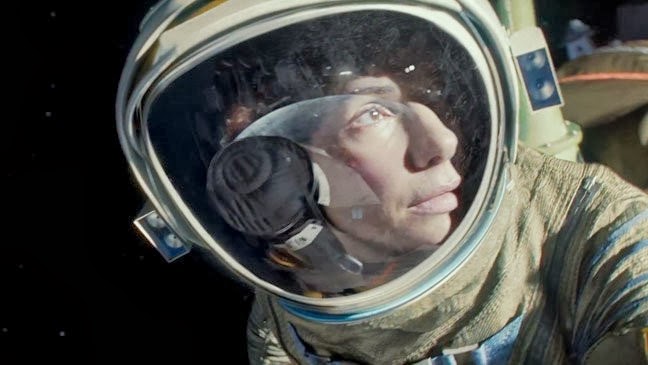
I got a call from a reporter from a Christian media outlet yesterday who wanted to talk a little about the movie Gravity and some of the spiritual themes I found there (which I wrote about for The Washington Post). Toward the end of the interview, he asked me a simple but very ticklish question: Is Gravitymore effective in drawing people to Christianity than Grace Unplugged?
Gravity, released last weekend, is the best movie I\’ve seen so far this year—a technical and artistic achievement that\’ll probably be in contention for an Oscar or two or 10. Grace Unplugged, also released last weekend on about 500 screens, is an explicitly Christian movie whose makers will likely watch the Academy Awards on TV, just like the rest of us.
But the question wasn\’t which movie is better. It was which movie was more effective as an evangelical tool. It\’s a variation of a question that Christians—at least Christians who think about movies a lot—have been asking for a long time. Should movie-making or, more importantly, movie-watching, Christians be more concerned with art or message? Is it better to tell a great story, like Gravity? Or a GREAT story, like Grace Unplugged?
My answer, in essence, was this: Do we have to make a choice?
Now, let\’s rewind a bit and scrub clear a potential misunderstanding—that Gravity is a good movie and Grace Unplugged isn\’t. Grace is quite good by Christian movie standards. The filmmakers should be proud of their product.
But it ain\’t Gravity. It doesn\’t pretend to be. And I think that\’s just fine.
Christians tend to split off into two camps when it comes to movies.
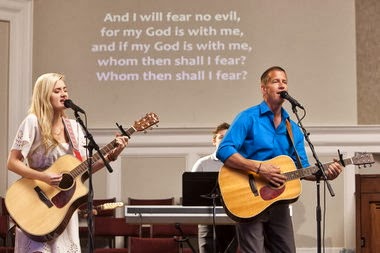
On one side, you have the movie idealists: They\’re the ones who believe that Christians should support clean, often explicitly Christian movies to send Hollywood a message. This is not to say that artistry is not important: Every Christian moviemaker wants to make a good one, and every Christian movie-goer wants to see a good one. But they\’re not going to compromise the message for the sake of the art. And for many, a great message is indistinguishable from great art. I\’ve heard from many folks who believe Fireproof was robbed of a Best Picture Oscar.
On the other side, you have the more artsy Christian moviegoers. This is not to say they paint all the time. Rather, they\’d argue that the greatest story ever—the story of our faith—should be told with the very best craft, and anything less is selling our faith short. Top-notch talent and artistry are essential, not optional. They tend to be more comfortable with what we\’d call at Plugged In \”questionable content\”—sex and violence and cursing and whatnot—if it effectively furthers the story. A story worth telling is a story worth telling well, they\’d say. And if you tell it badly, it may do more harm than good.
Personally, I lean a little toward the latter philosophy, even though the organization I work for tips toward the former. But in my six years working for Plugged In, I think I can see the value in both.

We all mean well. But we sometimes, I think, run the danger of forcing God into a box. We can think that there\’s a \”right\” way to spread our story and that, in itself, assumes that God prefers to show himself only under certain conditions. But to me, saying there\’s only one right way of telling God\’s story is like believing that there\’s just one right tree, or one right season. If God made them all, doesn\’t that imply that all are equally valued and, in their own ways, beautiful?
In the same manner, God made us all different, too. We love different foods. We like to play different games. We\’re moved by different things. It\’s in our God-given design. And I think that God shows Himself to us in ways that we can best see Him—even if the view looks a little differently for each of us.
That\’s not to say that I believe God is OK with cinematic beheadings. Or that he doesn\’t want His love conveyed in the most persuasive, most beautiful way possible. I\’m just saying that He\’s remarkably adept at showing Himself to us in unexpected ways. God, I believe, can work His way into almost every story—even when the storytellers are as imperfect as we.
What is more effective—Gravity or Grace Unplugged?
The answer, I think, is yes.

The Butler: Fathers and Sons

Lee Daniels’ The Butler was the No. 1 movie this past weekend, and it was nice to see. The film is a nicely crafted, uplifting tale with some pretty great performances. I thought John Cusack made a surprisingly effective Richard Nixon, and Alan Rickman and Jane Fonda were a surprisingly effective Mr. and Mrs. Reagan. Oh, and Oprah Winfrey hasn’t lost her acting chops since The Color Purple, either.
It also had a strong spiritual undercurrent about it—not overt or preachy at all, but meaty enough for the Weinstein Company to apparently commission a “faith companion,” outlining some of the themes in play (under such broad headings of “Prudence” and “Justice” and “Temperance.”
The guide is pretty good, and for those interested, they can read it here
But not wanting to duplicate their efforts, I wanted to concentrate a bit more on one of the main themes of the movie: The relationship between the butler, Cecil Gaines, and his son, Louis.
Cecil, who grew up in a time and place where African Americans were killed for little more reason than the color of their skin, was forced to be subservient. For him, progress is slow, steady and personal: He believed that hard work would help him rise above—and it did. He served seven Presidential administrations well and, in so doing, gave his wife and kids a life he’d never have dreamed.
Louis was raised in an environment much different than the one in which Cecil grew up, and he went to college just as the civil rights movement was beginning. Louis became a Freedom Rider and was regularly beaten, abused and thrown in jail.
For years, the two clash: Cecil thinks that Louis is a troublemaker. “Every gray hair I have is because of that boy,” he says. Louis is ashamed of his father’s servitude, believing him to be an Uncle Tom.
But both, in their own ways, were heroes—and after decades of friction, the two come to realize it. Their reunion is perhaps the most touching part of the movie.
“I lost you,” Cecil tells his boy. “I’m sorry.”
These same sorts of divisions, I think, litter our world—misunderstandings and superficial differences that tear us apart when we could and should be binding ourselves ever closer with one another. The Christian subset is no better and may be worse: Jesus wasn’t gone very long before Christians started squabbling with each other, even though they likely numbered in the hundreds. There’s 2 billion of us now, and it seems sometimes there are just as many things dividing us: denominational differences, style differences, differences in tone and tenor.
I know that many of those differences matter, but still. It’s a shame that we can’t all get along a little better, given that we worship the same God and pay homage to the same Savior. We could do so much more good in the world, I think, if we could unite our resources occasionally and focus on a cause we can all agree on. Maybe we should all be a little sorry about that.  

Elysium: Heaven on Earth

Much has been made about the politics in Neill Blomkamp’s bloody sci-fi romp Elysium. “Matt Damon plays an angry and well-armed member of the 99 percent in ‘Elysium,’ the most blatantly political sci-fi movie of the summer, if not of all time,” Newsday says. “The film\’s premise feels engineered to get Maureen Dowd to write an op-ed about it,” according to Deadspin.
And Elysium does feel pretty political, no question.
But the thing I was struck by the most was how strangely, quirkily spiritual it was.
It’s not overtly spiritual, mind you. Probably not even intentionally so—though the fact the elitist space station hovering above a grim and polluted earth is named Elysium in the first place is, perhaps, vaguely suggestive. And yet, the story’s central premise does feel quite Christian.
Warning: We’re going to get into some spoilers, here, so if you haven’t seen Elysium and would like to, you might want to check in here a bit later.
Elysium’s plot centers around Max (Damon), a one-time criminal who’s trying to live on the straight-and-narrow these days, working at a grimy and dangerous factory. But when he gets thumped by a dose of lethal radiation, Max realizes he only has one chance to survive: Get to Elysium and use one of their nifty healing cots—devices that heal anyone who still has a pulse instantly and are so pervasive that pretty much every Elysium manse has one.
But as he does what he has to in order to earn a ticket up to Elysium, he runs across an old friend of his, Frey, and her cut-but-very-sick daughter, Matilda (Emma Tremblay).
The meeting is a critical moment for Max, who eventually begins to think not just of saving herself, but Matilda, too. And in the end, he does save her. With a battery of important information stored unnaturally in his noggin, Max decides to download some critical codes that make everyone in the world—not just the rich—citizens of the space station, and thus give everyone access to Elysium’s nifty healing machines. But the downloading process, apparently, means certain death for Max. Max knows it. But he still does it—giving up his own life for Matilda’s future. 
It’s pretty obvious why so many observers have called Elysium blatantly political. But for me, there was more at work here.
It’s apparent that Max, for all his failings, is meant to be seen as a sort of sacrificial Messiah. One of the nuns who raises Max believes he might even be an answer to a long-whispered prayer. “You will do something very special one day,” she tells him. “Something you were born for.” Max’s sacrifice plays on a deep, time-honored theme that’s been in play for thousands of years. Perhaps Blomkamp would call Max a dystopian Prometheus, giving earth a life-changing tool.
But for me, the allusion takes on a distinctly Christian tint when we consider the paradox of Max’s sacrifice.
He sacrificed himself for one little girl. And yet in saving Matilda, he literally saved the entire world. We Christians are told very much the same thing about Jesus’ death on the cross: He came to save you and me, individually. He knows you. He loves you. He sacrificed Himself for you. It was a very personal thing, just as it was for Max. And yet in saving us, He also saved the whole world. It’s interesting that the exoskeleton Max has fused to his body seems to echo, in a way, a metallic, moving cross: an instrument of both torture and liberation.


And so, when you look at Elysium as not an economic symbol dividing the haves and have-nots but as a metaphor for heaven (where people never get sick and may, in fact, live forever—or at least for a very long time), this imperfect analogy becomes ever more resonant.
You see, before Max came around, people really had to earn their way into Elysium: They had to be, frankly, stinking rich. But Max opened the gates of Elysium to everyone—through an act of grace and of sacrifice. It didn’t matter how much money you had or what terrible secrets were in your past. Heaven was open to you in a way that it had never been before. 
Elysium, I don’t think, is a great movie. The story’s not as emotionally resonant as Blomkamp’s previous work in District 9, and it does come off as a little preachy at times. But still, it has something interesting to say.

A Friendly Response to a Friendly Atheist

I read an interesting little essay from Hemant Mehta, the “Friendly Atheist,” on CNN this morning, outlining some reasons why Millennials are leaving the Christian Church. He suggests that Christianity’s “sloppy defense” (“they’re anti-gay, anti-women, anti-science, anti-sex-education and anti-doubt, to name a few of the most common criticisms,” he writes) is partly to blame. But he also points to the inroads that the atheist movement has made in the culture—the atheists’ large, vocal presence on the Internet perhaps being the most obvious. Of this “impressive offense,” he writes:

Christians can no longer hide in a bubble, sheltered from opposing perspectives, and church leaders can’t protect young people from finding information that contradicts traditional beliefs.

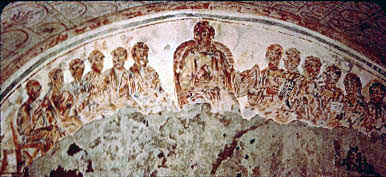
An Agape feast from an early Christian catacomb
I believe Mehta’s right on that score. There is no safe place to hide from ideas in the 21st century. The Internet has made even traditional notions of privacy feel rather quaint, and certainly we cannot expect our most cherished beliefs to be held without scrutiny.
That said, “hiding” has never been exactly high on a list of Christian virtues, anyway. While keeping a low profile has sometimes been necessary for Christians during the faith’s long and bumpy history, Christianity has always thrived best out in the open, facing the future—whatever it might hold—with a certain boldness.
And well we should be bold.
I’ve seen a great many stories over the last several days that track Christianity’s declining influence in the culture. According to the Pew Religion and Public Life Project, nearly 20 percent of all adults claim no religious affiliation, with nearly a third of people under 30 being unaffiliated. Author Nigel Barber claims in an e-book that atheism will replace religion by 2041.
Numbers like that can fuel a lot of angst among the faithful. We see church attendance dip year by year and congregations grow older. Folks who feel that the country should reflect traditional Christian values lament the tide of secularism. Mehta, with his “offense/defense” imagery, suggests we’re locked in a battle, and Christians can often feel that way, too—a battle in which the best, most persuasive ideology will eventually prevail. We feel like we have to fight.
But Christians must remember that this “battle” is, in the end, almost completely moot. We are not championing an ideal as much as we—both Christians and atheists—are searching for truth. And the truth is not dependent on how many people convert to one side or the other.
Man Reading by Candlelight by Matthias Stom
Religion and atheism aren’t warring over the merits of a political ideology or a plot of disputed land. We are simply asking the same question, but answering it in different ways: Is there a God? The answer, while unknowable, isn’t decided through debate. Either He’s out there or He isn’t. Whether religion or atheism wins this 21st century war of words is beside the point. It’s like fighting over a vacant lot—but ownership has already been decreed by deed, locked away in a mysterious safe somewhere.
Now, if you believe in a God like I do—one who’s in control—that should give some comfort in these uncertain times. That doesn’t mean we should be passive to challenges to our faith. But we shouldn’t get defensive, sloppy or no. This isn’t a war. We’re simply telling the world the truth as we see it—conveying that truth as best we can all its beauty and mystery and paradoxical rationality. Yes, we may be wrong. Then again, so may they.
If we focus in on those big questions instead of getting tangled up in smaller ones, I think we’ll be better positioned to show people God’s love and grace.
There’s no guarantee that the trends we see will reverse anytime soon, of course. I’d expect that the religious “nones” will continue to rise in influence in the United States. But we must not confuse trends with truth. Christianity has often been threatened. It’s often been beaten, quite frankly. And yet, the faith never seems to lose. It’s remarkable. It’s outlandish historical resilience would be enough to give, you would think, some atheists pause.
In The Everlasting Man, G.K. Chesterton wrote:

Christendom has had a series of revolutions and in each one of them Christianity has died. Christianity has died many times and risen again; for it had a god who knew the way out of the grave. But the first extraordinary fact which marks this history is this: that Europe has been turned upside down over and over again; and that at the end of each of these revolutions the same religion has again been found on top. The Faith is always converting the age, not as an old religion but as a new religion.

I think if Chesterton was alive today, he’d be pretty amused by the Christian hand-wringing over the rise of the “nones.” Yes, Europe is growing more secular—and yet there are more Christians on the planet than ever before. Even as the numbers of the “nones” grow as a percentage of the population, another Pew study tells us that “the unaffiliated have one of the lowest retention rates of any of the major religious groups, with most people who were raised unaffiliated now belonging to one religion or another.”    
Christianity is Cool Hand Luke. It is Rocky. It’s a stubborn cuss. For at least three centuries, atheists have claimed that the end of faith is just around the corner. But we faithful are still here, proclaiming our truth with cheerful boldness. 

The Wolverine: Finding Purpose

What gets you out of the bed in the morning?


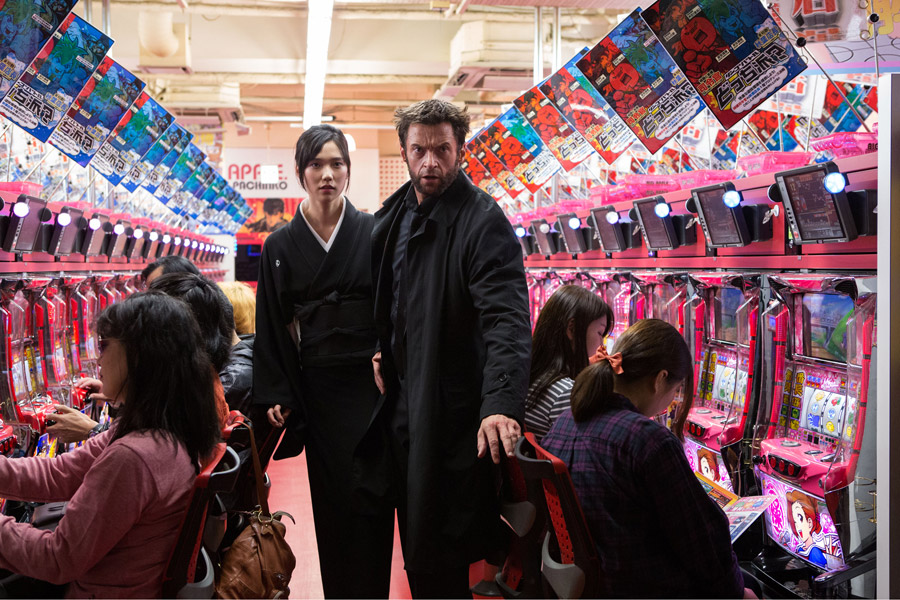
For Logan in The Wolverine, that\’s a hard question. The one-time X-Man has seen better days. He\’s still riddled with guilt and despair over the events of X3: The Last Stand, when he was forced to kill his love, Jean Grey. His immortality has become a wearisome burden. Now the guy lives in a cave, away from everything he could love or hate or feel anything about at all.

What gets Logan out of bed? Maybe his nightmares are the only thing.
But one evening, he meets Yukio, a bright-haired girl from Japan who wants Logan to renew acquaintances with Yashida, a man Logan saved in Nagasaki during World War II. Logan agrees to see the dying man, but when he walks into Yashida\’s high-tech sick room, it almost feels as though the old man is sorry for Logan. Yashida calls him a \”Ronin,\” a samurai without a master. His life is empty, without meaning, Yashida suggests. He has, perhaps, literally outlived his usefulness.
I\’ve always appreciated, but never loved, the X-Men movies. In some ways, they feel the most comic-booky of all the major superhero franchises out there, and I\’m not familiar enough with the source materials to unreservedly embrace these Marvel-ous mutants.
But I liked The Wolverine (albeit not without reservation). It\’s one of the best movies in the extended franchise. And while part of that may be because of the storyline (Wolverine stops healing!) or cool bullet train fight scene, I think I\’m also attracted to the flick because of the question at the core of it: What gets you out of bed?
It\’s a question I\’ve asked myself at times. I suspect all of us have. There are days where life just feels a little rote and even pointless—like an old-school videogame where you can\’t save and, whenever you die, you wind up at the very beginning. You wind up trudging through levels you’ve already done to earn rewards that don’t much matter and, eventually, you ask yourself, what’s the point?  
I don\’t have those moments often. but I do have them.
And while Logan and I couldn\’t be less alike (though someday I may try to grow wicked-cool sideburns), we did find the same answer to this bothersome question—or, perhaps more fairly, two: People and purpose. And both neatly intertwine.
After his strange encounter with Yashida, Logan meets his beautiful granddaughter, Mariko. And it’s not long before he realizes that lots of folks want her dead. Now, Logan may not be the warmest guy you’ll meet, but he’s always had a thing for protecting people. And so he swings into action, protecting Mariko as best as he can.
But here’s the thing: Logan has been infected with mortality. His wounds don’t heal instantly like they used to. And after one bloody shootout, Logan faints—and Mariko has to whisk him off to get him patched up.
“I never needed this before,” he says to someone after he’s been neatly bandaged.
“What,” the woman responds. “Help?”
We all could use a little help, even in those moments we pretend to be immortal or invulnerable. We need people around us. It’s funny—when I’m in a blue or foul mood, I don’t often search out people. But when I find them in spite of myself, or when they find me, they very often make my day. They ratchet down my loose thoughts and give me a better perspective on everything.
Through Mariko, Logan rediscovers his purpose. It’s not that he’s just touched by Mariko’s care. It’s not just that he winds up caring for her, too, and shows that he would do pert near anything to save her. It’s that, through his service and care for her, Logan realizes that he’s at his happiest when he’s doing that for other people, too. His mutated genetics didn’t just create a fearsome freak of nature. Something in his soul was branded with the policeman’s motto: To protect and serve. And before the credits roll, he leaves to protect and serve some other folks, as well.
He is a Ronin no more. He has a master: his purpose. And he is happier for it.
The Wolverine touches on a lot of themes that I talked about in God on the Streets of Gotham. Logan, Bruce Wayne, you and me are at our happiest when we’re doing what we’re meant to do. We’re all built for something. We’re made to work. By extension, we’re made to serve. Ultimately, of course, we serve God—but that often manifests itself here on earth by doing what we can for others.
When I ask myself that question, Why should I get out of bed today, the answer is deceptively simple: people and purpose. I have work to do. I have friends and family to support—and who very often support me when I need it.
And sometimes, even when I’m in a funk, I find that if I concentrate on people and purpose my heavy mood slips off my shoulders like a satin cloth. And I feel God’s joy running through my veins again. 

The Conjuring: Good Exorcise

Demons are not very subtle.
Every demon I\’ve ever seen—restricted, thankfully, to movies—have been about as restrained as Lady Gaga after chugging a few Red Bulls. They stomp around and scare people and spit pea soup. They scream profanities and chant in Latin and sometimes twist the folks they\’re possessing into pretzels.
If I was a demon, I think I\’d try to play it a little cooler. Because as soon as your host starts to weep blood or levitate out of bed, it\’s sure to bring the exorcists around, and before you know it, poof! You\’re being cast out and forced to endure interminable lectures from your higher-ups.
Of course, subtle demons would hardly be the subject of wide-release movies, either. Maybe demons just like the attention. Or maybe there\’s something in the very character of a demon that makes it impossible to be demure. After all, isn\’t self-restraint some sort of a … virtue?
The demon from The Conjuring certainly could use some counseling on how to control one\’s impulses.
She wasn\’t always a demon: Back in the 1800s, she was simply a witch named Bathsheeba who, shortly after her son was born, sacrificed the child to Satan. As soon as the deed was discovered, she ran out of her lovely Rhode Island home and hung herself on a tree outside—using her final breath to curse whoever might dare to buy the property forever after.
But unless you put these sorts of things in writing, people tend to forget. And so a century or so later, the Perron family (hubbie Roger, wife Carolyn and their five girls) move into the house and live quite peacefully for, oh, five minutes. And then things start to unravel.
The very first night, they find mysterious boarded-up cellar—something you\’d think would\’ve been spotted by an inspector. The next morning, the family dog is dead. Before long, the girls are screaming and sleepwalking and playing with strange, invisible playmates—and it\’s clearly about time to bring the professionals in—Ed and Lorraine Warren, two demonologists who\’d go on to earn a measure of fame dealing with a certain house (and its undesirable inhabitants) in Amityville, New York.
The Conjuring, like The Amityville Horror, is allegedly based on a true story straight from the real case files of the Warrens. While I’m sure the makers took a few liberties (and frankly, I hope they did), the real Lorraine Warren said they got the crux of the story right. Moreover, the Warrents are fervent Catholics who believe very sincerely in both demons and the power of God to dispel them. At the end of the movie, we see a quote from Ed Warren:
\”The fairy tale is true. The devil does exist. God indeed exists. And for us, as people, our very destiny hinges upon which one we elect to follow.\”
As such, The Conjuring is a pretty interesting feature for a Christian movie reviewer such as myself. The movie takes its faith seriously—so much so that faith-based marketers Grace Hill were involved in the publicity push. It\’s the sort of movie that embraces not just a generic sort of supernatural happening, but a real devil poking at a real, Christian God.
It\’s not the first horror flick to tackle spirituality so sincerely, of course. The original The Exorcist—the scariest movie I\’ve ever seen—was based on a book written by a Christian (William Peter Blatty), who intended it as a \”sermon that no one can sleep through.\” Scott Derrickson, who directed the well-regarded The Exorcism of Emily Rose, told Christianity Today that \”horror is a perfect genre for Christians to be involved with.\”
I know of people who\’ve felt the first real tug of faith through movies such as this.
But many Christians, particularly conservative Evangelical Christians, don’t typically like horror. It’s dark stuff, after all. Disturbing. They\’re certainly never very \”nice\” movies. Rarely are they uplifting.
Derrickson again:

To me, this genre deals more overtly with the supernatural than any other genre, it tackles issues of good and evil more than any other genre, it distinguishes and articulates the essence of good and evil better than any other genre, and my feeling is that a lot of Christians are wary of this genre simply because it\’s unpleasant. The genre is not about making you feel good, it is about making you face your fears. And in my experience, that\’s something that a lot of Christians don\’t want to do.

I have a complex reaction to horror movies—too muddled with personal baggage, perhaps, to be completely fair. I understand the unease that many Christians feel, but I\’m sympathetic to Derrickson\’s point of view.
Horror movies are designed to move us away from a place of comfort, and I wonder sometimes whether we Christians can sometimes be a little too consumed with making ourselves comfortable. We sometimes tune out ideas that threaten our worldview, shun people who might challenge us. Sometimes, it seems the evangelical subculture goes to some pretty great lengths to keep us from encountering anything that might discomfort us: We can spend our childhood in Christian schools, go to Christian colleges, do all our business at Christian establishments (helpfully noted by Christian business directories). Yes, the Apostle Paul did tell us to \”not conform to the pattern of this world,\” but I don\’t know if he would\’ve advocated building a whole new world so we wouldn\’t have to deal with the other one at all.
This is not to equate a dislike of horror movies with our sometime impulse to protect and even isolate ourselves. But still, it’s interesting. At times, I think we long to make earth a little more like heaven. Horror flicks, and often even the world around us, remind us that heaven is a long way off. We live in a dark, uncomfortable and sometimes frightening place. And movies like The Conjuringin their own rather unsubtle wayhint at how frightening, without God, it might be.

Running on Faith: Forced Rest

This year for me will go down as the year of stitches. Not the year in stitches, mind you—which would imply that I’ve had a very funny year. Though I must admit, I did get my last set of stitches in a rather funny (that is, odd) way.
Last Saturday, my wife and I had just come back from an evening walk and our little pooch, Hoover, was ecstatic—as he always is—that we returned yet again. He was so thrilled, in fact, that he started running around the living room, smacked into my leg … and sort of screeched to a sudden stop. And at the same time, he seemed to pull my leg toward him, as if with some mysterious canine magnet.
At first, I thought that perhaps some of my leg hair had gotten tangled up in his collar. And then I realized that if Hoover was pulling on my hair, it’d probably hurt a lot more than it did. And I quickly came to a rather disturbing conclusion: Somehow, his collar had hooked itself into my shin.
And that is exactly what happened.
The good news is that is sounds way worse than it felt. The pain was minimal, really.
But the bad news was that the wound necessitated seven stitches. Worse, the nurse on call said that the stitches were in an awkward place. Too much activity around the area, and there’d be a threat the things would pop. I’d be unable to run until someone yanked ‘em out … in 10-14 days.
Now, if you’ve read my running blogs, you know that I’m not exactly a runner runner—a guy who can’t wait to lace up his running shoes and dive into the cold, rainy, sleety morning for a jog, singing as cheerfully as Snow White does when she’s polishing furniture.
I don’t like to run. I like to eat, and running allows me to eat and still fit into my work pants. I like to say that I’m a runner, because I’ve never been athletic and it’s nice to pretend every once in a while. The running itself? Yeah, I could do without it.
Or so I thought. But as it turns out, I’ve been running regularly for so long that to not run feels very, very strange.    
At first, the forced break was nice—like a little vacation for my calves. There were many, many benefits. I got home earlier, for one thing. Cut down my showering to once a day without offending anyone (that I’m aware of).
But after about four days, I was missing my runs. My body felt like it was growing ever-more gelatinous. My brain was getting a little sluggish, too, not having a nice, steady regimen to latch onto. I felt like I was grumpier and not sleeping as well. I was turning into Robert Louis Stevenson’s Mr. Hyde without the fun of his scintillating night life.
Yesterday was the worst. I was on deadline for a couple of freelance writing projects and, moreover, had a devotional to give the next morning at work (I work for a Christian ministry, and we have a dizzying number of devotionals).
As I was sitting at my desk, wondering whether I could bum some Maalox off of someone, I thought to myself, “man, I could really use a run right now.”
That might’ve been the first time I’ve ever consciously had that specific thought. But in the moment, it was absolutely true. An hour-long run would give me time to plan my devotional. It’d burn off a little of the stress I felt over my deadlines. A run, I realized, would give me a sense of peace that I, at that moment, sorely lacked.
For me, running has always felt so much like my own experience and struggles with faith. Yes, I appreciate the discipline that faith requires of me. I like the benefits that I gather. I love the relationship inherent in faith—the privilege of communing with God (as imperfectly as that communion may look at times). But for me, the Christian walk can be work, and hard work. It’s hard to be ever mindful of God and faith (even when you work at a ministry). It’s trying to push forward sometimes. There are times, frankly, when it’d be cool to take a break.
And let me be completely honest: Sometimes I do. I know I fall short on what I should be doing to keep my faith up to snuff. I can forget. I can grow lazy. I can shove thoughts of God into the back of my mind and find myself far more mindful of other things: Work. Kids. Fantasy football.
But whenever I forget to pray, or contemplate God, or even when I purposefully shove aside my questions about spirituality, I find that it’s not long before I feel empty. I find that I miss it. I need it. I’m not whole without faith. I’m lost without my sense of God.
I just got my stitches out a few hours ago. All is, alas, not well with my little wound. It may be a little infected, which means another 10 days of antibiotics for me. And it’s not closed yet, which means the stitches have been replaced with some super-sticky tape.
But the doctor gave me the thumbs up to start running again. It can only help at this point, he says. Running will spark better circulation, and the more blood the cut gets, the better it’ll heal.
So after work, I ran. It was a short run. It’s amazing how out of shape you get after just a 10-day break. It was hot, sweaty, exhausting work.
And it felt really, really good. 

Could America Use More Secularism?

In 1971, John Lennon asked us to Imagine a world without religion. Turns out, a good chunk of us would rather not.
American pollsters have been seeing an increase in the country\’s \”nones\” for years now: About one-fifth of Americans say they have no religious preference, up from about 15% who said the same just five years ago. But according to a recent study by The Pew Forum on Religion & Public Life, many Americans see the decline of religion as a bad thing. And that includes a surprising chunk of nones.
Odd, huh?
Actually, all of Pew\’s numbers are pretty interesting—even if some of them make perfect sense. I, for one, am not too surprised that about half of Americans (48%) believe that the country\’s rise in secularism is a \”bad thing.\” We\’re still a very religious country: Even with the rise of the nones, 80% of us are at least nominally affiliated with a religion of some kind. And it stands to reason that most of those affiliated would see somesort of tangible benefit to having faith.
But drill down to how the \”unaffiliated\” answered, and things grow more curious. While 24 percent believe that the erosion of religion is good (perhaps agreeing with the late Christopher Hitchens that \”religion poisons everything\”), nearly as many—19 percent—say it\’s bad.
The numbers are almost as surprising for my own demographic block—that of \”white evangelical protestants.” While a gigantic 78 percent of them say that they\’re bummed by the country\’s growing secularization, 4 percent say they\’re kinda happy about it. Granted, that\’s not a huge number, but still. Why would evangelical Christians—a demographic prone to handing out Bibles and shouting from street corners and, sometimes, baptizing children against their parents will—be happy about our country\’s growing secularization? Do we just want there to always be a steady supply of people to heed our Baptist church altar calls? Do we love our Luis Palau crusades that much?
The whole study left Hemant Mehta of Patheos\’ Friendly Atheistblog a little perplexed. \”I don’t know what’s weirder,\” he writes. \”That there are evangelical Christians out there who are happy that more people are becoming non-religious… or that there are a lot of unaffiliated people who are upset by it.\”
But on further reflection, maybe those numbers aren\’t so weird after all.
First, the \”nones.\” These are people who don\’t have a religious affiliation, but that doesn\’t mean they\’re happy about it. Maybe there are lots of people who\’d like to believe in something but can\’t. They\’d like to have faith, but they haven\’t found a compelling reason to go there. I know folks like this. I also know atheists or agnostics who reject religion, but they appreciate all the good that religion can do. Faith-based groups are behind some of the world\’s most beneficial charitable efforts. Religion can foster a tremendous sense of responsibility to the poor and needy. And even when we leave altruism out of it, churches can be great places to meet people and find community. Even if God\’s not in the picture, the Church (with all due respect to Mr. Hitchens) is responsible for a great deal of good in the world.
As far as those 4 percent of evangelical Christians who think a more secular culture is a good thing, maybe I can help answer. In a way, I think I might be in that 4 percent.
Don\’t misunderstand me. I think religion is a really, really good force in the world. I\’d like for everyone to see not just how beneficial, but how beautiful and how real it can be.
But at the same time, I think that when Christianity goes unchallenged, it can get soft and even a little mean. We can take the beauty of the faith for granted. And then when we are challenged, we sometimes lose the knack to express our own views with kindness and thoughtfulness. \”As iron sharpens iron, so one person sharpens another,\” the biblical proverb says, and I think there\’s some truth to that when it comes to faith, as well. I like to talk about this stuff. I like to be challenged some. I think it\’s healthy. Whether we\’re Christian or atheists or Muslims or Buddhists, we should know what we believe and why. We should know why it matters to us. Why it\’s important. Do you agree? 

The Stranger Ranger

Yesterday during a run, I spent some time listening to an excellent StoryMen podcast (from the collective brain trust of Matt Mikalatos, J.R. Forasteros and Clay Morgan) featuring Eisner Award-winning comic book writer Mark Waid. He had some fascinating things to say about all sorts of stuff, but I was particularly interested in what he had to say about Man of Steel—especially the movie\’s controversial finale. While he was quick to say that he liked much of the movie (as I did), he said the fact that Superman killed Zod \”broke my heart.\”
And then he said this:

Cynicism is very easy to write. Cynicism\’s the easiest thing to write. And if you hammer me for two hours about how this character is a symbol of hope, and he will lift us to the sun, and he will inspire us to greatness and he will show us the light … there’s no payoff for that, because in the end, he makes a very cynical decision and we’ve lowered Superman to our level, and that is not what Superman is created for. We don’t need Superman to be more like us. We are supposed to be more like Superman.

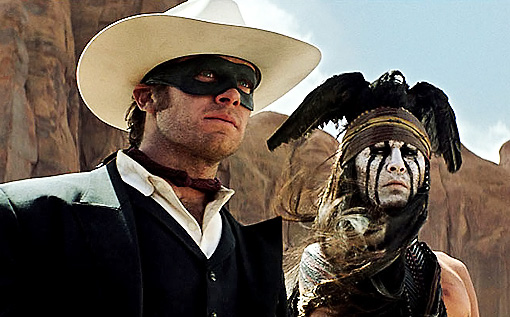
I was thinking about that in the context of another, far more cynical movie: The Lone Ranger, in theaters as of Wednesday.
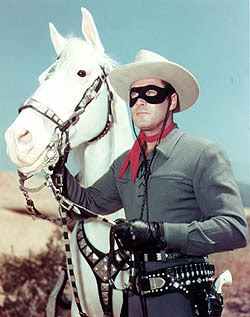
I watched Lone Ranger television reruns when I was maybe 7 or 8. And I know there were a few afternoons I slapped on a dimestore domino mask, rode a stick horse around the living room and hollered, “Hi Ho, Silver!” In a time when Westerns were no longer en vogue, the Lone Ranger still had some pull with a tyke like me.
I think I liked him for much the same reason that I liked a lot of folks back then. He was an incorruptible good guy. You knew the Lone Ranger was never going to suffer a crisis of confidence. Tonto was never going to leave the Lone Ranger’s side. Silver was always going to come at a whistle. When you’re a kid, having people you can believe in, that’s a big deal. Kids need those sorts of heroes. Maybe we all do.
I think from the beginning, that’s been a huge part of the Lone Ranger’s appeal. He was a true-blue, practically square hero. He even had a code of honor—a factoid I didn’t know about until I wrote my Lone Ranger movie review for PluggedIn. It goes like this:
I believe…
that to have a friend, a man must be one.
that all men are created equal and that everyone has within himself the power to make this a better world.
that God put the firewood there, but that every man must gather and light it himself.
in being prepared physically, mentally, and morally to fight when necessary for that which is right.
that a man should make the most of what equipment he has.
that \’this government of the people, by the people, and for the people\’ shall live always.
that men should live by the rule of what is best for the greatest number.
that sooner or later…somewhere…somehow…we must settle with the world and make payment for what we have taken.
that all things change but truth, and that truth alone, lives on forever.
in my Creator, my country, my fellow man.
The Lone movie seems to forget all that. Here, John Reid (the real name of Mr. Ranger) is indeed a law-abiding do-gooder. And yet, his sense of morality—that the rule of law triumphs over a fast gun, that human life is precious—is treated as an antiquated naivety that should be dropped in light of the harsh Western sun. Tonto’s all about working outside the law and killing when need be. And slowly (unless things find a better equilibrium in what would look to be a very doubtful sequel), the Lone Ranger begins to see things Tonto’s way.
It would seem the makers of The Lone Ranger would have us believe that the heroism of our fathers’ and grandfathers’ day is just too unrealistic now. Too unbelievable. The world is too bad to support that sort of goodness.
\”You can\’t make a movie now with the sort of story, characters and action that a 1950s TV show had,\” Armie Hammer (who plays the Lone Ranger) told movie critic Roger Moore. We are, he says, \”too hip for the guy the way he was. Audiences are more discerning today — more sophisticated in terms of what they expect from a Western, a story like this. We had to give these two men a fresh twist, and I hope we pull it off.\”
But by assuming that we’ve outgrown the sort of aspirational heroes that the Lone Ranger stood for in the first place, I believe the movie stripped out his very soul. You can’t have the Lone Ranger without his Dudly Do-Right rectitude. If you take that away from him, you just have a man in a mask. And we’ve already got plenty of those.
Perhaps this isn’t so much an indictment of The Lone Ranger as it is on us. Or me. Maybe Hammer has a point. I find my adult self drawn to the darker heroes: the Batmans and Jack Bauers of the world. I’m sure if I watched an episode of the Lone Ranger now, I’d roll my eyes from the cheese and saccharine sincerity.
But shouldn’t we find a place for real, honest-to-goodness heroes somewhere? People who, in Waid’s words, don’t come down to our level, but force us to reach up to theirs? Isn’t that, in a way, what our society is based on? Our desire to be better tomorrow than we are today?
For me, the newest Lone Ranger movie succeeds only in patches—when it sheds its cynicism, drops its oh-so-modern sensibilities and returns to its roots, becomes what the Lone Ranger always has been and always was meant to be. When it wipes the smirk off its face, mounts his horse and rides into the fray, the William Tell Overture playing in the background, that’s when the movie soars. 

Fire and Remember

Another June 23, another day of checking for fire updates.
Last year, it was the Waldo Canyon fire. Some friends had come down for the day and we were all planning to see a minor league Sky Sox game. Instead, they helped us pack when our house was put on a pre-evacuation notice. A couple of days later, as the fire rushed down a hillside and toward our house, we were forced out—unable to return for six days.
And we were the lucky ones. We had something to come back to.
The cabin, near South Fork
This year, the fires are burning a little farther from our front door, but I’m still following their progress with worry and concern. The West Fork Complex, a phalanx of four separate fires burning out of control in the southwestern part of the state, don’t threaten my immediate home, but they are near my heart and history.
Sometime before I was born, my grandparents bought a little cabin in the woods around South Fork. It’s a tiny place—scarcely 800 square feet, I’d imagine. Probably built in the 1910s, it’s essentially one big room with two lofts, a built-on bathroom and a covered porch to sleep on. A big deer head hangs in the main room, and it’s probably nearly as old as the cabin itself: Our family doesn’t have a lot of hunters.
I probably named that deer head decades ago, though I don’t remember what I would’ve named it. The very earliest memory I have—ever—is my dad holding me up to touch the deer’s coarse, stiff hair. The cabin’s been a part of my consciousness from the very beginning. I learned how to climb stairs there. I might’ve learned how to walk there, too.
Each crevice and cranny holds a memory. In the loft above the front door, there’s a knothole through which you can watch people come and go. Pull part of the staircase out, and you’ll find a toybox, loaded with army men and tiny cows. On the porch we keep a set of plastic poker chips: I’d build with them when I was little, pretend they were money when I was a wee bit older. Grampa taught me how to play blackjack with those chips later on, shuffling cards like a Vegas pro, cigarette in his mouth.  
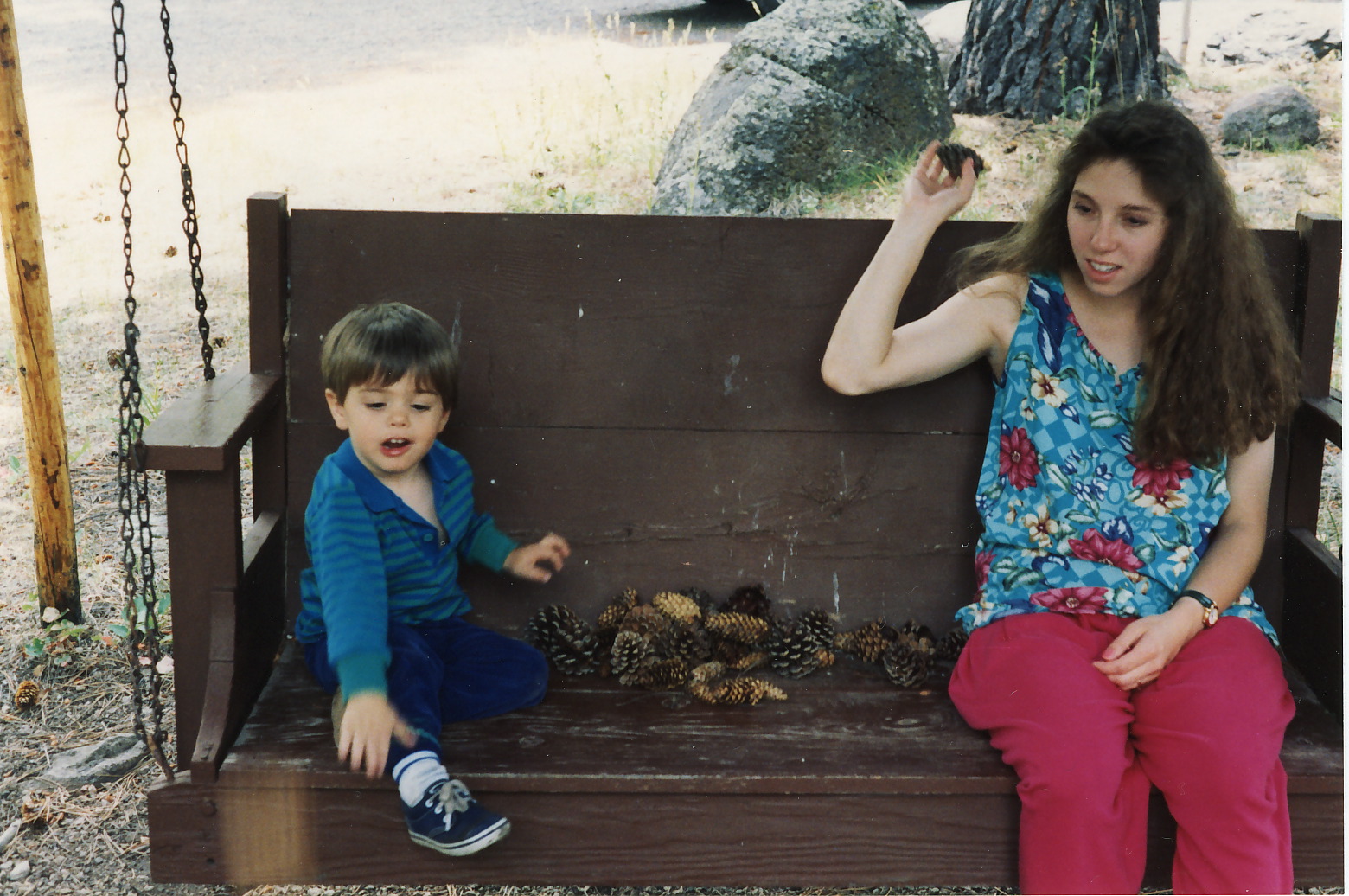
My son, Colin, and Wendy on the cabin swing,
about 20 years ago
I’ve spent Thanksgivings and Christmases and countless summer weeks at the cabin, watching the chipmunks outside and catching spiders in the tub. My cousin and I would produce elaborate puppet shows from one of the lofts. We’d play baseball by the outdoor grill, using a walking stick for the bat and a pinecone for the ball. When I was 9, I built a miniature golf course in the woods, using old tin cans stuck in the ground as holes. Every time I’m up there, I still find a new hole, it seems—filled with needles perhaps, but ready to use if someone would just come by with a club and ball. 
The cabin’s been a part of our family longer than I have. My grandparents are gone now, but the cabin’s there still, a piece of them there in real estate: Their names still hang above the door, their character still lingering in every corner. After Grampa died, I dreamed of him sitting on the tattered cabin couch, assuring me that he was just fine.
The cabin is a precious place for me—perhaps the most special place in the world. And whenever I walk through the door, I become a little kid again.
Eleven years ago, we almost lost the cabin to another fire—a tiny 3,000-acre scorcher that came a quarter-mile from us. We were lucky. It looks like we might get lucky again. The West Fork Complex, though it’s devoured 70,000 acres down there and probably torn through some of our favorite hikes, looks as though it’ll go by us—maybe all of us in the South Fork area. We know we owe a great deal to the firefighters down there, and the direction of the wind. But it still feels, for now, like a bit of a miracle—as if we had painted lamb’s blood on the door jamb and watched the fearsome angel pass by.
Me on the same swing, about 2008. Colin\’s in the back and
my daughter, Emily, is to the right
But the fire’s still raging down there, and anything can happen. And even if our cabin is saved this time, I’m learning to hold these things, no matter how precious they might feel, a little more loosely. It would be incredibly hard to see this cabin full of memories go. But maybe the important thing is that the memories themselves remain. No fire can wipe those away.
Sometimes, I have a hard time remembering that God’s blessings to us were never meant to be eternal. They are transient, just as we are. They are to be embraced and treasured, but we can’t hold onto them forever. Even if they last 200 years, we don’t. We fade. We move on. Ashes to ashes, as they say.
But we’re told that, even if our mortal selves will falter and fail, the core of our being will not. Even as we crumble to dust, the essential part of us rises to the sky, to meet with the Maker of memory itself.