Maleficent: Broken Hearted

It\’s hard to watch good guys turn bad. We don\’t want our heroes to fall.
But sometimes, it can be hard to watch our villains turn good, too.
Take Maleficent, Disney\’s re-introduction of one of its all-time best/worst evildoers. In Sleeping Beauty, Maleficent is as bad as bad can be—the self-proclaimed \”Mistress of all Evil\” who calls upon the powers of hell to help her do her nasty work.
Let me be honest: I kinda like that in a villain. It\’s nice to see someone who knows who they are and really owns it, y\’know? Forget the moral complexity, the makers of Sleeping Beauty said in 1959. Give us a woman with green skin and horns.
So much to my shame, I was ever-so-slightly disappointed in the positive moral trajectory in Maleficent. In the 2014 film, Angelina Jolie\’s Queen of Mean isn\’t so much as a dastardly diva as someone who\’s been really, really hurt—in more ways than one. The result, we see, is a pretty interesting examination of what hurt and bitterness can do to the human soul—and a hint of what is the only recourse out of it.
Be aware: There be spoilers ahead.
Maleficent wasn\’t always the towering figure of darkness we came to know in Sleeping Beauty. Once upon a time, she was a little fairy girl with horns and wings, full of hope and promise. When a boy named Stefan stumbles into her magical land and tries to swipe something (a pretty little gem), Maleficent gently tells him that stealing\’s wrong and winds up befriending the kid. The two become the best of buds (an unlikely relationship, given that Maleficent\’s magic land and Stefan\’s kingdom are constantly at war) and, eventually, even a bit more than that. In fact, Maleficent falls in love with the lad.
But the two grow apart and don\’t see each other for years. In that time, Maleficent becomes a powerful defender of her realm. Stefan becomes a steward for the mortal king. But when the dying king tells his court that he\’ll give the crown to whoever kills Maleficent, Stefan sees his chance for rapid career advancement. He takes off to the moors to rekindle his relationship with the fairy, planning to drug her and kill her while she sleeps.
But he can\’t: He still feels some affection for the girl (now a beautiful, winged woman). But he really covets the kingdom, too. So he slices off Maleficent\’s beautiful wings instead, taking them back to the king (misleading him in the process). Maleficent wakes up and is, understandably, devastated. Stefan mutilated the two things that made the fairy who she was: her wings and her soul.
Now, the potential spirituality of all this is interesting. When you look at a whole Malificent, your eyes are naturally drawn to the two things that make her so different from you and me—her wings and her horns. Both are, for Christians, instantly recognizable: When we think of humanoid-like beings with wings, most of us think of angels. Horns, on the other hand, are shorthand for the devil and demons. Neither horns nor wings are good or evil in themselves, of course, but they do represent—and have for centuries—the good and evil in the universe and, perhaps, the good and evil in ourselves (think about those angels and demons that appear on someone\’s shoulders in the old cartoons).
Stefan takes from Maleficent something angelic in her—something good. He steals what allowed her to fly closer to heaven. And, now earthbound—even dragging around at first as if the earth\’s gravity was pulling her closer to itself—she allows anger and bitterness and her more evil, horned nature to seep into the cracks of her soul.
She retreats to a dilapidated castle for a while to prood. And when she leaves it, Maleficent is a different person: Powerful in her anger, gorgeous in her hatred. She\’s a true villain in look and deed. She curses Stefan\’s little baby, Aurora. She and the king are now irrevocably at odds now, literally warring against each other. It reminds me of a really bitter divorce.
And that, I think, is at least partly intentional. We see here the horrors of a relationship gone horribly bad—how an act of betrayal can lead to an act of vengeance, a spiral of anger and hatred that can spin out of control. Each word and deed becomes more ammunition in this battle of … what? Wills? Control? Utter annihilation? Perhaps they don\’t know. When this sort of hatred spills over, there are no real goals, it would seem. Only the desire to hurt. We can get the same way, too. Many of us may know friends or couples who\’ve fallen to this level—where they can no longer stand the sight of each other. In our hurt, we wall ourselves away. And when we emerge, we sometimes come out different: Our hate can make us strong (just like Darth Vader warned us), but it twists us, too. It turns us into something we weren\’t before and were never meant to be.
In Maleficent and Stefan, we see the corrupting power of hurt. The bitterness of loss. After Maleficent lays the curse on Aurora, Stefan turns into a full-time brooder, so obsessed with destroying Maleficent that he doesn’t even attend his own wife’s deathbed.
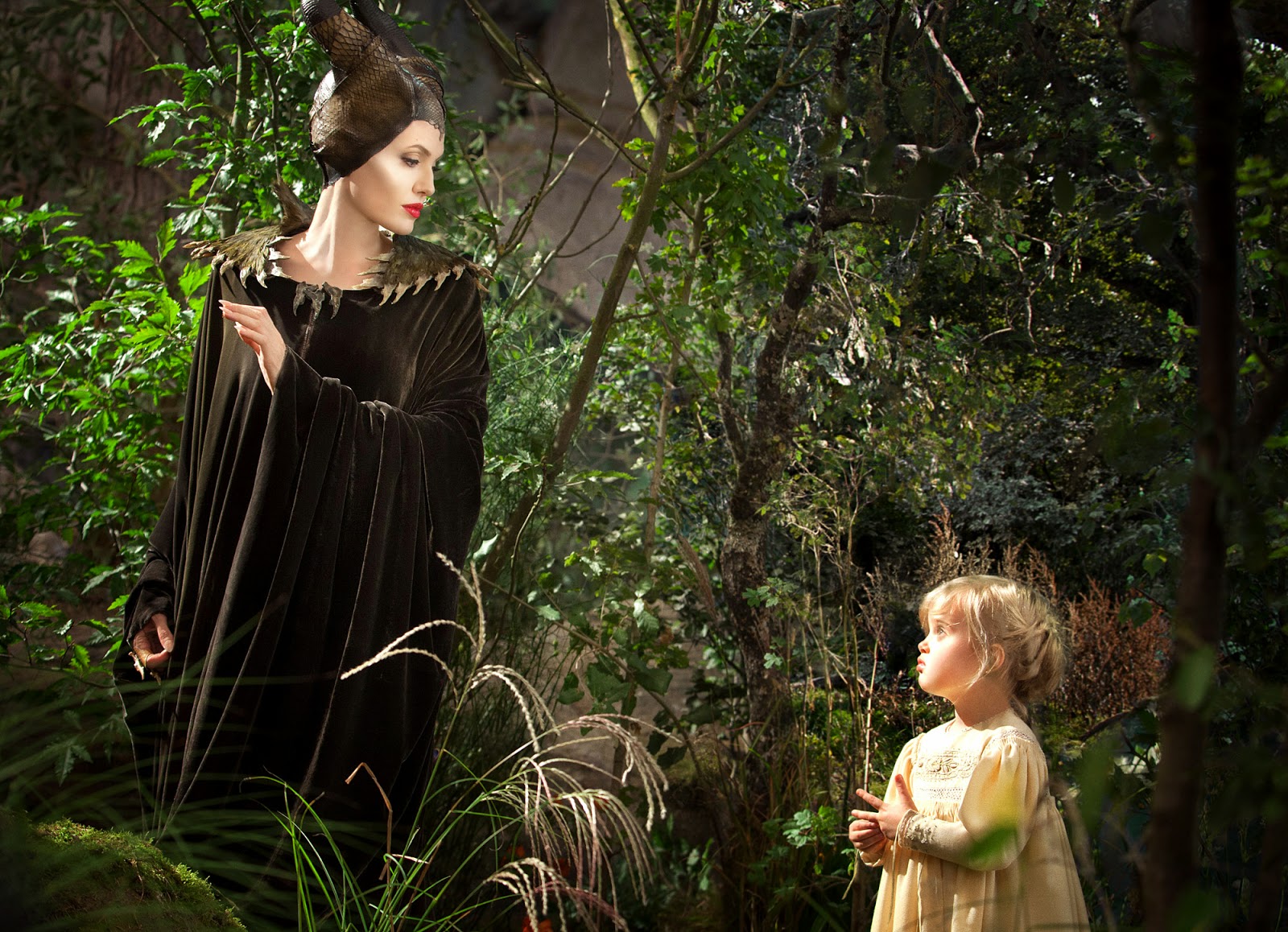
Maleficent is much the same … until she grows close to the very thing she cursed. Throughout Aurora’s childhood, Maleficent is never far away—watching, sometimes even caring for the child. So close she is that Aurora recognizes her shadow, a constant presence in her childhood. And she dubs Maleficent her fairy godmother. In the space of who knows how long, the two become close. And somewhere along the line, Maleficent realizes that she has room for something other than hate in her heart. Aurora—a name which references a strange dance of light in the cold, winter dark—has illuminated something of Maleficent’s black soul. Our villainess discovers a capacity for love.
I think that Disney missed a chance here to take this story of redemption and make it extra-special. Stefan could’ve been redeemed too, it seems: He wasn’t always bad. I’d like to think that he cared for Maleficent and loved his daughter. But here, Stefan takes the mantel of the true villain—incapable of accepting love through the iron hatred inside him.
But this, too, is a powerful reflection of how love, particularly God’s love, works. We may be offered love, even forgiveness. But we’re under no obligation to accept it. So often, we refuse. Our pain and anger won’t allow us to. We’d rather nurse a righteous bitterness than accept a little grace.
Toward the end of the movie, Aurora finds Maleficent’s wings and, magically still flapping, they find their way back to their mistress. She’s again whole, and powerful—a symbolic healing reflecting what Aurora had already done in the fairy’s soul. No longer the pure, horned evildoer, Maleficent spreads her wings, looking for all her past faults and sins, a little more angelic. She’s been restored. Redeemed. Maleficent, through grace, can fly again.

Who\’s the Evilest of Them All?

Walt Disney always knew the value of a good villain.
Maleficent, who haughtily strides into theaters Friday in the guise of Angelina Jolie, is proof of that. This self-proclaimed \”Mistress of All Evil\” is Disney\’s most dastardly diva, a woman who could teach Star Wars\’ dark Emperor a thing or two about fashion and eat Hannibal Lector for breakfast (as a dragon, quite literally). Maybe it\’s the horns. The evil raven. The fact that her very name seems to mean something like \”magnificently bad\” (if we\’re liberal with our Latin/English construction). Clearly, even her parents knew she was up to no good.
Rumor has it that she cuts a more sympathetic figure in this newest of Disney flicks, but part of me hopes that they don\’t mess with the lady toomuch. It\’s nice to have someone to root against—even if it\’s not always fair.
See, the problem with evil (well, one of the many, many problems with evil) is that it\’s often quite sneaky. We like to think of it in our stories as something outside of us—something other and ugly and monstrous. But unfortunately, what we think of as evil is really just good twisted up. The ol\’ Latin prefix of \”mal\” suggests as much. Our cars malfunction. Our wayward kids are maladjusted. Our bosses are malicious. It suggests that something that once worked just fine broke along the way. It\’s not right anymore.
We Christians believe that break happened at the very beginning of the world, when sin entered into it and led us all astray. And we\’re also taught that we all are prone to sin, which means we\’re all a little broken, too. We\’ve got a malady in us.
We don\’t like to think about that. We\’re all the heroes of our own stories, after all. By default, that makes us the good guys. We\’re Sleeping Beauty and Prince Charming, right? There\’s no Maleficent in us.
But of course there is. And maybe, just maybe, some of these outward manifestations of evil help us see the darker corners of our own souls.
So with that in mind, here\’s a completely subjective countdown of my five favorite Disney animated villains—and just what they might be able to teach us, too.
5. Captain Hook. For all his faults, I\’ve always respected the sense of style of Peter Pan\’s main villain. Not everyone can pull off a hat like that. And honestly, I\’ve always felt a little sorry for the guy. After all, we all might harbor some bitterness if someone fed one of our hands to a crocodile—which, we\’re told, is exactly what Peter Pan did. (If I was Pan\’s dad, I would\’ve told him that it\’s never OK to feed other people\’s body parts to reptilian carnivores, no matter what.) But where Hook goes awry is that he never, ever lets that misdeed go. He has vowed revenge on Pan for that crocodile snack, no matter how long it takes—and in a place called Never Neverland, that could be a mighty long grudge. Hook\’s obsession with Pan is a good reminder that forgiveness is an important and healthy aspect of our faith—even when it\’s really, really hard to forgive.  
4. The Coachman. Pinocchiohas so many fantastically bad characters that it\’s hard to settle on just one: \”Honest\” John, Stromboli, Monstro the whale … but since I\’m morally opposed to whaling and have the upmost respect for puppeteers, I\’d like to focus on the Coachman, the rotund fellow who takes Pinocchio off to Pleasure Island. He\’s the worst kind of villain—a guy who misleads the innocent and then turns them all into donkeys afterwards. For me, the guy\’s a pretty potent symbol of our own inclinations to slip into temptation and excuse our own bad behavior. We don\’t need a coachman to take us to Pleasure Island. Most of us can walk there all on our own.
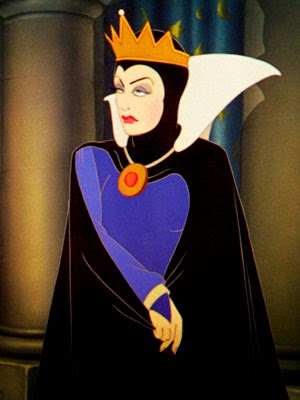
3. The Wicked Queen. The queen in Snow White is Maleficent 1.0, and even after more than 80 years, she\’s still a potent symbol of evil. But in her own way, she\’s a dramatic and still jarring zag away from how we typically think of evil. See, we humans have a bias toward beauty. Even modern-day studies suggest that we\’re more prone to believe pretty people than ugly ones. But here, the evil is found in this uber-glamorous queen (love that black cowl thingy she\’s got going for her). It\’s only when she \”disguises\” herself as an old crone that we see her true nature. And why does she change? Jealousy, plain and simple. The Queen decides to have Snow White killed because her mirror told her that she was prettier than she was. We can all feel a little jealous at times: Someone\’s always, it seems, a little prettier or stronger or smarter than we are. Sometimes we all need to be reminded that, in God\’s eyes, we\’re pretty awesome. If only someone would\’ve told the Queen that true beauty is found on the inside, well, we might\’ve saved a handful of dwarves a lot of angst (though their cottage would probably still be filthy).
2. Chernabog. Of all the Disney villains on the list, Chernabog—the demon at the end of Fantasia—is the only one I actually had nightmares about as a kid. This guy was as bad as they come, what with all the ghosts circling his head and the weird goblins he dumps into the fire and all. He\’s got claws and wings and the nastiest of scowls. He scared the dickens out of me, and I don\’t mean Charles. But here\’s a funny thing about we mortals: The things that scare or repulse us are sometimes the same things that we can be attracted to, sometimes unhealthily so. As a kid, I couldn\’t get Chernabog out of my mind. I didn\’t want to be the guy … and yet, the power that he wielded at the top of that mountain was, in a way, pretty enticing to a little boy who went to bed at 8 p.m. No one would make that winged demon eat his beats, that\’s for sure. Power  can be an, um, powerful temptation for some. And while power in itself isn\’t all bad (my editor certainly wouldn\’t think so), it can lead us down some dark, even diabolical paths.

1. Maleficent. If she wants to call herself the Mistress of All Evil, who am I to argue? While she may find a measure of redemption in the new movie, she\’s really, really bad in Sleeping Beauty—as in a servant-of-the-devil bad. I don’t think it\’s any accident that Prince Phillip fights the ol\’ girl with the Sword of Truth and the Shield of Virtue—an echo, perhaps, of Paul\’s \”Armor of God\” passage in Ephesians 6. (The shield even has a Christian cross emblazoned on it.) Clearly, Maleficent made some bad choices in her life. But maybe she would\’ve been in a position to make better choices had she, I dunno, not spent her time alone (goblin henchmen don\’t count) in a castle surrounded by thorns (yes, yes, you know-it-all Disney watchers, the thorns came later. Just go with me here. We\’re speaking metaphorically.)  I think that maybe, had she spent a little more time with her fellow fairies, she might\’ve turned out differently. Life and faith, after all, are meant to be lived in community. We need people to tell us when we\’re getting a little, um, weird. And perhaps, with a little more companionship, someone might\’ve ventured to tell her that the whole horned hat thing was a bad fashion choice.

Running on Faith: Breathing

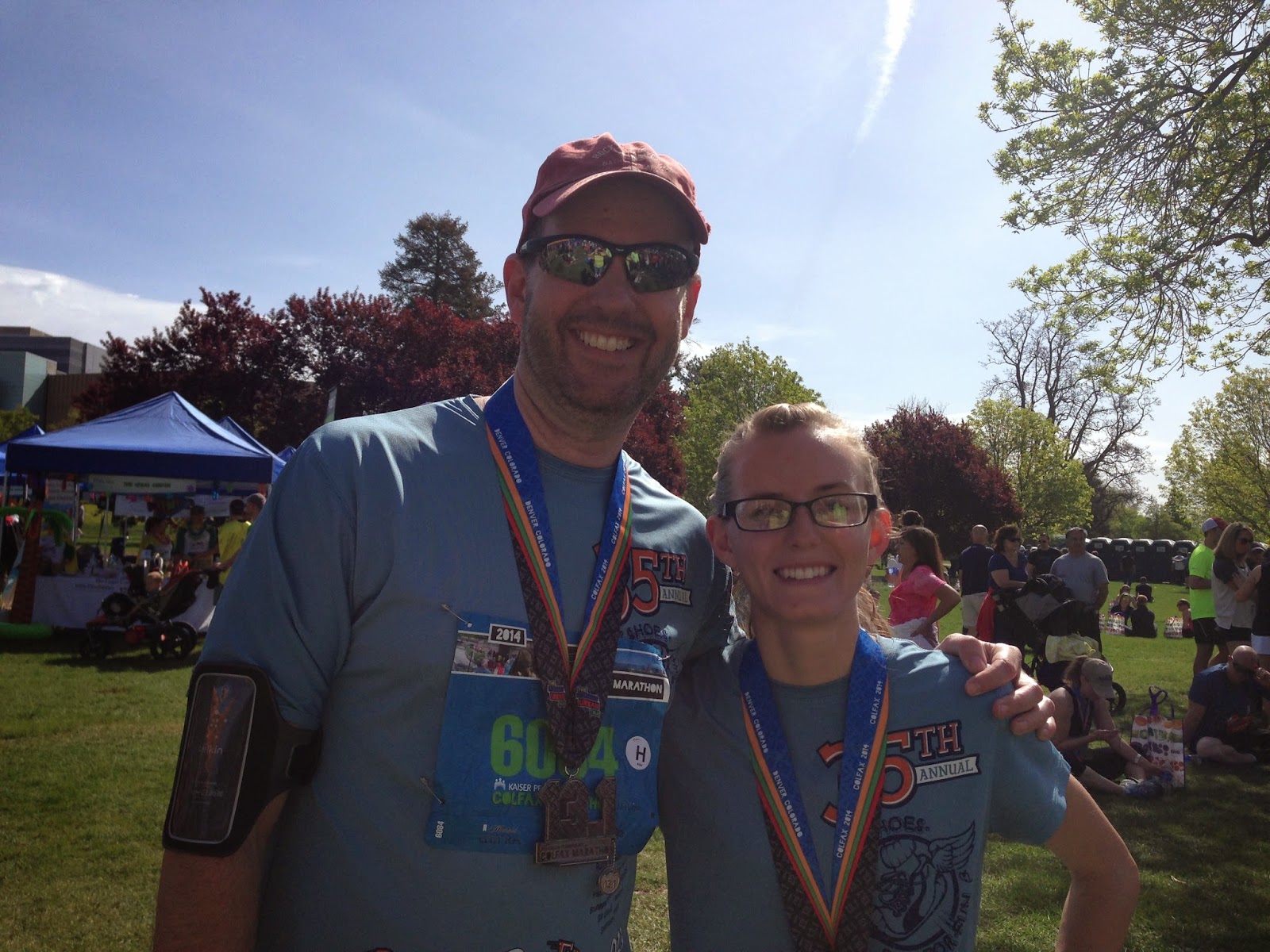
I thought it was just going to be a little training run—another step toward our fall marathon. It was easy to sell the race to Emily, my daughter and training partner. The 13-mile Colfax Half Marathon would go through the zoo, a fire station and some of Denver\’s prettiest neighborhoods. It\’d be a nice change of scenery from our typical training run. Plus, there\’d be medals. You can never have too many of those.
You can see us here in the picture, ready for another fun, fantastic run.
And for the first four miles or so, everything was great. The zoo was fun. The neighborhoods were neat. The weather was almost perfect.
And then Emily started feeling sick.
We walked some. Then some more. Instead of counting the miles, I\’d scan the streets for porta-potties. Emily was hurting bad. I could tell by how quiet she was. Normally, she talks the miles away on our training runs. But now, during this run, she wasn\’t speaking. She was fighting too hard with her body to talk, fighting with every step. I\’d fill in the void with some mindless patter, hoping to take her mind off things. But nothing I said made her feel a bit better. And so we walked when we had to and ran when we could, listening to each other\’s footsteps, the sound of the other breathing.
And by mile seven, neither of us was sure it was smart to keep pushing on.
\”I don\’t want to quit,\” she told me.
\”I know you don\’t,\” I said. \”I know.\”
A half-mile later, when we hit the fire station, we decided to call it. I dialed my wife Wendy and asked if she\’d be able to pick us up along the way.
She couldn\’t: The car was in the middle of the race traffic. We were on our own.
But just when I feared things might get really messy, Emily rallied. By mile 10, she was feeling better. By 12, the only things wrong with her was her foot and knee and hip—the normal aches and pains that you sometimes get when you run a ways. And by the time she was collecting all her \”free\” loot after we crossed the finish line—including the medal—she joked, \”this is the best day ever!\”
 In these little running/religion musings of mine, we\’ve talked about how sometimes both faith and a long run can be a struggle, and that\’s particularly true of when we\’re in pain. Our relationship with God can be tricky even the best of times. But when we\’re suffering or grieving, it can feel nearly impossible. The pain can be overwhelming. We can feel like quitting.
I\’ve done quite a few stories about grieving and suffering over the years, and one central question has been at the center of many of them: How can the rest of us help? If we know someone who\’s dealing with a crushing loss or battling illness or suffering from indescribable pain, how can we carry a little of that burden? What can we do to ease the discomfort?
The experts always seem to come back to the same, sad fact. Sometimes we can\’t. We can\’t always take away the pain. We can\’t speed up the grieving process. Some things, they just hurt.
But even though we can\’t take away the pain or speed up the recovery, we can still be there … in body and spirit. We can walk, or run, alongside them. We don\’t have to talk. Sometimes, it\’s better if we don\’t. Just to be with someone—to show them they\’re not alone—can be a comfort, as small as it might seem.
For one of those stories, I talked with a man who had terminal brain cancer. The man, a lifelong Christian, made a startling omission to me—one so different from the feel-good Christianese that people often wrap themselves in. He said there were times when he prayed that he felt … nothing. God, his great comfort and comforter, was silent.
He added that he\’s had some incredible times of prayer, too, but him talking about the silence of God struck me. I\’ve felt that same silence sometimes. There are dark nights when God\’s love seems to cover you like a blanket, but others where the blanket is gone. There is no solace found in that dark, quiet space. No spiritual platitudes to savor, no prayer to serve as salve.
But in those moments, I sometimes think back to an old Lifehouse song called \”Breathing.\” It\’s a psalm, in a way, that patiently tries to accept those silences, to make sense of them and even embrace them. The chorus goes:
I am hanging on every word you say
And even if you don\’t want to speak tonight
That\’s all right, all right with me
\’Cause I want nothing more than to sit
Outside heaven\’s door and listen to you breathing
It\’s where I want to be.
Emily and I spent a good chunk of the Colfax Half listening to each other breathe. It wasn\’t fun for either of us (and especially not for Em). But maybe there was something special about those painful few miles, anyway. Emily knew that, run or walk or crawl or stop, I\’d be with her no matter what. I felt the strange sense of gratitude of sharing a truly, if painfully, unforgettable time with my daughter—a time beyond smiles and laughter, a time beyond words. It was a time when breathing was as eloquent as it got. And it was enough.

Godzilla: Trust Issues

My Plugged In review of Godzilla starts out like this:

Hey, we all have problems. You got \’em, I got \’em. Maybe you\’re failing algebra or struggling to pay the bills. Maybe you\’re feeling a little flu-ish at the moment. Maybe your job is in jeopardy. Maybe your movie review is due right now and you\’re still trying to think of something clever to say. Our lives are never, ever problem free.
 But some problems are bigger than others.

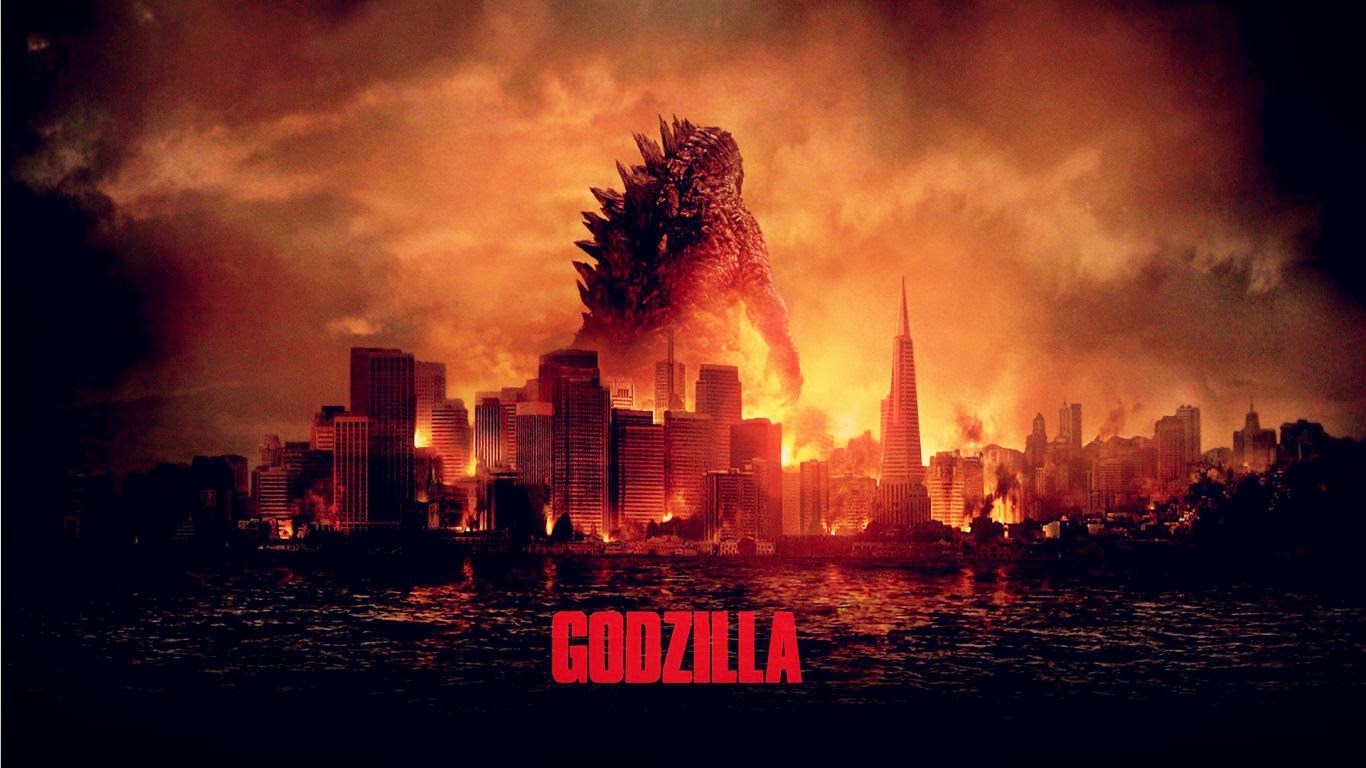
Back in 1954, Godzilla—the original movie that made the big guy so big—not only was a huge problem for the people of Japan, he represented one. Back then, the huge dinosaur-like beast was disaster incarnate, awakened by a nuclear blast. He was a not-so-subtle metaphor of nuclear destruction and terror—a horror that the Japanese people, with Hiroshima and Nagasaki still fresh in their collective memory, knew better than anyone else in the world.
As Toho studios continued to produce more Godzilla movies, it introduced ever-more exotic monsters, many of whom had a bit of symbolism attached them. Mothra (who first appeared in 1961) was almost a benevolent nature god, protecting the world and its many life forms from forces that would seek to do it harm. (Some have postulated that Mothra is symbolic for religionitself, or even Christianity with Mothra\’s penchant for death and rebirth.) Hedorah, a.k.a. the Smog Monster (from 1971) had some obvious environmental implications. Et cetera.
Even in this latest Godzilla is more than just a super-sized cash grab. This is, on one level, an environmental fable: Monsters called MUTOs (Massive Unidentified Terrestrial Objects) were uncovered by a hasty mining operation in the Philippines and involved in a horrific nuclear power-plant “earthquake” (reminiscent of the Fukushima Daiichi nuclear disaster of 2011). They unleash devastating electromagnetic pulses that wreak havoc on the grid and snack on radiation. At one point, Japanese scientist Dr. Serizawa tells us that “the arrogance of man is that nature is in our control, and not the other way around.”
“You have to ask yourself, ‘What does Godzilla represent?’” Director Gareth Edwards told The Daily Beast. “The thing we kept coming up with is that he’s a force of nature, and if nature had a mascot, it would be Godzilla. So what do the other creatures represent? They represent man’s abuse of nature, and the idea is that Godzilla is coming to restore balance to something mankind has disrupted.”
But whatever the stated symbolism, there’s no question these monsters represent problems. In fact, they are, both literally and metaphorically, huge problems—especially for those in the path of their huge descending feet. They’re too big to deal with, really. You just don’t sit down and reason with a 300-foot monster.
I think we all know the feeling. We know what it feels like to be faced with an issue that seems almost entirely out of our control. We face plenty of monsters in our lifetime. Sickness. Finances. A broken relationship. Depression. These problems are terrible no matter what, but when we feel like we’re powerless to do anything about them, it’s so much worse. Sometimes, it feels like we’re at their mercy. Helpless. Disposable, even, like a Godzilla extra. I’m in a place like that right now. It’s not very comfortable, feeling like you’re sitting in one of those trains that a Japanese monster might pick up and eat like a Twinkie. But most of us have been there. And if we haven’t yet, we probably will one day.
In the movie, we see folks try to take control. The Japanese try to keep one of the RUTOs contained in a deserted nuclear power plant, but that doesn’t work. The American military wonders if they might bomb these monsters away, but that has its problems, too. They’re like we are. We need to feel like we’re in control. We have to do something. Waiting around isn’t in our nature.
But sometimes, God tells us that that’s exactly what we have to do.
“But they who wait for the Lord shall renew their strength,” we read in Isaiah 40:31. “they shall mount up with wings like eagles; they shall run and not be weary; they shall walk and not faint.” In Psalms 33:20-22, we read, “Our soul waits for the Lord; he is our help and our shield. For our heart is glad in him, because we trust in his holy name. Let your steadfast love, O Lord, be upon us, even as we hope in you.”
It’s not comfortable to wait. It’s not very satisfying to trust. The Bible’s full of folks who wonder how long God’ll keep them hanging on. But that’s what God wants us to do sometimes. When things are out of our control, we’re asked to wait and trust and hope and pray.
That’s pretty much what Serizawa tells his anxious co-stars. Instead of trying to fix the situation, just let the monsters take care of themselves. “Let them fight,” he says. I doubt Serizawa’s a Christian, but he too has a kind of faith: A faith that nature will figure it out and put everything back in balance.
In the movie, that message gets incredibly muddled: Seems to me that if nature wanted to find some sort of “natural” balance, she might side with the gigantic MUTOs, who were here way before us and are simply doing “natural” stuff—eating and laying eggs. Think to long about Godzilla as a nature fable, and it falls apart.
But when we think of it through the realm of our faith, it works better (at least a little). We too can be faced with problems that tear our world apart. We too are asked to put our faith and trust in something outside ourselves—a being we can barely comprehend. And that can be a scary, scary thing. We’re not used to relinquishing control.
But sometimes, it’s the only thing we can do. When our problems grow too big, we have to rely on the strength of God, and trust that even while our worlds might not come out unscathed, He’ll be with us—no matter what. And when the credits roll, we’ll realize that all we needed was God all along.

Growing Up Godzilla

Godzilla will stomp into theaters this weekend, doing his part to tear down lots of cities and rake in lots of money. I\’ve seen it, and later you can check out my review at Plugged Income Friday and some extra thoughts right here that very same day. But in advance of the big day, let me tell you about my very first Godzilla movie.
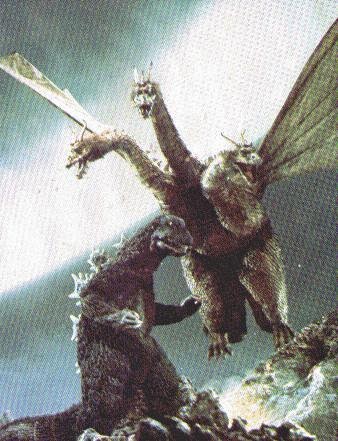
I was a Godzilla fan before I ever saw one of his movies. Our school library had a series of books about classic movie monsters, and when I was around 9 or 10, I checked out the book on Godzilla about 17 times. I knew all the characters: Rodan, Mothra, Ghidorah, the works. Their city-stomping ways fascinated me, and I wonder if maybe these Japanese Kaiju have always held a special charm for kids (as frightening as they’re supposed to be). They\’re big. They\’re bad. They can destroy whole cities like we might tear down a stack of blocks. Such overwhelming power. Such mighty feats of strength. For kids who don\’t have much of either, Godzilla and company would be pretty attractive. No one would ever send Ghidorah to bed early. Godzilla would never get bullied on the playground.
No wonder Godzilla—Japan\’s ultimate scaly villain in 1954—morphed into a hero after a movie or two. Kids needed the big guy in their corner.
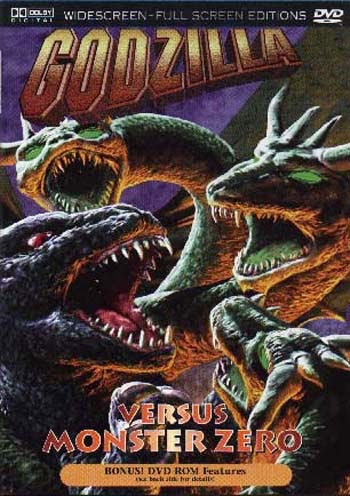
When I was in fourth grade, we heard that Godzilla vs. Monster Zero was coming to a local, late-night horror-movie showcase called Shock Theater. The movie wouldn\’t start \’til 10:30 and probably end after midnight, but all my friends with permissive parents said they\’d be watching. And so I asked—no, begged—my parents if, just this once, I could stay up and watch it, too.
In a complete departure from the parenting principles I\’d grown up with, they said yes.
It was a stunner, and I felt curiously grown up. Never mind that my dad was going to watch it with me, or that a couple of my stuffed animals were on call, too—just in case I got scared. The fact that I was going to stay up past midnight—watching Shock Theater, no less—was a big marker on my way to adulthood. Today, late-night television. Tomorrow, the driver\’s license.
It proved to be a terrifying night.
It wasn\’t the movie: Monster Zero, I think, was kinda lame for a kid looking for some Shock Theater-like thrills. But somewhere after Monster Zero (Ghidorah) destroyed one city but before he destroyed this other city, my dad went to bed. Went. To. Bed. Never had I been shouldered with such hefty responsibility, to be awake and safeguard the house alone before. It was, again, a strangely thrilling moment … and absolutely horrible, too. When he said goodnight and left me alone in our gloomy basement family room, I felt like I was being treated like an adult, and I knew I was nowhere up to the challenge.
I watched the movie to the credits, walked to the television and turned it off. The house was as still as a tomb. I flipped off the lights to the family room and watched it go black. I inched up the hallway stairs, straining my ears for the sound of any strange skittering sounds or raspy breathing, then turned off that light, too. My heart was pounding. I was clutching my stuffed bear \’til the stuffing nearly oozed out his ears. But room by room, I turned off the lights—turning some on along the way so I\’d never be in total darkness—until I reached the safety of my bedroom.
It was the first time I realized what an empty, dark house really looked like. Felt like. Before, my parents were always on patrol as I softly fell asleep. Tonight, I was on my own.
I felt like an adult, and it was horrifying. I was not strong or powerful like a movie monster, ready to deal with invaders from Planet X. I was scared. It was like I had a premonition of adulthood. Someday, I\’ll need to turn off the lights by myself all the time, I thought. What an awful thought
I suppose I should say something spiritual here. Maybe how we\’re all children of God and we can just relax, \’cause he\’ll watch over us in our metaphorical dark houses. He’s always on patrol. And I think that\’s true. But sometimes, God\’s presence can be a difficult thing to feel. Sometimes we can feel very alone in a dark and too-quiet world. We feel the pressures around us. The fear pressing in on us. Out from us.
When we\’re children, I think there\’s a time when we imagine that adults don\’t get scared. If only that were true.
But we deal, I guess. We have to. And I think with God\’s help, we learn how to cope. We\’re a little like the folks in Godzilla movies, maybe. The ones who aren’t screaming. We\’re surrounded by forces and fears we can\’t control and barely comprehend. But we move forward—with fear, yes, but with hope. Hope that becomes a wary confidence. Even courage. And maybe that hope is something that God gives us. Maybe our worlds will look pretty bad at times, like something big and fire-breathing trashed it all. Maybe we\’ll see some serious destruction when the sun comes up. But the sun does come up. And with each new day we\’re given another chance to help put things right.
I don\’t know whether I can blame Monster Zero for this, but when I was in junior high, I noticed something interesting in my sleep patterns. If I was spending the night at a friends\’ house or at summer camp or something, I could never go to sleep until I was sure that everyone else was. I wanted—needed, really—to be the last guy awake. And I\’m still that way. I won\’t ever go to sleep if there\’s someone in the house is stirring still—watching a movie or reading a book. It\’s physically impossible for me to do so.

I\’m the adult now. And maybe that night with Godzilla and Monster Zero taught me that, as an adult, I need to be vigilant—the guy on patrol–because no one else is going to do it for me. I\’m the one who turns out the lights.

Jack Bauer has a Secret, and its Name is Batman

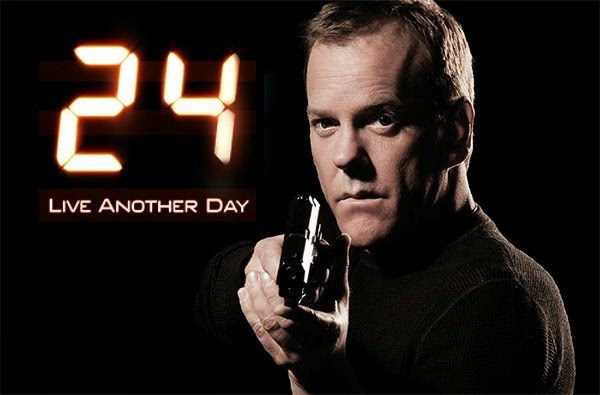
Fox\’s upcoming Gothamlooks pretty interesting.
Fox released the first TV trailer for its gritty Batman prequel during Monday\’s premiere of 24: Live Another Day, where we saw Batman and multiple evildoers in their Muppet Baby phase. Penguin looks like a strangely skinny high schooler with a thing for umbrellas, the Riddler an up-and-coming accountant, Poison Ivy a cross between a second-grade botanist and the girl from The Ring. Bruce Wayne looks all of 10, and the future Commissioner Gordon is an idealistic rookie.
But it and the extended trailer (below) make the new fall series look like, for a Batman dweeb like me, must-see-TV.
And how appropriate that Fox would choose 24 to premiere the trailer. After all, Jack Bauer is Batman.
Well, not really. Jack eschews both capes and huge Swiss bank accounts. Batman never carries a gun and never kills, while Jack has killed around 270 people (and counting) and likely belongs to some sort of \”gun of the month\” club.
But they really are the same sort of hero now. Both are grim and tortured souls who work in the shadows. Both seek justice by skirting the law. Both have, at best, an uneasy relationship with the law agencies they\’re supposed to be working with. And at times, those relationships can become positively adversarial—even though everyone involved is fighting on the same side. Both, I suspect, have some serious issues that a good psychologist could help with—but neither have the time nor inclination. Both like their gadgets.
And both, of course, have become dark legends—their mere names striking fear in the hearts of men.
What draws us to heroes like this, I wonder? Never mind the success of Iron Man at the box office, Batman is America’s best known, most popular superhero, and has been for decades. And even though 24 never got incredibly huge ratings, Jack Bauer is perhaps the most recognizable character to come from television in the last couple of decades—capturing our imagination like few before. There’s gotta be something in their very darkness that pulls us to them, I think. They’re the toughest of the tough, but broken, too.
Perhaps they borrow from the world’s first heroic template. In Homer’s The Iliad, I’ve long felt that Hector—the doomed would-be savior of Troy—was the story’s real hero, not mighty Achaean Achilles. But perhaps both have passed on their literary genes to Jack and Batman: Hector, with his self-sacrificial willingness to give his call for his city and country. Achilles and his unmatched prowess in battle offset by his penchant to nurse deep wounds in the sanctity of his tent.
Or maybe they play on a deeper, even spiritual level, they remind us a little of us.
In God in the Streets of Gotham, I wrote this:

In most superhero stories, the line between good and evil, the gulf between light and darkness, is clearly defined. … But there’s a part of us, maybe a small, nagging, unpleasant part, that treats those stories with suspicion. We know the line is not that bright; the gulf between “us” and “them” is not that wide. We feel not just the hero inside us, but the villain . . . the darkness. Batman, a guy who doesn’t just wear a black hat, but one with pointed, horn-like ears, is a representation of our own selves, a strange, graphic allegory of the soul, with Gotham City a microcosm of the fragile, fallen world through which we struggle to make our way. Gotham itself feels bad—Old Testament bad. We can catch a glimpse of ancient Sodom or Samaria when we see its streets, and we feel its sin press on us with an almost physical presence. Batman, as we’re told in The Dark Knight, isn’t a perfect savior for the city; he’s the one it “deserves,” in all his imperfection. He walks perilously close to the line.
 And yet there’s something inside the guy that sets him apart. He may look bad, but it’s not what he looks like that matters. It’s what he does, and what he stands for, that counts.
How curiously biblical Batman is in this way. He’s not much like Superman, but he is something like Moses, David, and Peter. The Bible doesn’t sugarcoat our heroes for us or tell us they’re anything but pretty sorry, flawed folks. And yet God takes them and makes them special, even great, just as he does with us.

Maybe the same could be said for Jack Bauer, too—a guy who’s tougher and badder than we’ll ever be. And yet we see in him the darkness, and light, in us. Someone who has hurt people and who’s been hurt. Someone who makes a ton of mistakes every day. And yet someone who’s still striving to do right in spite of it all.

24: Jack Bauer, the Worst Messiah Ever

I don’t watch much television. But tonight I make an exception. Why? Because Jack Bauer wants me to.
You don’t mess with Jack. Made famous by Kiefer Sutherland on Fox’s long-running show 24, Jack Bauer makes Chuck Norris look like a tofu-eating yuppie. In eight full seasons, the guy has killed his boss, cut the hand off his partner and threatened someone with a towel—all to save the world repeatedly from terrorists and duplicitous politicians and dirty bombs. I’m sure he could do something about climate change if he had more bullets. He makes even baking cupcakes look tough:

https://youtube.googleapis.com/v/dfpqZloAuXk&source=uds

And now, after a four-year hiatus, Jack is back with 24: Live Another Day. I admit it: I’m a little giddy.
I’ve watched 24from the beginning, every action-packed, sometimes ridiculous minute of it. When I worked at The Gazette (the daily paper here in Colorado Springs), me and a clutch of 24-loving editors and reporters would rehash the whole show the following morning: The shockers, the one-liners, the narrow escapes from rampaging cougars. Talking about 24 was almost as much fun as watching it. And when I moved to Plugged Inand reviewed the thing from a Christian perspective (and given all 24’s torture and stuff, it’s not really the sort of program Plugged In can give a hearty thumbs up to), I had to smile when some 24-loving readers skewered me for not “getting” the show at all.
I got it, I think. Or, at least, I appreciated it. Each season—each episode, really—was predicated on one thing: Just how far would Jack go this time?
The answer always surprised us. And over the arc of the 24’s run, we not only watched Jack do some terrible things, but suffer as well. He buried his wife and alienated his daughter. He lost nearly everyone he was ever close to. Every season, Jack’s job consumed a little of his soul.
\”In the early years of 24, after the 9/11 attacks, the common take was that the appeal of Jack Bauer lay in his strength,\” writes Time\’s James Poniewozik. \”He was tough, decisive, and effective, offering the fantasy of security in an insecure time. But in the long run, I don’t think Bauer’s most important function was to fight our battles; it was to feel our pain. Season after season, he would suffer physically and spiritually, he would lose friends and lovers (and sleep), he would save the country and get run out of town. He was like a psychic pincushion, a sponge soaking up all the toxic emotion of the era, committing our sins and swallowing the guilt until he seemed 100 years old.\”
He is television’s ultimate suffering savior, I suppose, as tortured as anyone he takes a towel to. He’d do anything to save the world, it seems, including sacrifice his own life.
But a Christ-like figure, he’s not. He knows it as well as anyone. While a blameless Jesus carried our sins, Jack (in Poniewozik’s words) commits them. He is a doomed hero, a savior in a world without grace or mercy or forgiveness. Jack might call himself a necessary evil, and Bauer apologists would agree. The theory goes that sometimes to take out the bad guys, you need someone willing to get his hands dirty.
But a necessary evil is still an evil. Jack may be a savior of sorts for a purely physical world. Maybe he saves our skins. But when it comes to souls, he can’t even save his own. For that you need grace and forgiveness and the healing power of God.
No, Jack’s not a Messiah. He’s just a guy like us—a flawed sinner who tries to do what he can to make the world a better place in his own brutal way.
Hey, I’m thrilled Jack’s back. I’m rooting for him to be thanked for all his hard work and get a medal or something. After saving so many people, it’d be nice for him to find some salvation himself.
But I’m not counting on it. For that, the powers that be would not just have to acknowledge Jack’s sacrifices, but forgive his crimes. And 24 is not a very forgiving show.

Noah: Snakes, Tubal-cain and the Slithery Nature of Evil

Of all the things most hotly debated in Darren Aronofsky’s Noah, perhaps nothing’s stirred more controversy than all the snakes.  
They’re significant, for sure. We say a black snake slither out of a green one in the Garden of Eden—Satan out to give Adam and Eve a rough time. Thousands of snakes slither into the ark shortly before the Flood. Evil stowaway Tubal-cain chows down on a snake while hiding aboard the ark. And then, of course, you’ve got the snakeskin used as a magical talisman by Noah’s extended family—a glowing symbol passed down from generation to generation.
Aronofsky’s snakeskin has encouraged some Christians to believe that Noah’s “Creator” isn’t God at all, but the devil. By holding onto an aged snakeskin from the Garden of Eden, Noah and his family were following Lucifer’s pipe.
Not so, says Noah co-writer Ari Handel in Relevant Magazine:

When Adam and Eve are expelled from the Garden, it says God gave them a garment of skin—sort of a parting gift from God to mankind as we leave Eden and go out into the world. So we wondered what that was—and as we looked at commentaries about it, one of the common ones was that it was the skin of the snake. We wondered why that would be, and it occurred to us that God made the snake. The snake was good, at first. But then, the Tempter arose through it. In our version, we have the snake shed that skin, and the shed skin is the shell of original goodness that the snake left behind when it became the Tempter. It’s a symbol of the Eden that we left behind. It’s a garment to clothe you spiritually.

That’s pretty much how I interpreted the whole snakeskin thing when I watched the movie. And the symbolism of Aronofsky’s serpent echoes throughout the movie.
As Handel says, the snakeskin that Noah makes such a big deal about is the shell of God’s beautiful creation. Evil, somehow, slithered out of that creation and infected the world.
That’s in keeping with what Augustine taught the early church. Satan can’t create anything on his own. Evil isn’t a thing in itself as much as it’s a perversion of the good. It’s God’s creation twisted in ways that God never intended. Sex is great—unless it manifests itself in adultery or porn or whatever else falls outside of God’s design. Lies are, by definition, a twisting of the truth. To kill is to rebel against creation itself. Evil has to come out of something good: It has no other option.
Satan slithering out of God’s green snake fits with Augustine’s thoughts on the matter. But, of course, evil crawls out of more than just legless reptiles. It comes out of us, too.
In a critical turning point in Noah, our titular character comes to a realization that evil is not just in prime villain Tubal-cain and his crew. It’s in Noah, too. In fact, that evil’s buried in his whole family. There’s a snake inside all of us—an inescapable corruption that a flood won’t be able to completely cleanse. It’s a big revelation for Noah, and he begins to believe that to get rid of Satan’s serpentine influence forever, Noah’ll have to get rid of (directly or indirectly) anything that has a hint of evil inside.
But even though both Noah and Tubal-cain have some badness inside, Aronofsky—in my interpretation, at least—makes a critical distinction between the two of them. See,
Tubal-cain is in a state of rebellion.
Noah, whatever his faults may be in the movie, tries to do as he believes his Creator wills. Tubal-cain has no such goal in mind. While Noah wants to be a tool in God’s hands, Tubal-cain wants to hop out of God’s toolbox, run away and do whatever tools would otherwise do. More simply: Noah lives for God. Tubal-cain lives for himself. “Damned if I don’t do what it takes,” Tubal-cain says. “Damned if I don’t take what I want.” And so takes God’s creation, perverting it and twisting it for his own ends.
And then, curiously, he wonders why God has been out of touch. “I am a man, made in Your image,” he prays bitterly at one point. “Why will you not converse with me?”
When Noah feels like he failed God (which he doesn’t), it’s not out of rebellion, but weakness. He wasn’t strong enough to carry out what he believed to be the Creator’s terrible will. But Tubal-cain never wanted to follow God anywhere—not if God’s goals differed from his own. Just like Satan, really. It\’s interesting that, when you look at Tubal-cain\’s armor above, it looks a little … scaly.

It’s telling that, when Tubal-cain smuggles himself aboard the ark, he kills an animal and eats it to regain his strength (a no-no in Aronofsky’s environmental fable). What animal? A snake, of course: He bites off its head and swallows it. Just as the rebel Satan came out of a snake, so the rebel Tubal-cain consumes one. He destroys a unique bit of God’s creation in rebellion. And so doing, he metaphorically takes a bit of Satan inside himself … the deed itself, not the snake, poisons the meal.

Noah: Lots of Baggage, But It Floats Somewhere Special

I just received a letter from a reader who, very politely, said my Plugged In review of Noah “missed the mark.”
“This film is a mocking, blasphemous, butchering, occultic, science fiction affront to the God of Genesis on every conceivable level,” the writer said. “This movie should have received the lowest recommendation possible. Seeing this movie will not benefit ANYONE.”
And you thought the Flood was bad.
The storm around Darren Aronofsky\’s film has been pretty crazy. I don\’t think I\’ve ever reviewed a movie so polarizing. And I get the Christian backlash against the film. The source story is, after all, quite literally sacred. So when Aronofsky turned the story into a Tolkienesque fantasy epic for his own storytelling ends, well, many folks were bound to be upset. I think they have the right to be.
But I’d disagree with my critic saying that the movie won’t benefit anyone. I actually found the movie pretty interesting—sometimes even inspiring. And I think perhaps where Aronofsky went most “wrong” is where the movie is at its most intriguing. An example: The issue of discerning God’s will.
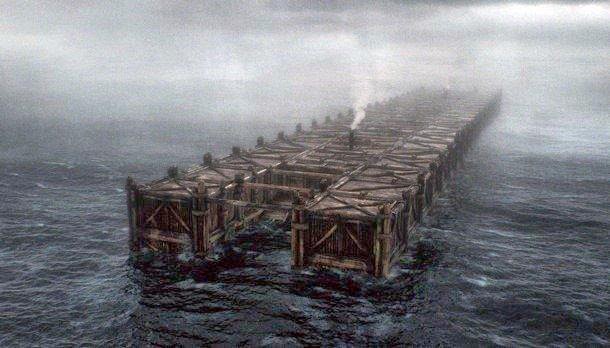
In the Bible, of course, Noah had pretty direct marching orders from God. Our old sailor was not only told to build the ark, but how big to build it and out of what. Sure, Noah’s neighbors may have thought it was a crazy thing to do, but Noah trusted God. And I think most of us, if we heard a booming voice from on high a la Bill Cosby, we’d be inclined to listen and trust, too.
But in Aronofsky’s vision, God does not communicate so clearly. The Creator (as God is called here) speaks to Noah through dreams and visions, and rarely even those. And for everyone else, the Creator is silent. Even the Watchers—semi-fallen angels—are left to wonder what God would have them do.
Tubal-cain (who I hope to write about more fully later on this week) is the movie’s clear antagonist. But for all his bluster, the villain is surprisingly complex: Tubal-cain would tell you that it’s not that he’s turned his back on God, but that God has turned away from him.
“No one’s heard from the Creator since He marked Cain,” Tubal-cain says. “We are orphan children.” At one point, he even seems to beg for God to speak to him. And so he feels like, if God’s not going to take care of them, it’s up to these “orphans” to take care of themselves.
(Of course, Tubal-cain ignores the fact that God, clearly, istalking with someone. Noah. Why else would the villain be so sure the rains were going to come, and why he made such an effort to build an army to take over the ark?)
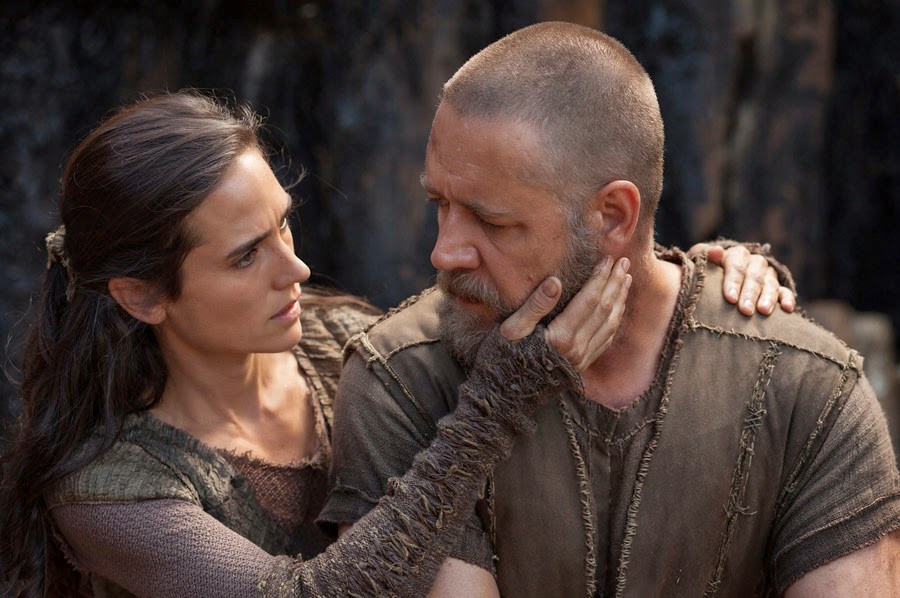
But even for Noah, God’s wishes are not always clear. And once the floods hit, Noah’s interpretation of the Creator’s will takes center stage. He comes to believe that all men have evil in them. As such, humanity does not and should not have a place in the new world God’s preparing. He believes that God wants them all to die—if not in the flood, then afterward. And the Creator chose Noah because he was the only one with the strength to see this terrible task through.
Now this, of course, is horrifically unlike the Noah we read about in the Bible, and if the guy had managed to live a few millennia longer, he’d have a heckuva libel case.
But narratively, this controversial choice works for me because it illustrates a frustrating problem we modern-day believers struggle with all the time. What does God want us to do?
We hear this question in news stories every day. Would Jesus bake a wedding cake for a gay couple? Would He go see Noah? These questions are predicated on a deep uncertainty that many people of faith deal with every day. We pray and talk and parse Bible verses in the hopes of getting some insight on what’s the “right” thing to do. But sometimes, even when we search most fervently and pray most sincerely, we come to different conclusions.
And sometimes the folks who are most convinced they’re in the right are the ones that, in my eyes, seem to be the most wrong. The late Fred Phelps of the infamous Westboro Baptist Church never seemed to have any doubt about what he was doing.
I’m not suggesting that certainty is necessarily wrong or bad. But knowing God’s will can be tricky. Moses’ wife, Naameh, and daughter-in-law, Ila, also felt that they knew what God would want. They pointed to certain signs. They pointed to what they knew of God’s character. Noah would not be swayed, barreling forward in his single-minded understanding. He had no Bible at the time to guide his actions, no kindly pastors to talk with. He was alone. And the Creator, unlike God in Genesis, did not choose to speak so definitively.
In the end, Noah makes the right decision—even though, in the moment, he feels as though it’s wrong. He looks at his own progeny and finds that he has nothing but love for them. Sure, he knows that they still have evil inside, that they might make another wreck of creation. And yet he loves them and saves them.
He kicked himself mightily for that lack of “obedience.” And yet, knowing what we do of God’s loving character through Jesus, Noah was being deeply obedient. For God sees us the same way. He sees our sins. He sees our imperfections. He sees the evil inside us all and knows that we can mess up His creation mightily. And yet, he looks down on us with love. He saves us.

“For the foolishness of God is wiser than human wisdom, and the weakness of God is stronger than human strength,” we read in 1 Corinthians 1:25. Never is that foolishness more obvious, or beautiful, than in His reckless love for us.

Sacred Space

I was kicked out of a theater the other day.
I’d settled in to review Wes Anderson’s The Grand Budapest Hotel somewhere in downtown Denver. It wasn’t a private screening for reviewers, but that was no biggie: I’ve reviewed lots of movies without the benefit of a formal screening—including movies at that very theater. I always take great care not to bother anyone with my little light-up pen. I go to the earliest screenings possible and sit as far away from everyone else as I can. I cover up my penlight with a sheet of paper to minimize any hint of illumination. I’d imagine that you’d have to be as light sensitive as the kids in The Others to even notice it.
Which might explain why the manager who caught me was so pale. Despite much pleading, and despite the fact that no one had complained or even (as far as I could tell) noticed my pen, the manager refused to budge on his no-light policy—even in the case of super-courteous but dutiful note-taking movie reviewers. (He was kind enough to give me a refund, though.)
I’m not asking anyone to feel sorry for me. It’d be fruitless—like Kim Kardashian arguing that rhinestone and spandex makers should give her a special discount. “You brought a lightinto a movie theater?!” you’d gasp. And if I didn’t know how eensy-weensy my light was, I’d be right there with you. I’m appalled when I see people text in movie theaters. I get irritated when I hear people whisper asides to each other. And parents who bring their six-month-olds to the movies? That should be a felony.
 The theater is hallowed ground, in a way. And I think for many people, it’s the only sacred space they know.
I don’t want to be flip or sacrilegious about this: Obviously, the theater is not a church. We do not worship there, not in any traditional sense.
But in our increasingly secular society, fewer people go to church anymore. They have little regard for the rites and hymns of worship and little time for God. And yet I think that we all have an innate need to connect with something greater than ourselves—something that puts us in touch with the transcendent. Nature may be the best such conduit. But the movies, with its emphasis on transcendent storytelling, may be next in line. There, in a darkened theater, we encounter things literally larger than life: People, ideas, emotions. Movies tap into our emotions like worship can do and challenge our intellect like a good conversation or sermon. We file into this sacred space with a certain sense of reverence and anticipation. We come hoping, and expecting, to be moved—just as believers who go to church do.
And it’s a very ritualized environment, where we’re expected to act and react a certain way—most unique . When we go to a football game, we can sit on our hands or dance in the aisles. When we stand on the top of a 14er, we might be expected to do most anything: Hold up our hands in triumph, sit on our haunches in contemplation, or ask around for some oxygen. But in a movie theater, most of us follow predictable rituals, and we’re expected to behave with uniform respect, even reverence.
A few weeks ago, I suggested that the characters in Gravity found themselves in a “thin place,” a place closer to God. But a few folks who watched Gravity might’ve also found themselves in sort of a thin place, too: They encountered something special there while watching. I think it might’ve potentially brought them closer, in a way, to God (at least if they were in their thinking along the same lines that I was).
Going to the movies is, and should be, a special experience. And I think that, sometimes, it can lead us to places even more special: These stories can influence thought, trigger emotion and bring voice to something deep in our core. It is not a religion, of course, and it cannot replace faith. But maybe sometimes, in that quiet, dark space, we may encounter something truly special—a thought, or feeling—that points us somehow to the Author of us all.
Sometimes, there is another light besides that in the projector. Sometimes, another light shines in our movies—one way bigger than any ol’ penlight, that’s for sure.