Cloud of Confusion

Yesterday, Colorado Governor John Hickenlooper signed a proclamation that officially legalized marijuana in my home state. This was not exactly a shocking development around here. November, voters gave legal marijuana a green light (so to speak) with a convincing (if not overwhelming) majority. “If the voters go out and pass something and they put it in the state constitution, by a significant margin, far be it from myself or any governor to overrule,\” he told reporters. \”I mean, this is why it’s a democracy, right?”
That very same day, I read a timely article on the Relevant Magazine website: \”Should ChristiansSmoke Pot or Not?\”  by Mark Driscoll of Seattle\’s Mars Hill Church. Given that Washington state just passed a similar law to Colorado\’s, the issue was pretty front-of-mind for Driscoll, too—so much so that he wrote a whole ebook about it.
While Driscoll is very cautionary about marijuana use, saying he\’d \”never encourage anyone to smoke weed recreationally,\” he stops short of saying that it\’s un-Christian to do so. And as much as we might secretly long for a spiritual leader like Driscoll to tell us what to do (either a \”Smoke up! I\’m rolling a joint right now!\” or a \”Good heavens, no! A passage in 1 Esbithians clearly states that …\”), I think Driscoll\’s response is the right one.
Alas, there is no 1 Esbithians to give us direction. God hasn\’t told us explicitly whether cannabis is an inherently bad thing to smoke or roll or bake in brownies. And so we\’re left to work out the details through our own powers of discernment.
Discernment. Even the word just screams “no fun.”
Now, let me just say this up front: I have no intention of using marijuana, legal or not. I grew up in the \”just say no\” generation, and we had anti-drug symposiums every other week, it seems—where some poor guy without any teeth told us that he lost his home and his job and his left kneecap to marijuana use. I voted against marijuana legalization, so you might fairly accuse me of bias.
But let me try to set aside all the potential physical positives and/or negatives of marijuana—be it no worse than alcohol or a dangerous gateway drug or whatever—and just focus on marijuana morality: Is smoking pot a sin? Could it potentially get in the way of our relationship with God?
Maybe Moses didn\’t bring down a commandment that said \”thou shalt not toke.\” But I think for many folks, using marijuana might be a problem, spiritually speaking—perhaps not so much because of the substance itself but for the underlying issues that it\’s used for.
Driscoll says that marijuana often qualifies as a form of “self medication,” and that feels pretty fair to me. Some might use it to check painful issues they really should be processing through prayer. For others, it can be a temptation or distraction—something that pulls us away from our God-given calling. When we’re distracted by a drug or unhealthy pastime, we can lose sight of the people we\’re supposed to be caring for and the jobs God\’s asked us to do. And though proponents say marijuana isn’t all that addictive (at least compared to some substances), it still feels that it can be plenty addictive enough—threatening to become (as all addictions do) a substitute for God Himself: The medicine and master to which the user sacrifices his or her whole life.
That’s a whole lotta pitfalls, it seems to me. And frankly, I wonder whether our culture has far too many pitfalls as it is.
Says Driscoll:

As a pastor I have noticed that people tend to stop maturing when they start self-medicating. Everyone has very tough seasons in life, but by persevering through them we have an opportunity to mature and grow as people. Those who self-medicate with drugs and/or alcohol (as well as other things) often thwart maturity as they escape the tough seasons of life rather than face them. This explains why some people can be biologically much older than they are emotionally and spiritually.

That\’s true, I think. Even if pot\’s legal, our development can still be arrested through its use. And even more problematic: When we self-medicate, we\’re inherently turning our darkest problems and deepest longings over to a substance when we should be entrusting it to God. 

God v. Science: The Lamest Debate

“In the red corner, weighing in at 3.35 times 10 to the 54thpower, with a reach of 93 billion light years, science! In the blue corner, weighing in at his incomparable, indescribable glory, with a reach encompassing all of creation, God!”
Whether you’re a devout believer, a faithful atheist or just someone who’s interested in where God fits in this complex universe of ours, there’s few things that seem to interest us more than a good match between God and science. The typical bout consists of secular scientists facing down religious leaders on a college stage somewhere: Atheists trot out Charles Darwin and Carl Sagan and snicker at the Creation Museum in Kentucky. Religious debaters—well, you never know what we’re going to say. They might proffer some thoughts on intelligent design, or riff on Isaac Newton’s watchmaker God, or just say, “Hey, what’s so funny about the Creation Museum?!”
Let me confess something: This whole God vs. science narrative is beginning to drive me up the wall.
The most recent showdown between God and science took place last week as part of an Intelligence Squared Debate in New York City. Secularists Lawrence Krauss (director of the Origins Project) and Michael Shermer (founding publisher of Skeptic Magazine) squared off against Ian Hutchinson (professor of Nuclelar Science and Engineering at MIT) and Dinesh D’Souza (who we know a little about), and was dutifully reported by Fox News under the headline “Science vs. god: doesprogress trump faith?

But in the end, we all know that this narrative of science and God locked in eternal opposition is just lame.
We’re given two choices here: Either God is a fiction, leaving the battlefield empty on one side; or God is real, and He and science are in cahoots. 
God, who is typically understood to be outside the realm of time and space, is by definition impossible for science (under the domain of both) to either prove or disprove. And so the arguments are forever lacking.
For instance: God proponents might point out the astoundingly outlandish odds that the universe just, by chance, created itself and in such a way to support life. (And indeed, you’ve got WAY better odds of winning the Powerball jackpot every week for the rest of your life.) But atheists will note, as Krauss did, that “we would be surprised to find ourselves in a universe in which we couldn’t live.”
Atheists will claim that our fondness for faith and belief in God is just a trick of our genes—that (again as Krauss said) “we may be programmed to believe in certain things.” But Krauss’ own word “programmed,” of course, suggests a programmer.
These debates are impossible for anyone to win. God, for whatever reason, doesn’t want to come down (yet) and say “I told you so.” And secularists have never had much success in dispelling the notion of a deity despite hundreds of years of bluster. Despite the radical advances science has made, atheism hasn’t made any real intellectual progress since Darwin’s day. Only the volume has changed.
Admittedly, the advances we’ve seen in science and technology have also been powerful tools for atheists as of late. If they can’t disprove God outright, perhaps they can suggest He’s no longer relevant. Who needs God when you have Google?
But D’Souza, and most other Christians, know the answer to that.
“The questions to which God is the answer are not scientific questions,” he said during the debate. “Science can show us how we got a universe, but not why.”
And that’s what it comes down to—the why. Why are we here? Why do we hurt? Why do we dance like crazy when we hear a certain song? Why do we gasp a little when we see a beautiful sunrise? Why do we laugh? Why do we care about beauty or integrity or love? Why?
Science can’t answer. Most non-believers don’t want to. Because a world without a why is a bleak one indeed.

Running on Faith: New Shoes

When we’re little, the only thing separating us from awesome, near-superhuman powers is the right set of shoes.

 When I was in first grade, I assumed I was horrible in gym class because my shoes were lame. I was sure if I could just talk Mom into buying a pair of popular sneakers—something that had some cool racing stripes on the side, maybe—I’d be way better at kickball and dodgeball. And running? I’d be a tiny blur, able to run faster than our station wagon and leap over small ponies.

 Yessir. A pair of the right set of shoes would make all the difference, I thought.

 And you know what? I was right.

 Last week, I bought a new pair of running shoes. It was time. My old ones were looking like a couple of unidentified bits of roadkill (they smelled suspiciously like that, too). After a five-mile run, they felt as forgiving as a pair of tiny granite countertops.

 And while my new shoes, alas, didn’t give me superhuman powers—I was still just as stubbornly slow as ever—the difference was nothing short of revolutionary.

To run in new shoes is like running on cotton candy, tho’ not as sticky. Lacing them up is like strapping a pair of singing rainbows to your soles. Oh, sure, that sense of luxurious tranquility may be long gone by the time you hit mile seven. But runners take what comfort we can.

As I’ve said before, I think running has something in common with our walk of faith. And I think there are times when our spiritual journeys can use their own set of new shoes.

I gotta be honest: I’d recently been in a bit of a Bible-reading funk. While I try to read the Bible pert near every day, a few months ago, I hit a wall, right in the middle of Proverbs. I’d had enough of hearing about wise men and fools and virtuous women and children in need of a whuppin’—at least for a little while. I put down the Good Book and told myself I’d pick it back up in a few days.

After a couple of months, I figured out something was amiss. Turns out, I think, I might’ve just needed some new shoes: Or, more to the point, I needed a new plan for reading the Bible.

Well into my home Bible-reading drought, the ministry I work at launched into Biblica’s Community Bible Experience. We were given New Testaments that had been stripped of their chapters and verses, and the books themselves had been shoved into an unfamiliar (though, the folks at Biblica tell us, a more historically accurate) order. We were asked to plow through the Testament during our normal devotionals.

Now, I’d be lying to you if I said the experience radically changed the way I think about my faith (though some people apparently have). But I did come away with a new appreciation of the Scriptures that inform that faith. The books, stripped as they were of their standard biblical trappings, seemed to take on new resonance and urgency and power.

For instance: There were no red letters in the Community Bible Experience.

Now, I know that many of you may love those red letters. And that’s great. But I come from a newspaper background, where copy was just black letters on white newsprint. My editors were constantly stripping all sorts of emphases out of my stories—my clever italics and my moments of ALL CAPS. They said that my words should carry the story. If I needed to utilize extra bells and whistles to convey a point, perhaps I should use stronger words. And ever since then, italics (which I still use often) and other typographical doo-dads have struck me as visual cheats.

Red-lettering Christ’s words always feels a bit like a cheat to me—as if readers can’t be trusted to pay attention otherwise. It’s not like Jesus, when he walked the earth, had angels angels playing trumpets before he spoke (at least not too often), or his disciples shouting to the crowd, “LISTEN! THIS IS IMPORTANT!” Jesus’ words should be powerful enough on their own that we shouldn’t need a colorful cue to tell us to pay attention.

And, through the Bible Experience, I discovered Jesus’ words carried plenty of oomph even when they weren’t red. In Mark’s sturdy prose, Jesus’ words sounded like poetry. In John’s beautiful, graceful book, Christ’s voice still carried above all.

It’s amazing what a few little changes in a familiar book will do.

I don’t think Bible readers in a funk, like me, need to turn to the Community Bible Experience. They might need to just plow through a new reading program or pick up a new translation. Cruising through a few books in The Message can be kinda revelatory, too. It doesn’t mean you have to punt your trusty King James or NIV. I’ve still got my regular Bible by the nightstand—and I’m reading it again, too, beginning again at the beginning as I’m prone to do. But I’m eager to read it again. I just needed something new to get me going again.

As long as we’re Christians, the Bible’s going to be with us always. We should turn to it day after day—for inspiration, for guidance, for comfort. Its words are constant, its message eternal. In the beginning was the Word, John says. And in the end, the Word will be with us still. It’s as important to us as—just as important, and more, as shoes are to most runners. They’re both with us step for step, mile after mile. They make, for many of us, the run possible.

But every now and then, it doesn’t hurt to get a new pair of shoes. It doesn’t hurt to look at the Bible in a new way, with fresh eyes. The experience can be rejuvenating, invigorating. Even beautiful.

A Deal Even Bruce Wayne Couldn’t Pass Up

What would be the perfect Christmas gift?
Naturally, it’d be indescribably cool—both entertaining and inspirational. It would be something you wouldn’t have to wrap. Oh, and ideally, it’d be free.
But where could you find a gift like this? Shangri la? Never Neverland? The North Pole?
Well, OK, so probably all those places have really great gifts, too. But they’re pretty hard to get to on a budget and their Internet connectivity is spotty. And let’s face it: When it comes to the North Pole, those elves can be a cantankerous bunch.
But thankfully, there isa gift that you can get right from the comfort of your own computer (or tablet or smartphone or other super-techy device). And unless my eyes are deceiving me, you’re at one of those devices right now. Which means you’re just a click or two away from a gift that will make you a legend among your family and friends, a gift that, if your place in heaven wasbased on works, would surely get you a place in a trendy heavenly neighborhood.
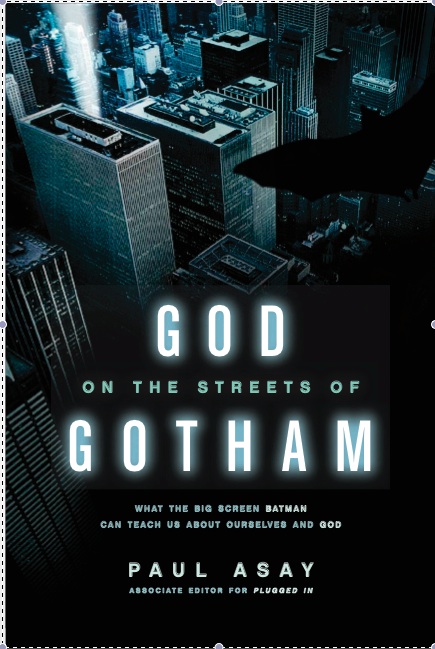
What gift could do all this? An e-copy of my book, of course. Tyndale is offering God on the Streets of Gotham: What the Big Screen Batman Can Teach Us About God and Ourselvesabsolutely free starting right now and lasting through Dec. 8. Naturally, you gotta have some sort of e-reader like a Kindle to actually read the book. But trust me: Spending a few hundred dollars on a tabletish-like device is a bargain for the wit and wisdom found in this book (if I do say so myself). It looks like it’s available through Amazon and the Apple bookstore and who-knows-where-else.
Of course, if you wanted to have a real, paper-and-ink copy of the thing, I’m sure Tyndale has a few of those available, too. But you’ll have to pay for those.
At any rate, I’d love it if you passed this bit of information onto anyone you think might be interested … or, as I say, give it as a gift. I’d like to think that it’d be a nice little addendum to a Dark Knight Rises Blu-Ray.
Alas, I cannot sign e-books. But, should you download one and wish to drop me a line, I’ll send back a picture of my signature that you can print out and paste on whatever nifty device you happen to use.
Best wishes, folks, and happy reading.

Half a Man? Hardly.

You’ve probably heard now that Angus T. Jones called Two and a Half Men—the show that made him a star—“filth” and pleaded that fans should never, ever watch the thing again. Now that he’s a committed Christian (he attends the Valley Crossroads Seventh-Day Adventist Church in Pacoima, Calif.), the sleezy humor that’s made Two and a Half Men so successful doesn’t really jibe with his newfound faith. 
You’ve also probably heard that Jones quickly issued an apology to the folks at the show: “Without qualification, I am grateful to and have the highest regard and respect for all of the wonderful people on Two and Half Men with whom I have worked and over the past ten years who have become an extension of my family,” he said, adding, “I apologize if my remarks reflect me showing indifference to and disrespect of my colleagues and a lack of appreciation of the extraordinary opportunity of which I have been blessed. I never intended that.”
All that caused some confusion: Does Angus (which has got to be one of the best first names ever) think the show’s filth or not? Is he trying to save his job (which pays him around $300,000 an episode)? Did he (as some have suggested) go off his rocker, just like another notable Two and a Half Men star?
So it was nice to read Christianity Today’s interview with Jones, which really did a great job of aligning both his rejection of the content in Two and a Half Men while still calling the show’s cast his “television family.” The interview (by Maria Cowell)  doesn’t showcase a guy who, thanks to his newfound religious convictions, has jumped off the deep end. Nor does it present us someone who has sacrificed his faith at the altar of his lucrative profession. In the interview, Jones comes across as someone who’s struggling with how to best follow Jesus in an imperfect world that, quite honestly, sometimes seems to demand compromises.
When he’s asked how his conversion is impacting his work, he says: 

It\’s a really interesting experience. I know I am there for a reason, but at the same time I have this strange twist of being a hypocrite: a paid hypocrite. That\’s the way I have been looking at it lately…. Even though it\’s my job to be an actor, I have given my life to God. I am very comfortable and firm in that, but I still have to be on this show. It\’s the number one comedy, but it\’s very inappropriate and the themes are very inappropriate. I have to be this person I am not.

Angus tells CTloads more during his interview: It’s worth the read, and you can find it here. But let’s face it: It’s not easy being an outspoken Christian in the entertainment industry. Just ask Stephen Baldwin, who had his own literal “come to Jesus” moment and who’s been fairly marginalized ever since.
“It just sounds like Angus is having an authentic experience with the gospel of Jesus Christ,” Baldwin said during a Good Morning America interview.  “It’s a serious thing. A real, true walk of Christianity is very difficult, quite radical. … He didn’t want to offend [show creator] Chuck Lorre or any of the people from the show or be disrespectful, but I think he authentically means what he says where he finds now if you hold up the content of his show to the Bible, what he’s saying is, ‘Now there’s a conflict for me.’”
Baldwin’s right. Christianity, if you take it seriously, is pretty radical. And it’s not just actors on a hit sitcom that feel the tension. I work at a Christian ministry, write about Christianity all the time and I still feel that tension every day. It’s inescapable. What should I be doing as a Christian? What should I be staying away from? Should I buy Powerball tickets or not? We know that our faith isn’t wrapped up in works or deeds, of course. But still, we want to please God. We want to set good examples for folks around us. We want to show that Christianity is more than just a dunk in a baptismal: It’s a game-changer.
I don’t know what’ll happen with Angus and his career on Two and a Half Men. But I’m rooting for the guy. Clearly, Angus T. Jones isn’t half a man anymore. He’s dealing with some pretty grown-up issues.

Character Counts. Really.

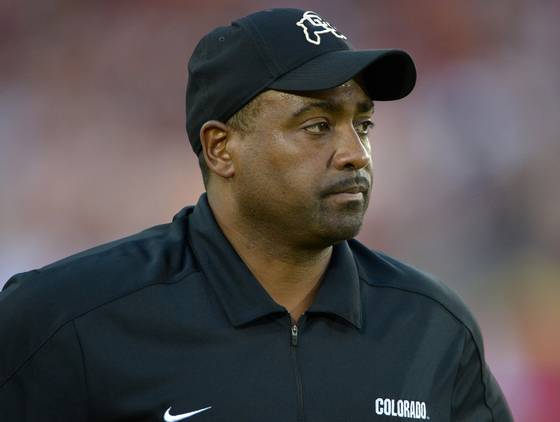
Jon Embree, who had been head coach for the University of Colorado football team, was officially let go after two terrible, horrible, no-good very-bad years. In two seasons, the Colorado Buffaloes won four games, and their 1-11 campaign last year was the worst in the school’s 123-year history.
But during a tearful news conference, Embree indicated that his teams had a lot to be proud of.
\”You had the highest GPA the last three semesters that this school has ever had in the football program,” he told them. “You stayed out of trouble. You guys represented yourselves well. You set a legacy and a standard, and as I told you guys when we\’re going through tough times, you\’re not judged by the scoreboard at the end of the day.
\”I was,” he concluded. “But you won\’t be.\”
And so on his way out the door, Embree pointed to one of the prickly dichotomies of our time—perhaps of most times: The tension between the ends and the means, between “just do your best” and “just win, baby.”
I’ve raised two athletic kids, and from the very beginning, I told them that sports were about friendships and teamwork and dedication. I don’t know if I ever explicitly ladled on the old, “It doesn’t matter whether you win or lose” cliché: I hope not. I have standards, after all. But I always hoped that the meat of that message got through.
Except it never really got through to me.
See, while my kids were pretty sportsy, I never was. The only game I liked in gym was dodgeball, because I was sure to get pegged in the game’s first 30 seconds and be able to sit down for the rest of the period. But even though I never could do sports, I’ve always loved them, and I loved watching my kids play.
Correction: I loved watching my kids win.
My son played on a competitive soccer team that won a lot. My daughter was in a park-and-rec league where most of the girls rarely knew the score—and a few didn’t know their goal.
My son was a defensive dervish, flying through the air to thwack soccer balls with his noggin … and if he sometimes crashed into an opposing player hard enough to rattle the guy’s teeth a little, well, that’s all part of the game.
My daughter was both an offensive and defensive force, jitterbugging through the opposition like—well, a jitterbug, I suppose—earning oohs and ahhs from the parents on the sideline and making her father smile with a sort of geekish intensity … until about the third game in the season (each season), when my daughter always mysteriously throttled back. My mid-season, she talked as much as she kicked, sometimes (gasp) complimenting members of the opposition.
I love both of my children with equal fervor.
Alas, I couldn’t say the same about their soccer games.
We like to win. We like our winners. Let’s face it: Much of our American culture, from our economy to our politics, from our GPA-obsessed educational system to our winner-take-all sporting competitions—reflect a preoccupation with winning.
And yet, you don’t see a lot of winners in the Bible. Oh, sure, many of our favorite characters wound up on top (and we would concentrate on those stories, wouldn’t we?), but often not before they had some devastating setbacks and heartbreaking losses. God, I believe, is a little like a diehard Cubs fan: He has a soft spot for loveable losers.
See, losing doesn’t just reveal our character: It builds it. Winning can be pretty distracting when you think about it: Knowledgeable jocks say all the time that “winning covers a multitude of sins:” And while they may mean that teams don’t bicker as much if they’re seeing success on the field and don’t necessarily notice that their punter’s horrible, I think the cliché has a deeper meaning: When we’re on top of the world, we can lose touch with our real priorities—what we’re really supposed to be doing and how we should be living. Who knows? If Joseph hadn’t been thrown into that well and just spent his whole life relishing his father’s special coat, he might’ve been a big jerk. If King David hadn’t needed to deal with Saul in his early days and his wayward son Absolom in his old age, he might not have gone down in biblical history quite so favorably.
When I first published my book, I think I got a little too caught up in the “win” of the moment: I imagined that it’d sell well and I’d earn royalties and, instead of thinking about what the book might do in people’s lives, I started thinking about all the remodeling products my book might help me buy.
Well, God on the Streets of Gotham has, to this point, not helped me do any hefty remodeling projects. It’s not sold well enough. But maybe that’s a blessing—if not for my fantastic publishers at Tyndale, at least for me. It helped me see the book better not as a tool for my own enrichment—a tool to help me “win” in the publishing world (whatever winning there looks like)—but as maybe something that’ll help a few people who read it, whoever and however many they may be.
My son’s team won a couple of championships, and those were great: But looking back, seeing him hoist a trophy isn’t that memorable. No, what I remember is the afternoon when Colin got thwacked in the face with someone else’s head. He got up, blood streaming from his nose and mouth, and never flinched—ready to defend the goal as he always had. And Emily, I don’t remember her soccer career as much as a cross-country meet held on a 40-degree night and in a heavy, freezing drizzle. She was never the fastest runner on the team; it wasn’t really a priority for her. But that evening, she ran for three miles, her glasses covered in ice and rain so she could barely see. She slipped twice, fell, and still crossed the finish line. She walked to the stands, water dripping from her hair and nose and chin, her teeth chattering.
A few other runners bailed that night, but not her. Not my daughter. She didn’t win, but she finished. She finished strong. And when I saw her in all her bedraggled misery, I was so proud I almost cried.
Embree’s right: At the end of the day, we’re not judged by what the scoreboard says. Winning, in real life, is much different. 

The Life of Pi: Being Thankful, Even for Tigers

From the very beginning, The Life of Pi (which opened yesterday) promises to be a story about God. But God, in the ethos of this beautiful movie directed by Ang Lee, is difficult to pin down.  
Pi is an equal opportunity believer. He grew up in the Hindu faith, so he considers himself as a Hindu. He’s wowed by Christ and Christianity after encountering a kindly priest, and shortly thereafter asked his cynical father if he could be baptized. But he loves Islam, too—or, at least, the sound of Islam as its prayers fall from his lips as he bows toward Mecca. And throughout the film, we get a sense that God—for Pi at least—is found less in one religion than in all of them. Or perhaps none of them. And if we read the end of the movie as cynically as possible (no spoilers here) God is who we want or need Him to be.
I’m not such a cynic, but it’s clear that The Life of Pi features some spiritual themes that are simply non-starters for Christians. Pi tells us that Hindus believe in a pantheon of 33 million gods, so one more maybe isn’t that big of a deal. But we Christians are told pretty explicitly that there’s just one way to reach God, and that’s through Jesus. If we try any other path, we’re just kidding ourselves.
But while I don’t think The Life of Pi gets the theology quite right, the way faith feels here is, I think, pretty beautiful.
The core story’s simple: After his ship crashes, Pi finds himself on a lifeboat with a giant Bengal tiger named Richard Parker—not an ideal survival scenario. But survive he does for more than eight months (according to the book; I don’t think the movie’s so specific), fighting hunger and thirst and storms and Richard Parker’s fearsome teeth until his boat comes to rest on the coast of Mexico.
But here’s the thing: Pi’s improbable survival story is just the merest shell of the real tale here. To say that The Life of Pi is about surviving for eight months with a tiger is like saying the meaning of marriage can be conveyed through a wedding album, or the birth of a son could be fully communicated through a Facebook post.
Pi isn’t just floating toward Mexico: He’s on a spiritual odyssey. In Pi’s mind, it’s not just he and Richard Parker in the boat. God’s with them, too—in the wind, the water, the world around them.
Throughout the film, we see Pi show his gratitude toward God for everything he’s been given—even in this horrific situation. He thanks God for the fish that flop in the boat and for the bit of pencil that allows him to keep a diary. He even expresses his gratitude for Richard Parker (even though the tiger would be unlikely to return the favor). \”My fear of him keeps me alert,\” Pi says. \”Tending to his needs gives me purpose.\” Without Richard Parker, Pi believes he would’ve died long ago.
It’s a beautiful reminder for us (particularly as we head into Thanksgiving tomorrow) that we have much to be thankful for, even if we feel like we’re stuck in a lifeboat ourselves, tigers breathing down our necks.
But Pi’s God is no comforting deity-in-a-box, a talisman for tough times. As C.S. Lewis’ Mr. Beaver might say, he’s not a tame lion, anymore than Richard Parker’s a tame tiger. As Pi’s voyage goes on, everything that Pi depended on—the boat’s store of food, his water collection devices, even that stubby old pencil—are swept away, leaving Pi seemingly with nothing: Nothing but the boat, Richard Parker and God Himself.
There’s something troubling but deeply profound in this—the idea of Pi being stripped of everything. The movie doesn’t tell us explicitly that God is the cause. But I think in some ways, it makes sense.
See, if there is an antagonist in The Life of Pi, it’s not the tiger: It’s man—or rather, man’s pride that, in the end, he can save himself.
Pi’s father is a man of reason. He calls all religion “darkness” and rolls his eyes at his son’s sincere religiosity. And while reason and science have its place (Pi says later he would not have survived his ordeal without his father’s instructive grounding) it can’t save you. Not really.
It’s telling that all his father’s plans (and his ship) sink above the Marianas Trench—the deepest, darkest part of the world. Despite the fact that the freighter cruises with (as we hear) the quiet confidence of a continent, its technology and bulk cannot withstand the spiritual storm. It goes down and Pi’s small lifeboat—perhaps representing the faith that Pi’s father mocked—is the only thing that stays afloat.
But in that boat, Pi still has tools that are, metaphorically at least, of his father. The life vests. The instructional book full of survival advice. The foodstuffs and cannisters of water. All Pi needed for survival appears to come from the muscle and ingenuity of man. Perhaps, had Pi survived with the aid of all that stuff, there might’ve been some doubt as to who Pi owed his life to: the authors of his survival book? Or the Author of all?
And so, in this merciless, metaphorical world, Pi needed to have everything stripped away. He was Noah in the ark, Joseph in the well, Lazarus in his tomb. As Pi’s strength failed and even Richard Parker grew feeble, it was clear whose hands they were in, whose mercy they depended on. And, when Pi thought he was as good as dead, he once again gave thanks.
Pi survived, of course: It’s no spoiler to say so. And in the end, we all heave a sigh of relief, knowing that Pi made it through such a horrific ordeal.
And yet, maybe we feel a little envious, too. Or, at least, I do. Not that I ever want to be stuck in a boat with a Bengal tiger, mind you … but in the midst of Pi’s terrible trials, he was surrounded by God’s power, His beauty, His love.
Celtic Christians used to talk about the thin places—spots in their world where the membrane between heaven and earth was thinner, where God’s presence could be more easily felt. I think that, perhaps, most of us have felt a “thin place” in our walks—moments where we could feel the very presence of the Almighty, and it took our breath away. Perhaps it was in a moment of prayer or tumult. Maybe it took you by surprise. I’ve been surprised like that a time or two.
In my own Christian walk, I sometimes feel a bit like Pi’s father. Yes, I have faith—but sometimes it’s a reasonable faith, a measured faith, one that doesn’t make too many demands. I fit that faith snugly with the rest of my life, like a can of crackers on a lifeboat. My faith becomes a tool, one of many.
And then, in the heart of a storm or in the glow of the dawn, I’m overwhelmed. Awed. And I remember that faith isn’t found in a box or in a building or even in a boat. It is not a thing to be used by me. No, it uses me. It is power and light and meaning. It is—He is—everything. And in that moment I, like Pi, find myself resting, helpless and loved, in the cup of His hand. 

Faith and Film: Lincoln

Steven Spielberg\’s Lincoln, along with Argo and The Life of Pi, is one of my favorite Oscar-type movies of 2012. Daniel Day-Lewis is predictably incredible. Sally Field shows the same talent that earned her two Academy Awards. My review for Plugged In can be found here, so I won\’t probably say too much more about it. The movie speaks eloquently enough.
But I did want to point you to a pretty interesting, related article I ran across on the Christianity Today website this morning, written by Lincoln scholar Ronald C. White Jr. White discusses President Lincoln’s mighty second inaugural address, parsing his frequent mentions of God and quotations of Scripture to show how he tried to use faith as a conduit for national healing.
“In a total of 701 words, Lincoln mentioned God 14 times, quoted Scripture 4 times, and invoked prayer 3 times,” White writes. “Lincoln\’s address provides a model for how Christians can speak of faith and politics together.”
I’d agree. Lincoln used language as well as any president, and the address shows Lincoln at his best, I think: Thoughtful, forgiving, wise. It’s fitting that Spielberg’s movie actually concludes with Lincoln reciting part of his address. There’s a weariness about it; an admission that the country, north and south, have been through a terrible trial unequaled in its annals. It stressed the commonality of the combatants, not their differences, and suggested the whole country was being judged by God (the sort of admission that would get a politician roundly mocked today). And yet, for all its sometimes gloomy realism, it offers a thread of hope—of redemption and healing.  Take a look:

Neither party expected for the war the magnitude or the duration which it has already attained. … Both read the same Bible and pray to the same God, and each invokes His aid against the other. It may seem strange that any men should dare to ask a just God\’s assistance in wringing their bread from the sweat of other men\’s faces, but let us judge not, that we be not judged. The prayers of both could not be answered. That of neither has been answered fully. The Almighty has His own purposes. \”Woe unto the world because of offenses; for it must needs be that offenses come, but woe to that man by whom the offense cometh.\” If we shall suppose that American slavery is one of those offenses which, in the providence of God, must needs come, but which, having continued through His appointed time, He now wills to remove, and that He gives to both North and South this terrible war as the woe due to those by whom the offense came, shall we discern therein any departure from those divine attributes which the believers in a living God always ascribe to Him? Fondly do we hope, fervently do we pray, that this mighty scourge of war may speedily pass away. Yet, if God wills that it continue until all the wealth piled by the bondsman\’s two hundred and fifty years of unrequited toil shall be sunk, and until every drop of blood drawn with the lash shall be paid by another drawn with the sword, as was said three thousand years ago, so still it must be said \”the judgments of the Lord are true and righteous altogether.\”
   With malice toward none, with charity for all, with firmness in the right as God gives us to see the right, let us strive on to finish the work we are in, to bind up the nation\’s wounds, to care for him who shall have borne the battle and for his widow and his orphan, to do all which may achieve and cherish a just and lasting peace among ourselves and with all nations.

We owe Lincoln a lot and we know it. His kindness and wisdom have become so inculcated in our national heritage that it’s easy to forget or ignore the flip side of Lincoln—the consummate, cagey politician that we see in Spielberg’s Lincoln. I think some people might be surprised, even shocked. Christians who demand their heroes be as pure as a newborn unicorn may, perhaps, think of Lincoln a little less fondly. But it’s good to remember, I think.
Jesus told his disciples to be “as shrewd as snakes and as innocent as doves.” And that bit of advice is worth remembering in any age.

Running: Good For the Soul (But Not For the Sole)

There are days when I think that, if God intended for man to run, he would’ve given them running shoes and hydration packs—or, at the very least, discount coupons to the nearest sporting goods shop.
           
Oh, I know there are runners out there who believe that running is God’s favorite athletic event. They’ll write race-centric Bible verses on their shoelaces before a big race (“1 Cor. 9:26!”) point out that John’s “beloved disciple” was faster than Peter and tirelessly quote Eric Liddell from Chariots of Fire.
           
“I believe God made me for a purpose, but he also made me fast,” Liddell tells us. “And when I run I feel His pleasure.”
           
When I run, I do not feel God’s pleasure. Though sometimes I think I hear his laughter.
           
God did not make me fast. He did not make me strong. He did not give me, frankly, any particular desire to run. And yet, like a bull determined to ballroom dance or a howler monkey set on making an American Idol appearance, I push myself to run almost every day. If running is God’s favorite sport—which, considering the pain involved, I don’t see how it could be—I believe I help keep the obligatory blooper reel stocked.
           
See, here’s the thing: I run, but I am not a real runner. I know what real runners look like and what they wear and how they run. I see them gracefully bounding like gazelles all over town, they of the wicking shells and multi-bottle hydration belts and bumper stickers that say “runner.” I am not of that type. I am, frankly, not capable of it.
           
I know runners who enjoy running. Almost all of them are insufferable.
           
My boss runs every day at lunch without fail: If there’s a snowstorm, he has his administrative assistant dig a path for him as he runs. Both invariably come back into the office with massive smiles plastered across their faces, apparently thrilled to be in such simultaneous proximity to nature, to God and to frostbite. Running makes him happy, he tells me. It keeps him centered, he says. It gives him time to contemplate God, to pray. I try to pray, too—and sometimes find myself whispering involuntary prayers during particularly long runs: “God,” I say, “Please, if it’s in your will, help me not to throw up all over my new running shoes. Help my kneecaps stay attached to whatever they’re supposed to be attached to. Please, keep them from exploding and hurting innocent bystanders.”
           
I have a friend who runs. “The first hour is for the body,” he tells me. “ The second is for the spirit.” Perhaps—but only because your body is probably close to dead by the end of the first hour, so really that’s all that’s left.
           
My own daughter loves to run. There are few things she’d rather do. I’ve always known there was something wrong with that girl.
           
I rarely enjoy running. I think I’ve experienced what they call a “runner’s high” about twice in my life, and both times it was followed by the lesser-known “runner’s low,” in which your legs are so sore that you have to scale staircases by sitting on them and moving your rear upward, step by step.
           
I run not for the sake of the run, but for the sake of the meal afterward. I run so I can eat like a famished billy goat and still fit into my five-year-old pants. When I’m training for a marathon, I’ll go on long weekend runs early in the morning. And then, as an after-run reward, I’ll zip over to McDonald’s and buy myself a couple of Sausage McMuffins as a reward.
           
Oddly enough, I dofeel God’s pleasure in Sausage McMuffins. Though there’s a chance that feeling might just be the cholesterol lodging inside my arteries, causing a certain lightness of head.
           
Why run, you ask? Why not just get yourself roomier pants?
           
Habit, I suppose. If I don’t run, I feel guilty. And as many Christians know, guilt can be a powerful motivator. I ran my first marathon about 10 years ago because a good friend of mine talked me into it. And, after having geared nine months of my life toward covering a ludicrous distance of 26.2 miles in a matter of hours—on foot—it’d feel wrong to just say, “well, that’s that. Where’s my barcalounger?”
           
And then there’s this, too. While I don’t particularly like running—that is, putting one foot in front of the other about half a million times—I like what comes with it. I like the discipline it asks of me, because I am deeply undisciplined. I like the sacrifices it requires, because I am often selfish. I even find I like the pain—not in a masochistic sort of way, but because with the aches and soreness that sometimes accompany running, I know that I’m doing something with my body. I’m not wasting it. And that’s the strangest thing about running for me. I find that if I don’t do it for a week or two, I feel a little sick. I find that I miss it: the regimen, the discipline, even the pain. As tedious as some of my runs can be, the whole they leave when they’re no longer there is worse.
           
“Consider it pure joy, my brothers, whenever you face trials of many kinds, because you know that the testing of your faith develops perseverance,” wrote James in his New Testament book (James 1:2-4). “Perseverance must finish its work so that you may be mature and complete, not lacking anything.”
           
“Now I rejoice in what was suffered for you, and I fill up in my flesh what is still lacking in regard to Christ’s afflictions, for the sake of his body, which is the Church,” the apostle Paul wrote to the Colossians (Col. 1:24).
           
My little pavement-pounding regimen is certainly not a test or trial of faith. When I run, I am not suffering for the good of the Church. I don’t want to prop my aches and pains to the real tribulations people suffer both for their faith and in the midst of faith. But in a small (perhaps very small) way, I think I’m a little closer to understanding how someone can be joyful—truly joyful—in the midst of trials and pain. And it helps me grasp the nature of faith a bit better … or, at least, how I sometimes experience faith.

Siriel, the Make-Believe, Answer-Everything Christian App

According to a new survey from the Pew Forum on Religion and Public Life, one out of every five Americans now claims to have no religious affiliation.
Now, there’s been a lot of discussion about the study—what it means, what it doesn’t mean, how accurate it is—but for me, it made me think about how great it’d be if there was some sort of one-size fits-all, answer-everything Christian app.
I’m not talking about an app that gives you encouraging daily Bible verses or walks you through Leviticus or offers you coupons allowing you to attend your next church service for free. Those are great, but I’m talking about an app that would act as a spiritual Siri or something—a sort of all-purpose pastor on call, answering all your immediate spiritual needs.
Say you wanted to know whether it’d be OK to omit your annoying Uncle Harry from your Thanksgiving Day gathering. The app (should we call it “Siriel?”) would tell you whether you, as a good Christian, could in good conscience do such a thing. Or maybe you’d really like to see Paranormal Activity 4 (heaven help you) but worry that maybe God wouldn’t like you going to horror flicks. Well, Siriel would tell you whether horror movies would ever be allowed in a Christian’s entertainment diet—and if so, which ones. (The Exorcism of Emily Rose might be OK. The Sawmovies, not so much.)
It could be theological: No longer would devout fundamentalists need argue over pre-millennial vs. post-millennial interpretations of Revelation. Siriel would render a quick and chipper verdict. It could be sensitive: Ask it why a good God would allow so much pain in the world, and it’d have a ready answer. “Are you speaking generally, or are you referring to your recent breakup with Mindy, that no-good restaurant hostess?” it might say. It might even offer voting advice.
And, if it noticed that your spiritual life was in some jeopardy—say it noticed you were walking into a Saw movie with Mindy—it’d set off some sort of officially licensed alarm to gently usher you back to the path of righteousness. Linda Ronstadt’s “You’re No Good,” perhaps, or AC/DC’s “Highway to Hell.”
And, if we didn’t like Siriel’s advice—if it felt just a little too judgmental for our tastes–maybe we could adjust the settings so that it might go a little easier on you.
An app like that would solve a lot of problems, wouldn’t it? Wouldn’t it be great if something like that could tell you how to live your life? We’d never have to think again.
Just as God gave us that pesky sense of free will—giving us a choice as to whether to follow Him or not—he made the act of following Him really tricky at times. Jesus told us to love our enemies, but He might not’ve had Uncle Harry in mind at that very moment. Paul might’ve encouraged us, in Philippians 4:8, to focus on whatever is pure and virtuous and noble and whatnot. But he also said in 1 Corinthians 10:23 that everything’s permissible. So where does that leave Saw?
The thing is, Christianity is hard. It’s not just hard to act like a Christian (though that’s plenty hard). Sometimes, it’s hard to know just how a Christian would act. It’s as if God wanted us to struggle at times. It’s as if he wanted us to think deeply about this stuff.
It’s as if He thought that, grappling with the mysteries of life might help us draw closer to Him. It’s as if He was really serious that we should put our trust in Him and that boundless grace and mercy—to follow His will as best we can but to understand that we won’t get everything always right … and to know that, sometimes in spite of ourselves,  that our lives are still cupped in his loving hands.
Which, ironically, makes this hard faith of ours quite simple as well.
But paradox is a hard sell. Any PR agency or focus group could tell you that. Mystery and wonder and struggle (particularly struggle) won’t do much to convince those 20 percent of religiously unaffiliated American to give Christianity a go.
No, what we need is an app.