Oscar Meets God

Experts say that the United States is growing ever-more secular. Studies and polls back that up. About 18 percent of us claim no religious affiliation these days, up from 15 percent in 2009.

But those numbers don\’t tell the whole story. Many of those non-affiliated Americans (colloquially called \”nones\”) believe in God. They pray, sometimes daily. Evidence of a stubborn sense of faith and religion is found everywhere in our society–including in our entertainment. And when I look at the films nominated for the Academy Awards Best Picture, I have to wonder: If we Americans are growing less spiritual, why are our films growing more?
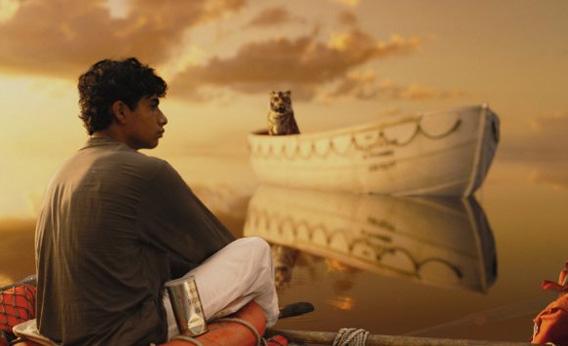
Pi, from Life of Pi, might be forced to call himself a \”none\” if asked–only because there\’s no box to check for \”all.\” He claims to be a Hindu-Christian-Muslim, seeing God everywhere. He is, I think, a more accurate reflection of where American faith is moving. And it makes sense–if not theologically, at least culturally. We Americans like to think of ourselves as having no boundaries, no restrictions. We\’ve been taught from the cradle we can do anything we set our minds to. So why restrict ourselves to  one religion? Why follow one path when we can follow all?

As a pretty traditional Christian, I can think of lots of reasons why one path is better … but that\’s not really the point here. Pi still manages to express, I think, both the beauty and power of spirituality–something most of us feel at times, regardless of  belief. We\’ve been born with a desire to reach for God. God gave us that desire. And Pi conveys that desire better than perhaps any movie I\’ve ever seen.

I think that Beasts of the Southern Wild is another manifestation of \”none\” spirituality. Its worldview is very much secular. The main characters consider themselves–even pride themselves–on being \”beasts.\” They\’re survivors in a beast-eat-beast world, in marvelous union with each other and the world around them. There\’s no talk of God, no consideration of heaven. Heaven for them is in the rural backwoods \”bathtub\” that 6-year-old Hushpuppy and the adults around her call home.

And yet, the movie is still deeply spiritual–full of cosmic portent and divine energy. This is myth on a grand scale, full of morals and monsters and universal force. It suggests that even those who don\’t pay homage to God, any god, still feel that spiritual tug. Says Hushpuppy:

When it all goes quiet behind my eyes, I see everything that made me lying around in invisible pieces. When I look too hard, it goes away. And when it all goes quiet, I see they are right here. I see that I\’m a little piece in a big, big universe. And that makes things right. When I die, the scientists of the future, they\’re gonna find it all. They gonna know, once there was a Hushpuppy, and she live with her daddy in the Bathtub. 

In almost every movie nominated for a best picture Oscar this year, God is somewhere in the picture. Sometimes you can feel His presence only at the edges. But sometimes He fills the screen. In Zero Dark Thirty, our hero, Maya, seems as hardened a secularist as there is. And yet she confesses that she feels as though she was \”meant\’ to track down Osama bin Laden–a sacred calling from an unknown source. In Lincoln, our title character believes that slavery is our nation\’s greatest sin and he means to expunge it once and for all–even as others suggest that keeping other people in bondage is somehow God\’s will. In Django Unchained, there\’s an implicit understanding that slavery is evil–a true evil that transcends and supersedes cultural, societal purely human-based whims.

And then we have Les Miserables–an explicitly Christian parable from beginning to end. We see the conflict between the Pharisaical Inspector Javert and the grace-filled reality of Jean Valjean–along with perhaps revolutionary France\’s version of the \”nones\” in Mr. and Madame Thénardier. As Javert and Valjean joust over what\’s right or true, the Thénardiers are more concerned with what\’s in it for them–a worldview that while not at all attractive in Les Mis, has some unapologetic adherents today.

As a Christian movie reviewer, sometimes I hear readers talk about how \”godless\” Hollywood is. And it\’s true that the entertainment industry doesn\’t produce many films that cater to conservative evangelical Christians. But truth be told, Hollywood is far from godless. It seems to me that filmmakers are searching–and sometimes finding–God all the time.

Hail to the Chief: Presidents in the Movies

How did you celebrate Presidents\’ Day? If you celebrated it like I did, you worked. Not many people get Presidents\’ Day off anymore, it seems. But, since the President doesn\’t seem to get the day off himself, I guess that\’s OK.

If I had gotten a holiday, though, I would\’ve almost certainly probably celebrated it by watching a movie with a president in it. And I would\’ve had plenty to choose from.

According to the Internet (which is, as you know, never wrong), at least 180 have been made that feature American presidents (not counting fictional presidents, like Thomas J. Whitmore from Independence Day). Of the 44 presidents the United States has had thus far, 38 have gotten their own movies–or, at least, some fictionalized cameos. Abraham Lincoln has addressed the most screen time: A total of 25 actors in 28 separate movies have played our 16th president, from Joseph Henabery in D.W. Griffith\’s classic (but horrifically racist) The Birth of a Nation to Tom Amandes in this year\’s Saving Lincoln (now in very limited release). He\’s backed up Bill and Ted in an Excellent Adventure and spent some time as a vampire hunter earlier this year. And in a week, doppelganger Daniel Day-Lewis could take home an academy award.

It got me thinking about my favorite Presidents–not politically, but cinematically. Here, in the order you would\’ve found them in your American History class, are my top five.

John Adams (Paul Giamatti), John Adams (2008): In the true spirit of American politics, I\’m cheating right out of the gate. John Adams was a miniseries, not a movie–but it\’s simply too good to not list here. The seven-part HBO miniseries eventually bagged 13 Emmys (the most ever by a miniseries) and brought to life the guy who, historically, had the misfortune of getting lodged between George Washington and Thomas Jefferson–two presidents who have their heads on both Mount Rushmore and the spare change you\’ve got in your pockets.

Abraham Lincoln (Daniel Day-Lewis), Lincoln (2012): I\’ve already said a thing or two about this movie. But let me say one thing more: While Day-Lewis has earned plenty of accolades for his work before, this role may make his memorable turns as Christy Brown (My Left Foot), Bill the Butcher (Gangs of New York), Daniel Plainview (There Will Be Blood) and all the rest look like mere preamble to this towering achievement.

Ulysses S. Grant (Jason Robards), The Legend of the Lone Ranger (1981): OK, so this might not have been the highlight of Robards\’ career, nor was it probably that great a movie. But I saw it when I was an impressionable kid, and for two weeks I was running around the house loading my toy gun with silver bullets. Robards\’ Grant seemed like an awfully good president to the little kid me, and as such, I\’ve never fully believed all those nasty things historians have said about him afterwards.

Richard Nixon (Frank Langella), Frost/Nixon (2008): This movie made about $27 in theaters and was still nominated for a Best Picture Academy Award. The $27 (actually, about $18.6 million) is easy to explain: Who wants to watch a whole movie about two people talking? The Academy Award nom is also pretty easy to explain: Never, since the original Lincoln-Douglas debates, have two people talking been so riveting. Langella was a favorite to take home the Oscar for Best Actor … but you can\’t really argue with Daniel Day-Lewis taking the award home for his turn as Daniel Plainview in There Will Be Blood, can you?

George W. Bush (Josh Brolin), W. (2008): Wow, 2008 was a big year for presidents, apparently. While staunch supporters of Dubya weren\’t thrilled with this Oliver Stone docu-comedy, I actually thought it was more even-handed than it could\’ve been. Brolin\’s turn as Bush 43 was a bit sympathetic, a bit sad … and undeniably a very effective acting job.

Giving Up House Hunters for Lent

I haven\’t started shaking yet. I\’ve not begun to whine (or, at least, not too much). But hey, it\’s only been two days. The worst is yet to come. Giving up HGTV for Lent will not be easy.

I know that most people, when they observe Lent at all, make more impressive-sounding sacrifices. They give up alcohol or fast food or some horribly bad habit. I was once in a play where one of the main characters gave up electricity.

I might be the only person who\’s going on an HGTV fast during this holy season–though it seems like, according to a Christianity Today story, almost everyone on Twitter is giving up something. Many  are giving up Twitter–the No. 1 ironic sacrifice being made by the world\’s tweeting masses. (At least the Twitterverse will immediately know if there\’s any backsliding.) Chocolate was No. 2 (a particularly cruel sacrifice, considering Girl Scouts are hocking cookies even as I type), followed by swearing, alcohol and soda.

At No. 11? Giving up Lent.

Since I don\’t swear and just gave up regular Mountain Dew earlier this year, I decided to give up something that is truly a sacrifice: Thinking about houses.

This is not a problem most folks have, I don\’t think. But a couple of years ago, my wife, Wendy, and I stumbled across this show called House Hunters, wherein people–get this–hunt for houses. They\’re looking to move, see, and the show gives them essentially three houses in their price range from which to pick. For thirty minutes, they ogle granite countertops and whine about back yards and occasionally throw small fits over the color of the bedroom walls. And then they pick a house and live in it, presumably, happily ever after.

This may not sound like an extreme vice, perhaps. But here\’s the thing: Wendy and I got sucked into the HGTV vortex, and rarely does our dial move off the network these days. We watch The Property Brothers. We watch All-American Handyman. We watch every sort of House Hunters show HGTV decides to put on: House Hunters International. House Hunters on Vacation. Island Hunters. If HGTV execs decided to unveil a House Hunters: Unfinished Basement edition, Wendy and I would be on our couch watching the thing, chatting with one another about the house\’s unfinished concrete walls.

And here\’s the thing: I think all that couch-bound house-hunting we\’ve done has made us want to sell our house–a house that, for 13 years, has served us pretty well. We think, \”Oh, wouldn\’t it be nice to have a back yard like we saw on House Hunters?\” Or \”You know what our house could use? An indoor pool, like the one Mandy and Bob looked at when House Hunters went to Reno.\”

Now, this isn\’t to say we won\’t or shouldn\’t get another house eventually. Maybe we should. But that\’s not really the issue: For me, these HGTV shows do something a bit insidious. They make me dissatisfied with a living arrangement that\’s worked pretty well for more than a decade. They make me want more space or higher ceilings or shinier countertops–none of which I need or would use or, in some cases, even want. Or I wouldn\’t have wanted it had I not seen House Hunters.

And suddenly, I\’m thrown into a position of telegenic envy. I can\’t fully appreciate all the wonderful gifts that God has given me because I want something else.

For me, giving up something for Lent is about giving something–whatever it might be–that interferes with our relationship with God. It doesn\’t have to be inherently bad stuff. It\’s just stuff that gets in our way. And in our consumeristic culture, very often that stuff is, literally, stuff. In my case it\’s tile floors or ocean views. For other people, it might be a new dress or new car or the very latest video game.

So for the next six weeks or so, I\’m giving up HGTV. I\’ll have to watch something else at night: A basketball game, maybe, or a cheesy Syfy movie. Or maybe we\’ll check in with Ancient Aliens on The History Channel. That\’s always good for a laugh. But House Hunters will have to make do without us for a while.

Hey, I wonder what\’s on the Do-It Yourself network?

Do Atheist Churches Have Potluck Suppers?

Stop me if you\’ve heard this one: A couple of comedians start an atheist church in London. And–get this–lots of people come. So many that they have to send overflow atheists to a pub around the corner to watch the service via computer stream. Now they\’re thinking about creating a YouTube channel.

Funny? Well, maybe not in the same sort of way that Jon Stewart is or  The Simpsons used to be. No one, as far as I know, is laughing about the success of The Sunday Assembly–least of all the comedians who created it. After all, they\’re now looking at cutting back on their comedy gigs to become full-time atheist pastors.

But it is funny as in … well, curious. I\’d imagine many atheists turned to atheism specifically so they\’d never have to go to church again.

“We’ve had a pretty positive response from people of faith. Hardly anyone seems to be saying anything negative,\” Assembly co-founder Pippa Evans told the New York Daily News. “Atheists, in fact, seem to be the ones most upset with us because some say we’re creating a religion.”

Yeah, about those upset atheists? They may have a point.

Not to suggest that atheism is a religion, exactly. Sure, they share some similarities. But in all my years as a religion reporter, I never once attended anything like an atheist church, and I can\’t imagine that one have much in common with the Methodist congregation down the street. There\’d be no scripture readings–though perhaps someone read passages from a Christopher Hitchens\’ book. Instead of hymns, congregants would be forced to sing John Lennon\’s \”Imagine\” over and over again. (It\’s a very pretty song, but I, ahem, imagine it\’d get old after a while.) Prayer time would be right out. The only thing left to do in atheist church, really, would be to listen to the message itself (inspiring, I\’m sure) and pass around the offering plate.

But there\’s gotta be something curious happening at London\’s Sunday Assembly–something unexpected and, yeah, maybe a little funny. Some London atheists, it seems, felt like they were missing something in their non-believing lives: A strange itch that going to church, somehow, is able to scratch.

It\’s arguable that those attending the Sunday Assembly were just looking for community–a yearning that all of us, regardless of what we believe, have. We all like to talk with people who share our interests and outlooks. We all like to feel like we\’re a part of a larger body, a piece of a movement or something something greater than ourselves.

There\’s power in community. Sometimes, it can be a terrible, awful power, as we\’ve seen both in religious and secular circles. But very often, that communal energy can be harnessed for great good–something that the folks at the Sunday Assembly understand. The Daily News reports that last week, congregants heard a message on the theme of volunteerism–how important it is to help out folks in need.

And that\’s great. Awesome, really. But … funny.

See, altruism, as far as I\’m aware, really germinated in the soil of religion. This is not to say that atheists can\’t be very generous or that religious folks can\’t be very selfish. But the concept of altruism–volunteering, giving to the needy, etc.–historically finds its first and (if I may say so) its most beautiful expression in the context of faith. All the great major religions embrace altruism, and have for  thousands of years. If you believe the Bible, God was talking about providing for widows, orphans and aliens when Moses and the Israelites were still tromping around the wilderness.

Altruism and charity are dependent, I think, on the concept of good and evil–a sense of right and wrong that goes beyond anything that science can explain. If we\’re all merely creatures of evolution, with our survival predicated on our strength and cunning and swift adaptation, it doesn\’t make a lot of sense to give away our time or money or energy to someone who can never pay us back. And yet many of us–whatever we believe–feel that altruistic impulse deep inside us: The desire to do \”good.\” The longing to help when and where we can.

Where does that longing come from? Science, I don\’t believe, holds the answer to that question. That answer is found elsewhere.

Perhaps that longing, and others related to it, is part of the subconscious pull of the Sunday Assembly–why people give up an hour or two of their weekend to gather with people of like minds, to raise their voices and reach for a transcendent reality they say they don\’t believe in. Perhaps they know that they\’re merely products of evolutionary chance … and yet they somehow sense that there\’s more to it than that. Perhaps they have purpose beyond their biological makeup, a calling beyond chemistry. Perhaps they were meant to be. And the church–excuse me, the Assembly–gives them just a hint of that deeper meaning.

Funny, isn\’t it?

Paperman: God is My Paper Airplane Co-Pilot

Cartoons should be seen, not heard.

That seems to be the philosophy for short animation films these days. \”Forget dialogue,\” animators seem to say. \”Let\’s tell a story with just pictures and movement and maybe a little music. Who needs those stinkin\’ words?!\” 
And they\’ve got a point. I mean, the folks who craft these moving works of art are … well, artists. They\’ve been trained to talk through image. And when we see Pixar\’s amazing short films (most of which are wordless) or \”The Master,\” which I blogged about last year, words seem superfluous–even distracting. These artists understand what we sometimes forget (particularly us writers): The most profound, most powerful moments often come unaccompanied by syllabic flotsam. Words just get in the way.
Take a look, for example, at \”Paperman\”–a short by Disney that\’s been nominated for an Academy Award for Best Short Film (Animated). Just six minutes long and presented in gloriously rich black and white, it still conveys a world of emotion.
Nifty, ain\’t it? It needs not a single word of explanation but is still filled with promise and regret and tension and magic. No back story needed. No subtext required. It\’s a  gem to be appreciated simply for what it is.
And yet, it also sticks with you. And maybe in its wordless way, it propels you along an unexpected line of thinking.
\”Paperman\” obviously wasn\’t designed to be a spiritual illustration. And yet it could be–on the strange, mysterious way in which some of us feel God works in our lives. 
Look at the man again, throwing his pile of paper airplanes. All his work and toil (and perhaps painful papercuts) seem to come to naught. But then, the airplanes themselves seem to pick up the cause, mysteriously forcing these two would-be lovers together. The planes lead, encourage, even flirt. And when the man seems bent on going another way, they physically force the guy to move toward his destiny.
I\’ve interviewed a lot of folks who feel as though God has \”told\” them what to do–that He pushed them to perform a certain task or take up a certain job or give a certain gift. \”I didn\’t want to do it,\” they sometimes tell me. \”I had no intention of doing it. But it became so obvious that that\’s what God wanted me to do.\” It\’s as if God\’s paper planes surrounded them and pushed them along.
Now, I\’ve always treated these stories with a certain skepticism, maybe because I\’ve never really been there–never felt so obviously \”pushed\” by God. I have no burning bushes or talking donkeys in my backlog of memories. I\’ve never heard God tell me to do something. Never felt Him manipulate me like a Ouija pointer to a pre-determined course. Oh, don\’t get me wrong: I\’ve felt God\’s presence in my life (or I feel as though I\’ve felt Him), but when it comes to big decisions–to leave an old job or capitalize on a new opportunity or take a grand leap of faith–God grows silent. 
Or perhaps not. Maybe He, like the film \”Paperman\” itself, speaks to me without speaking  … His influence quiet but inexorable, graceful but unmistakable. After all, He knows us all so well. Maybe He knows (just like my wife knows) that I don\’t like to be told what to do. Maybe He speaks to us in tailored language, communicating what we need to hear in ways we best understand. 
Maybe God knows that, for some reason, I need my illusion of control. That I need to make my paper airplanes. And that the beauty of faith for me isn\’t so much in certainty–a call from God by bullhorn–but in mystery. To watch my planes float through the air, wondering where an unseen hand might take them. 

Warm Bodies: Spiritual Zombie Love

It may say something about me—and something not altogether good—that Warm Bodies was not the first zombie-themed romance I’ve seen It might not even be the fifth. Or tenth. But this picture, based on a novel by Isaac Marion, may be the best.

Warm Bodies isn’t much of a horror flick. Rather, it’s Romeo and Juliet with a dash of rigor mortis and, of all things, a happy ending. Instead of people poisoning or stabbing themselves, some of the main characters spring back to life.
And that’s great. Because really, who wants to see zombies give Shakespearian speeches as they try to kill themselves (again)?
 It’s also potentially quite spiritual, if you’re looking for that sort of thing. Sure, the makers of Warm Bodies probably didn’t have a Christian metaphor in mind when they made the thing, but I’ve always felt that zombie narratives and Christianity have quite a bit in common. After all, our whole walk of faith is predicated on finding life in the midst of death. Jesus raises several people from the grave, and He’s often telling us that we’re actually the zombies—not fully alive until our hearts are kick-started by the grace of God. And the main premise of the movie (you can watch the trailer below) is that love can bring even zombies back to life. That’s not just sweet. It’s pretty profound.
But the thing that struck me even more in this film was how the zombies learned to love in return.
Our two main characters here are R, a angst-riddled zombie, and Julie, the still-living daughter of a post-apocalyptic general. When the two meet, R’s priorities immediately change. Instead of his life revolving around grunting and shambling and eating people, he’s all about Julie—her wants, needs, and comforts. When Julie knows she has to go back to her own people, R dutifully escorts here—even knowing that he’ll likely lose her. And when he learns that a bunch of “boneys” (zombies that are beyond redemption) are after her, R sneaks into the human compound to warn her—even though it could well mean his death. Or second death. Or whatever.
R’s love goes beyond just romcom sweet and sentimental. It goes beyond even sacrificially heroic. It touches a pure, biblical manifestation of love. Take a look at what Paul says:

Love is patient, love is kind. It does not envy, it does not boast, it is not proud. It is not rude, it is not self-seeking, it is not easily angered, it keeps no record of wrongs. Love does not delight in evil, but rejoices with the truth. It always protects, always trusts, always hopes, always perseveres. … And now these three remain: faith, hope and love. But the greatest of these is love. (1 Cor. 13: 4-7, 13)

I love my wife. I love my kids. But does my love always patient, always trusting? No. But R’s love is. He’s never rude. He’s never self-seeking. But does he trust? Does he persevere even in the worst of moments? Yes. R seems to live in a world where there is very little faith, very little hope. But he loves. And as it turns out, that’s enough.

Running on Faith: Dodging Rattlesnakes

My daughter and I are training for a marathon–my fifth, her first. She\’s pretty excited about it, but it\’s early yet. When she\’s running 15 miles at a pop, it might sap her enthusiasm a bit.

Still, she intrinsically enjoys running more than I do. For me, going out for a run is a duty. For her, it\’s a joy. And she did run cross country throughout high school (she\’s a college freshman now), so she knows a thing or two about putting on the miles. In fact, she\’s teaching me quite a bit.

For instance: Never pick up a rattlesnake while running.

This was sage advice she picked up in high school. One of her cross-country cohorts (a guy, naturally), was chugging down a pathway when he saw a rattlesnake lying on the side of the road. \”Look, a rattlesnake!\” he said. And he stopped, reached down and picked it up.

Now, we all know that youth today are, in lots of ways, much smarter than I was growing up. Their lives are full of technology undreamed of back when I was in high school, when cell phones were the size of microwave ovens and people were still hanging out at video arcades. I think they\’re dealing with way more pressure, too–from school, from their peers, from their parents. When I talked with my kids about what they were learning in high school, I often felt that I needed a translator.

But maybe  we Gen-Xers do have one thing over today\’s Millennials: We know better than to pick up a rattlesnake.

The guy was bitten, of course. He was whisked off to the hospital and was just fine: The snake hadn\’t pumped any venom into the guy. The rattler, I\’m guessing, was so flabbergasted that someone would dare to pick him up that he hadn\’t gotten his poison pumping yet.

It seems that cross country running is fertile ground for disturbing stories with important morals. One afternoon, members of the team were stalked by a mountain lion for a couple of miles. Moral: Don\’t run alone. Mountain lions are less likely to attack people in pairs. (I guess a secondary moral might be to run with someone who\’s slower than you, just in case a lion does attack). On another afternoon, a girl broke her leg from taking an awkward step. Moral: Don\’t run alone in case you break your leg. Forget Aesop\’s Fables: Try Adidas\’ Fables.

Most cross country morals, I gather, culminate in some variation of \”don\’t run alone.\” Even the rattlesnake story had a similar addendum. While the primary moral was, of course, to not pick up rattlesnakes, the secondary lesson went, \”But if you do, be sure you do so while running with someone else so you\’ll have someone who can drag your stupid self back to the car.\”

Our Christian run, I think, has a similar moral: Don\’t do it alone. When I was a younger–about the same as my daughter is now, actually–I thought that faith was something best done alone, through prayer and reading and introverted monkish pursuits. And it\’s probably no coincidence that that was the time when I felt the least connected with my faith. It\’s too easy to stray off the path when you\’re running alone. It\’s too tempting to do something dumb. You\’re an easier target. You\’re more prone, perhaps, to pick up a rattlesnake along the way.

With all due respect to all those saintly hermits of yesteryear, Christianity was always meant to be done in community. \”For where two or three gather together as my followers, I am there among them,\” Jesus tells us in Matthew 18:20. Most of Paul\’s letters weren\’t to individuals, but to churches–folks who joined together in order to worship communally. Hey, this Christian faith of ours can be tough at times–to tough to do by ourselves. It\’s nice to have company along the way: People we can trust to keep us on the right track, people who will be with us when things inevitably go wrong, people just to talk with: Not just about faith, but about anything. We need people to help us smile and laugh just as much as we need people to wipe away our tears.

I\’m a recluse at heart. It\’s not in my nature to really seek out running partners–either for my actual runs or for my more metaphorical jog of faith. But whenever I do, I\’m grateful when I find someone to share the journey. It\’s nice to know there\’ll be someone around if I should, y\’know, a rattlesnake attack.

Star Wars: Bad Prequels (But Better Theology?)

I was listening to the Strangers and Aliens podcast while running this afternoon, and I was thrilled to hear them discussing one of my favorite topics: Star Wars.

The gist of the podcast was discussing all the many questionable stepchildren that the success of Star Wars spawned, slating them as either of \”the light side\” or \”the dark side.\” The revival of the Star Trek franchise was given light-side status, while Moonraker–James Bond\’s worst movie ever–was justifiably banished to the Dark Side. But the topic really got me thinking about another massively important product of Star Wars: Me.

I was 8 when Star Wars came out (that\’s be Star Wars IV: A New Hope to some of you), and George Lucas\’ little creation was nothing short of a revolution to my little world, which before then had primarily revolved around reading, collecting rocks and smashing glass. (I grew up in Taos, N.M., which, despite being very artsy then and now, was a pretty boring place for non-artsy, non-sportsy kids.)

But when I saw Star Wars, my whole life changed. I became obsessed with the movie and forced my parents to take me to see it five times (remember, these were the days before we, in Taos, had ever heard of a VCR). I dreamed I was Luke Skywalker. We were too poor to buy Star Wars action figures, so I made my own out of cardboard. (My Millennium Falcon was the most pitiful-looking spacecraft ever.) It was the first movie I ever fell in love with.

My fascination with Star Wars was tolerated around my house for the most part. And, several years later, when an expert on the Star Wars universe came to visit the family church about the time Return of the Jedi was released, I found myself looking forward to going to church for the first time in years.

Imagine my disappointment when the guest speaker announced that Star Wars–my beloved, earth-shaking franchise–was awash in dualism and eastern spirituality and thus incompatible with Christianity.

These theologians. Can\’t they leave anything alone?

I suppose my research in trying to prove this cat wrong might\’ve been the impetus to my long, weird and still puzzling road to that of a Christian movie reviewer. Now I\’m the guy who warns Christian parents about Star Wars\’ quasi-spiritual underpinnings–though I\’d like to think I\’m a bit more open-handed about it all. \”In The Force, we can see hints of Zoroastrianism and Taoism,\” I might say. \”But man, are those light-sabers awesome or what?!\”

Truth is, I have a hard time believing that watching Star Wars is a faith-shaking event for most of us (the 390,000 U.K. residents who list \”Jedi\” as their faith of choice notwithstanding). But still, the religiously wonky side of me did appreciate the spiritual underpinnings of the recent prequels, even if the movies themselves were pretty meh. Yes, the Force in the Star Wars universe still, as Yoda says, \”surrounds us and binds us.\” It has its light side and dark side. But the core story we see in the prequels (The Phantom Menace, Attack of the Clones and Revenge of the Sith) is an echo to the Fall of Adam and Eve.

Anakin Skywalker is tempted by the future emperor and his powerful \”Dark Side\” of the force–a form of forbidden knowledge, really–just as Adam and Eve were tempted by the fruit from the Tree of Knowledge. Both of these deeply rebellious acts set narratives in motion that required a miraculous intervention to fix. And even though I hated Jar Jar Binks as much as anyone, I found the redemption of Darth Vader–in some ways, a stand-in for all us miserable sinners–more moving because I better understood his backstory.

There\’s more to say on this topic, of course. But that\’ll have to wait. But now you have one more thing to curse George Lucas for: The creation of an overly interpretive, religiously oriented movie reviewer.

Armstrong and the Power of Penance

Lance Armstrong came (kinda sorta) clean during an interview with Oprah Winfrey Thursday night—telling the world that he used performance-enhancing drugs to help him win seven Tour de France titles.
\”I made my decisions,\” he said. \”They are my mistakes.\”
He said he bullied people and lost himself in the midst of his competitive desire. \”It\’s a major flaw, and it\’s a guy who expected to get whatever he wanted and to control every outcome,\” Armstrong said. \”And it\’s inexcusable. And when I say there are people who will hear this and never forgive me, I understand that. I do.\”
Oprah\’s interview allowed Armstrong to apologize. But—perhaps befitting a man who, shortly after his Tour de France titles were stripped from him, tweeted out a picture of him lounging underneath the framed yellow jerseys he won—his apology didn\’t actually sound or feel that apologetic.
He did not cry. He did not sound particularly contrite. He insists that he did not dope during his 2009 comeback (the U.S. Anti-Doping Agency would beg to differ) and denied numerous allegations that he bullied other teammates into doping. And while I don\’t feel really comfortable in measuring tears to weigh a person\’s level of contrition, many believe that Armstrong\’s admission are more strategic than heartfelt: He wants to rehabilitate his image. He hopes that the powers-that-be will shrink his lifetime ban from the sport of cycling to, perhaps, eight years.
And while there\’s lots of different angles with which to discuss Armstrong\’s Oprah mea culpa—a great faith-based take can be found at RelevantMagazine—the saga triggers, at least in me, a more basic question: Just what does a real apology look like, anyway?
This is a pretty important question for me and my faith, given the centrality of forgiveness in Christianity. One of its central tenants is that all of us, like Armstrong, are dirty and guilty. All of us are in desperate need of mercy. And we\’re deeply grateful that our God is an infinitely merciful and forgiving one—whether we confess our sins on Oprah or not.
So when I hear people bark at Armstrong for his insincerity—he\’s not sorry he doped; he\’s sorry he was caught—it makes me wonder about my own level of sincerity when it comes to grappling with my own sins and stuff. I mean, don\’t a lot of Christians fall into the same camp? Most of us remember being told in Sunday School that, if we didn\’t confess our sins, we were gonna wind up in hell. In some churches, that\’s the primary reason giving for falling in line with Christianity at all: If you don\’t, you\’ll pay for it.
What if we judge own confessions as we do Armstrong\’s? And, if we find that we\’re a little Armstrongish in our confessions, does God forgive even our insincerity?
Maybe this is all simple stuff that I should know, but it\’s something that I struggle with at times. It reminds me a little of Claudius, the dastardly uncle in Shakespeare\’s Hamlet, as he wails about how awful he feels that he murdered his own brother to grab his kingdom and bed his wife. For him, asking for forgiveness means not just confessing his sin (which is hard enough), but completely repenting of it, too—pretty tricky, when he\’s surrounded by the perks of his murderous sin.
My fault is past. But, O, what form of prayer
Can serve my turn? \”Forgive me my foul murder\”?
 That cannot be; since I am still possess\’d
 Of those effects for which I did the murder,
 My crown, mine own ambition and my queen.
 May one be pardon\’d and retain th\’ offence?
Claudius, had he lived through Act V, might\’ve considered performing some serious penance for his nasty deed. Public relations officials believe that, if Armstrong is ever to be rehabilitated in the culture\’s eyes, he\’ll also have to repent and do a form of penance, Help Anti-Doping officials clean up the sport that had been so good to Armstrong when he, himself, was dirty. The culture might forgive, but it almost always demands some sort of recompense.
But we evangelicals—always wary of trying to work ourselves into heaven—don\’t really have a great tradition of penance. We confess to God; He forgives us. It\’s a nice system.
But if God doesn\’t need us to perform penance, perhaps we mortals do for ourselves. Make what recompense we can for what bad we\’ve done. Maybe this can slip into unneeded and perhaps spiritually unhealthy self-flagellation at times. But at others, it seems appropriate. At least we should not, as Claudius says, \”retain th\’ offence.\”
The same day I was reading about Armstrong\’s expected confession, I was also came across the story of Margot Riphagen. Seems she received an unexpected letter recently—one containing four rings and a handwritten confession note. The letter writer admits that he or she had taken the rings from the Riphagen house 15 years ago.
\”I am truly sorry for any pain, heartache that my actions may have caused your family,\” the letter reads. \”I hope that you can find it in your hearts to forgive me. As an adult I realize how sentimental items like this can be.”
It was signed, simply, “a dumb kid who wants to right a wrong.”
The rings, it turns out, were indeed very sentimental: Wedding bands and anniversary presents. “We never thought we would get any of the stuff back,” Margot admitted.
Apologies can be tricky things. We doubt the sincerity of others. We may even question our own. But this, is in my mind, is the way a real apology should look. And maybe Armstrong could think about that a bit before he asks for an early reinstatement into the world of cycling.  

\’I Used to Be a Hero … Then I Took an Arrow to the Knee.\’

I really need to lighten up.

So my 22-year-old son tells me (or he would, if he wasn\’t so polite). What for him is just a video game becomes, for me, a study in comparative morality.

I\’m talking about The Elder Scrolls V: Skyrim–a game that, ever since I bought it for my son last Christmas, I can\’t seem to stop playing. My son was so frustrated that I never let him play his own game–a game that I bought for him, after all–that this Christmas, he bought Skyrim for me and then just kept the thing.

For those who aren\’t familiar with Skyrim, it\’s essentially Dungeons and Dragons with less dice, more random conversations with NPCs and way better graphics. You fight giant spiders and cast magical spells and shed lots and lots of blood as you try to save the land of Skyrim from an infestation of dragons.

It might be the most habit-forming video game I\’ve ever played.

Early last year, I played all the way through the primary quest: I killed the evilest of dragons and dutifully fought and smithed and enchanted my way up to level 60 or so. It was fun. But I refused, on moral grounds (really), to pursue any of the major storylines that, ahem, required me to compromise my virtual ethics (other than the necessary killing of bandits and plucking wings off of butterflies and such). I did not join the Thieves\’ Guild. I did not join the Dark Brotherhood, Skyrim\’s nefarious league of assassins. I did not cow-tow to any of the game\’s diabolic gods.

And my son told me that I had missed some of the best parts of the game.

We discussed my moral predilections, and (stifling a smirk) he suggested I play Skyrim like a redemption story: Horribly misguided at first, only to reform later on and become a true hero.

So sometime in November, I picked up the game again. I told myself I was not going to feel bad about pickpocketing innocent people. I was not going to mourn my horse if I accidentally killed it during a fearsome skirmish. And I was going to do some of the things that my bizarre sense of video game ethics wouldn\’t let me do the first time around.

And so I did. To a point.

I joined the Thieves Guild. And admittedly, it was pretty fun. My favorite part of Skyrim is skulking around in the shadows, anyway, and the Guild gives me plenty of excuses to do that. But I still have a hard time actually–well, stealing anything. At least from people who\’ve not done me any wrong. And the Dark Brotherhood? I just don\’t think I can do it.

Clearly, I\’d never be able to get through a game like Grand Theft Auto without serious professional counseling.

Some people see video games as an escape–not just from real-world mundanity (if that\’s a word) but from the morals and worldviews they embrace, too. It\’s like dressing up for Halloween, but requiring more thumb-based dexterity. For me, though, it\’s almost just the opposite. I want to be a role model to these virtual people in ways that I don\’t always replicate in my day-to-day life. In Skyrim, I always help anyone in need. In the real world, I\’m not sure if I\’m always so considerate.

Does this make me a bad person? Or, at least, a bad gamer?