Running on Faith: Terror

I thought about the runners in Boston this morning.
Long before I heard about exploding bombs or injuries or death, I thought about the people running today—the 27,000 people fast enough and disciplined enough to qualify for the United States’ most prestigious race.
It’s a big deal to run in the Boston Marathon—out of reach for a plodder like me. Those who were finishing up when the bomb went off were slower, by Boston’s lofty standards: For many of them, merely lining up at the start would’ve been the pinnacle of their running careers. To finish—well, after being on their feet for more than 26 miles, the elation (weary as they might’ve been) would’ve gone beyond description.
And then for some, it was all torn away.
I’ve written about my marathon training a time or two on this blog—drawing a few tenuous parallels between running and a life of faith. Both require discipline. Both can be incredibly hard and even painful. But both offer rewards, both tangible and transcendent.
But I didn’t think that a marathon would run headlong into that sort of unexplainable horror we sometimes suffer in life—the kind of cataclysm that can make some question the mercy of God.
“Where was God?” Goes the question. “Where was He in …” and then the blank is filled with pain. In Aurora? In Sandy Hook? In Boston?
If you’re Christian, it’s a hard question to answer. If God is who He says He is, then He was there—there in some capacity. But why, then, did He seem to do nothing? And there’s no answer, none at all, that can satisfy.
“And we know that in all things God works for the good of those who love him,” Paul writes in Romans 8:28. And yet he died at the hands of a Roman executioner.
“Are not two sparrows sold for a penny? Yet not one of them will fall to the ground outside your Father’s care,” Jesus says in Matthew 10:29. And yet the blood of Jesus fell to the ground as He was crucified.
But then, I think to the prayer that same Jesus taught us to pray: “Our Father in heaven, hallowed be your name, you kingdom come, your will be done on earth as it is in heaven.”
That line suggests, to me, that God’s will is not always done here on earth. Sometimes, people with evil in their hearts and weapons in their hands get in the way. We were given free will—to love and obey or go our own way. And sometimes, we use that will badly.
We don’t have to like all that happens in this world. We should hate it, in fact. That free will, so destructive at times, is the very thing that can spur us on to correct and curb such destruction. We can pursue evil. We can care for the wounded. We can be the hands and feet of God.
“If you are losing faith in human nature today, watch what happens in the aftermath of an attack on the Boston Marathon,” writes The New York Times’ Ezra Klein. “The flood of donations crashed the Red Cross’s Web site. The organization tweeted that its blood supplies are already full. People are lining up outside of Tufts Medical Center to try and help. Runners are already vowing to be at marathons in the coming weeks and months. This won’t be the last time the squeakers run Boston. This won’t be the last time we gather at the finish line to marvel how much more we can take than anyone ever thought possible.”
Distance running is, in some ways, an exercise in dealing with pain. It requires those who participate to push through fatigue and hurt and boredom. Yes, the tragedy in Boston makes those standard-issue running trials feel pretty lame. And yet, the principles are still in place: When it seems outlandish to imagine going on, we do.
And so it is with faith sometimes. Sometimes, God’s will is not done on earth. Sometimes, evil walks with us. Runs with us. It hurts us and threatens to break us—and at the most heartbreaking times. And yet we go on. We go on.
A few hours after I heard the news, I drove to the local Y. I laced up my shoes, the soles still crusted with dust and mud from the previous weekend’s long run. I filled up my water bottle, flipped on my iPod and listened to Philip Yancey’s book, Prayer.
And then I began to run. I’ve got a marathon to do in a month. And I plan to do it.


Matthew Warren and Space to Grieve

It\’s been an extended weekend of loss, it seems. We lost a great many people who impacted many of us—Roger Ebert (whom I wrote about here), Annette Funicello, Margaret Thatcher.
But the loss I most keenly felt this morning wasn\’t a celebrity or politician, but a 27-year-old pastor\’s son who succumbed, apparently, to depression in the worst way possible.
Matthew Warren, son of Pastor Rick Warren (author of The Purpose Driven Life and senior pastor for California\’s Saddleback Church), died early Friday after spending the previous evening with his mother, Kay, and father. It sounds like he had struggled with depression for most of his life.
Warren wrote a letter to the Saddleback staff, asking for prayers. In it, he wrote:

Kay and I often marveled at his courage to keep moving in spite of relentless pain. I\’ll never forget how, many years ago, after another approach had failed to give relief, Matthew said \” Dad, I know I\’m going to heaven. Why can\’t I just die and end this pain?\” but he kept going for another decade.

In his letter, Warren writes that “no words can express” the anguish he and Kay feel. For those of us who’ve never lost a child, the loss is truly inconceivable.
The subject of suicide has always been a tricky thing in the Christian community. We’ve struggled with how to deal with the topic. Before I left my gig at The Gazette, I had the difficult honor of talking with parents still grieving over the suicides of their children. They talked to me of the heartbreak, the loss and, sometimes, the lack of support they received from their churches–where mental illness was treated as an unspeakable secret, suicide an irredeemable evil. And they talked of the pain. Years later, they talked of the pain that never goes away.
But yet in most manifestations of Christianity today, there is a thread of hope in even the midst of the greatest pain. I hope the Warrens find a hint of solace in the hope that Matthew is home now, waiting for a glorious reunification. Thoughts of heaven are surely little comfort in this moment, but a little comfort is better than none.
It amazes me that there are those who would try to strip away that small bit of comfort in this period of unimaginable grief. Some are Christians that believe suicide amounts to an unforgivable sin—overlooking God’s boundless love and mercy. Others are atheists, almost gleefully trying to destroy faith in this moment of grief and anguish. Writes Cathy Lynn Grossman for USA Today:

You can find, among hundreds of comments on USA TODAY\’s news story on Matthew\’s death, comments such as the Cincinnati poster who says, \”Either there is no God, or God doesn\’t listen to Rick Warren, despite all the money Rick has made off of selling false hope to desperate people.\” In another comment, the same poster counsels Warren to \”abandon primitive superstitions and accept the universe for what it is — a place that is utterly indifferent to us.\”

The Internet is a wonderful tool, but there are times when the unfettered communication it provides can be a bitter thing. In ages gone by, families grieving could’ve found space to mourn in their own way. They would’ve been given time to heal, time to make sense of it all. Now, it seems, there is no time—no time at all before an unfeeling cacophony fills every place of peace.
There are atheists who declare that the Internet is god—our collective minds wired together forming an all-seeing, all-knowing web of consciousness. There are those who even say it answers prayer.
But as amazing and transforming as the Internet has been, there are times when it reveals itself for what it truly is: A hive made of broken, sometimes petty people, all needing the only real Hope there is. 

If You Love Something, Keep It Free

North Carolina will not vote for an official state religion after all—despite an impassioned move toward that end by a handful of the state’s politicians. And that’s probably a good thing.
A little background: For the last few days, North Carolina has been enmeshed in a pretty remarkable political brouhaha regarding state-sanctioned prayer. The American Civil Liberties Union (on behalf of three plaintiffs) filed a lawsuit against a county board of commissioners for opening 97 percent of its meetings with Christian prayer.
Now, anyone who follows this stuff knows that these sorts of suits are fairly common: The ACLU often files lawsuits against governments, schools or other state-run institutions that (they say) push Christianity in public settings. Sometimes, these lawsuits are dismissed after the institution promises to never, ever pray in the name of Jesus again. Sometimes, they go to court—with mixed results. The First Amendment is a tricky thing.
But this is the first time that I remember a state saying, in essence, that governmental Christian prayer is so important that they’d be willing to write a law that would, essentially, supersede the First Amendment. It said, in part:
North Carolina General Assembly asserts that the Constitution of the United States of America does not prohibit states or their subsidiaries from making laws respecting an establishment of religion.
The proposal was nixed before it could come to a vote. And I think all of us, religious and secular alike, can be grateful.
Christian thinker Os Guinness has done a great deal of ruminating on the themes of faith and freedom. Last year, in his book “A FreePeople’s Suicide: Sustainable Freedom and the American Future,” he talked quite a bit of something he called the “golden triangle of freedom”—a dynamic absolutely critical to, he says, the success and future success of America.
In The Christian Post,he described the triangle like this: “Freedom requires virtue, virtue requires faith of some sort, and faith of any sort requires freedom. And like the recycling triangle, it goes round and round — freedom requires virtue which requires faith which requires freedom which requires virtue, and so on.”
Guinness says that freedom is great and all—but it can’t be just sort of a willy-nilly, hedonistic freedom that some would like. Our personal freedoms have to be tempered by virtue—a moral code of some sort that helps us govern ourselves. And Guinness doesn’t believe that such virtue is possible without faith of some kind. Atheism just doesn’t have the ethical oomph to provide it.
But there’s another side to that: Faith needs freedom to flourish—not just freedom to worship Christ, but freedom to worship, or not worship, anything at all.
I heard Guinness speak several years ago, and I remember him stressing how brilliant the First Amendment—protecting the rights of all faiths—was to the character of the country. Europe (he pointed out) has always been filled with countries that sanctioned official state religions. But when religion is tied too closely to a government, it often grows corrupt and, as such, it often doesn’t look much like the work of God at all. Guinness said at the time that the First Amendment—and the freedom of religion it guarantees—is a prime reason why the United States is still so religious compared to much of Europe. Faith needs freedom to flourish, even if folks use that freedom to reject faith completely.
And really when you think about it, that philosophy mirrors the whole concept of God-given free will. God doesn’t force us to love Him. Jesus never twisted anyone’s arm to follow him. He simply asked if they’d like to. And that still seems like a pretty good strategy to me.
I know that Christians can grow kinda tired of secular assaults on faith and tradition. And hey, I like Nativity displays in the town square as much as the next person. But the solution, I don’t think, is to replace our spiritual liberty with a state religion—even if the religion is one I agree with. 

After-Easter Stitches

You know it’s going to be a rough day when, first thing in the morning, someone carves a chunk of skin out of your arm.

And when you pay someone to do it? Well, that’s even worse.

Yeah, that\’s the way my day began this morning. You can see the resulting handiwork in the picture. I\’m hoping the eventual scar winds up looking cool and manly. Perhaps I can tell people that I received it swordfighting or something, when the truth will be far more prosaic.

A few weeks ago, my dermatologist informed me that a bothersome mole would have to go. I was a little surprised, given that the mole had been with me for much of my adult life and it had never expressed discontent with his situation. It was not particularly troublesome, nor (as moles go) even all that ugly. The only time it ever seemed at all peevish was shortly after my dermatologist performed a tiny biopsy on part of it. After that, it turned red, one can only assume from anger.

My dermatologist didn\’t like the look of the thing at all. And after the results of the biopsy came back, he said the mole would have to be forcibly evicted from my arm. It wasn\’t cancerous, he said: Not yet. But it was \”atypical,\” and it was displaying a particularly fearsome form of atypical-ness. Which leads me to believe that my mole was the anatomical equivalent of a quiet, unassuming neighbor that one day, out of the blue, drags all of his living room furniture out on the front lawn and sets it on fire. So with that in mind, I let the doctor excise a diamond-shaped section of skin about the size of a quarter. Then he stitched the thing up like a medieval purse and sent me on my way.

Technically, the little out-patient operation wasn\’t that big of a deal at all–less serious, maybe, than getting a tooth filled. (It was certainly less painful.) I know people deal with far worse things. But even so, it\’s left me feeling a little frail. I\’ve been told not to lift anything over 10 pounds. Technically, I shouldn\’t run for two weeks (which\’ll put a serious crimp in my marathon training). And even though the mole wasn\’t yet cancerous, it\’s strange, and a little disturbing, to think of your own body working against you. It\’s like having a sleeper cell on your body, scheming away.

When we\’re reasonably healthy and happy, it\’s easy to forget that we\’re quite frail creatures. I felt my weakness after running this weekend. I sensed my own fragility while watching basketball yesterday—when Louisville’s Kevin Ware suffered a catastrophic injury doing something as routine as jumping.

But maybe that’s part of the poignancy and beauty of Easter, just now passed. Jesus was weak, just as we all are. He hurt, just like we do. He bled when beaten, struggled for breath on the cross and died—just as we all someday will. I have a hard time wrapping my mind around why He had to suffer so … but maybe part of it was to remind us all not only of His human frailty, but ours. He reminded us that, sometimes, circumstances can swamp us. Our human strength can only take us so far—and in times of crisis, that’s not necessarily very far at all.

“Frail,” by Jars of Clay, is one of my favorite songs, beautiful and true:

If I was not so weak
  If I was not so cold
If I was not so scared of being broken
Growing old
I would be … frail.

And yet God—indescribably great, unfathomably powerful—works through weakness. Almost every biblical hero you can think of came from ignominy or dealt with near-crippling flaws. And Easter is a continuation of that.

On Good Friday, we commemorated not just a death, but a humiliation: A man stretched out in the most vulnerable pose imaginable, exposed to the elements and abuse and ridicule. Crucifixion was designed, it would seem, to humiliate. To exploit human weakness. To take would-be heroes or martyrs and turn them into pitiable, prosaic lumps of flesh.

And on Easter, we celebrated. In that moment of ultimate weakness came eternal triumph. Crazy.

We are weak creatures, yes. But God can do remarkable things in our frailty. And even as I’m reminded a bit of my own weakness, I’m reminded that God sometimes does his best work through folks as weak and as whiny as I am. 

Marcus Mumford and the Christian Clique

Marcus Mumford isn\’t a Christian. So he says.

The lead singer for the Grammy-winning Mumford & Sons talks about God, faith and whatnot in the April issue of Rolling Stone. And even though he\’s the son of the founders of Great Britain\’s evangelical Vineyard movement, and even though the group\’s lyrics are saturated with themes of faith and redemption, sin and salvation, Mumford avoids the whole \”Christian\” label.

He says:

I don\’t really like that word. It comes with so much baggage. So, no, I wouldn\’t call myself a Christian. I think the word just conjures up all these religious images that I don\’t really like.

Those three sentences have already stirred quite the reaction from Christians who love both Jesus and Mumford & Sons. A couple of thoughtful reactions can be found here and here, but it seems that most Christians are saying something like this: Marcus, I get it. I really do. Christians can be kinda lousy at showing the world what Jesus was all about. But you can\’t just hang out with Jesus and ignore all his sometimes inconvenient followers. It doesn\’t work that way. As Matthew Linder wrote in his nice piece on patheos.com:

It is much easier to take the route of “I just love Jesus” or “Jesus is a cool dude” in a culture that would mostly concur with that sentiment. Accepting the label of Christian is difficult, especially when we inhabit a post-Christian culture, but one that I will gladly take on, as should all of us who love Jesus.

I get, and I agree, with Linder\’s point. For years, I was a lot like Mumford–loving Jesus (in my own stunted way) but reluctant to associate myself with the other \”Christians\” that I knew (or thought I knew). It just wasn\’t a group I wanted to be associated with. I wanted to get to heaven. But kinda hoped that, once there, I\’d be able to hang out in my own little heavenly neighborhood–away from the sorts of Christians who annoyed me.

And, honestly, I haven\’t quite outgrown that arrogance. There are days when I might hear somebody say something I disagree with and I think, \”do I really share a faith with this person?\”

On the surface, I think most of us Christians (particularly in protestant, evangelical circles) view Christianity as a kind of club. It\’s not a particularly picky club: You don\’t have to pay dues or do community service or anything (though all that, of course, is appreciated). As long as you accept a few basic premises–that Jesus died for your sins and rose from the grave is a biggie–you\’re in. And from then on, no one can revoke your membership.

But in practice, sometimes we Christians can treat Christianity more like a clique. Or, rather, a collection of them. And  those of us who hang out in one clique point to the others and whisper snide comments to our friends. Because our clique, naturally, must be more Christian than the others.

I\’ve heard that you can\’t possibly be that Christian if you vote for a Democrat, or a Republican, or if you drink, or if you see R-rated movies, or if you or prefer hymns or don\’t keep a prayer journal or like reality television or commit any number of ethical, intellectual or social sins. I\’m irked by this attitude. And yet, the very fact I\’m irked can push me into a clique of my own. I\’m not like those Christians, I might grumble deep in my gut somewhere. I\’m different. Less judgmental. Better.  Which naturally, makes me just as judgmental and no better at all. It seems that many of us are forever carving heaven up into cliquish neighborhoods

And yet, when you mingle amongst these various cliques–as I\’ve had a chance to do in my career–you find that in every one of them there are folks who love God and Jesus passionately.

I think that Marcus Mumford is critiquing our cliquish culture–even as he forms a bit of a clique of his own. And here\’s the funny thing: I think most Christians would feel like they\’d fit in just fine in Mumford\’s little circle. Of all the Christians I\’ve talked to, almost every single one has lamented the hypocrisy seen in Christianity–the baggage that our glorious faith has been so burdened by.

I don\’t know where Mumford\’s faith stands. I have no way of judging his or anyone else\’s relationship with God or Jesus. Sometimes, it doesn\’t feel like I\’m in a great position to judge my own. But I do believe that, whatever religious cliques we affiliate with within Christianity, we\’re also part of the same messy family. And I wouldn\’t have it any other way.

Would Superman Wear Superman Boxers?

So I was putting on my favorite pair of superhero boxers the other day, and I began to wonder: If Superman was in need of new underwear and he happened to see a pair of Superman-themed boxers in his local Walmart, would he buy them? Or would that be too weird?

This is not the first time I\’ve asked myself questions along the same lines. Oh, not about underwear: I rarely get too obsessive about underwear. At least not to write a blog about.

But if clothes do make the man, what happens if a man wears clothes that have an image of the self-same man? Or even a symbol of that self-same man? Would it be unseemly, for instance, for Tim Tebow to buy a Tim Tebow replica NFL jersey? Does Jacqueline Smith actually wear Jacqueline Smith-branded clothing from Kmart? Would Che Guevara, if he were not dead, be comfortable wearing a designer Che Guevara T-shirt?

Once upon a time, I would\’ve said that few celebrities would wear something so obviously connected with their celebrity. It would feel just too self-promotional. But that was before the Kardashians rose to power. Now everyone knows that promoting one\’s personal brand is practically a full-time occupation, no matter how bizarre it might feel.

Truth be told, I once when into a Barnes and Noble branch and bought one of my own books. It doesn\’t make much sense, really: I\’ve got a box of the self-same books in my closet, and even if I didn\’t, I could probably just write the whole thing again if I was really desperate to read it again. But still, I figured that buying my own book might trigger a sudden sales riot: \”Why, look at that wonderful book that man is buying!\” I hoped to hear people say. \”I must get one, too!\”

Alas, I did not trigger a riot. No one even recognized my picture on the back of the book. Another branding experiment gone awry.

But back to the point.

Superman doesn\’t seem like he\’d be interested in promoting his own Super brand. He doesn\’t seem to need the money, and he would be quite famous enough for lifting aircraft carriers and flying and stuff. And, unlike many reality stars, he doesn\’t seem the sort to bear his underwear in order to increase his, ahem, exposure.

As such, I\’m almost positive that he, as Superman, would never buy himself Superman underwear at Walmart–not even if it was the only underwear left. And if someone gave branded underwear to him as a gift or part of a sponsorship package, he would likely try to give them away–to some sort of underwear-poor country in South America, perhaps. He\’s a modest fellow.

But Clark Kent–now, that\’s a different story. Superman\’s alter-ego might well buy Superman underwear. Indeed, he might actually seek it out. After all, any Lex or Lois would know that Superman would never, ever wear Superman underwear. Which would make Superman underwear a perfect disguise for Clark Kent. It would fool even more people than those glasses of his.

Batman, on the other hand … It\’d really be just an extension of all of his Bat-branded doodads: The Batmobile, the Batcave, The Bat-copter, the Batpole, the Batphone, The Bat-asprin located in his Bat-medicine cabinet in his Batroom. He\’d buy Batman underwear in a Bat-flash.

Yeah, let\’s face it. Batman may be a tortured soul, but he knows all about branding.

Searching for Sugar Man … Finding a Miracle

I may have grown up in the ‘80s, but I’m emotionally a child of the ‘60s and ‘70s. When all my school chums were listening to Tiffany and Rick Astley (well, some of them were, anyway), I was grooving to Carole King and Simon & Garfunkel. I know, I know. Geeky. I never even learned to moon walk. I never claimed to be cool.
But geeky or no, I think I would’ve been a big fan of Rodriguez back in high school … had I ever heard of him.
But I hadn’t. No one had. The guy released two or three albums in the early 1970s that flopped in America—more never-was than has-been. But then, a decade after the guy failed miserably, something amazing happened. He became incredibly popular in South Africa of all places. His music became one of the impetuses to overturn apartheid. He—well, why don’t you just watch the trailer?

Searching for Sugar Man won the Academy Award for Best Documentary just a couple of weeks ago. Well deserving, I think. Great story, great music. Check it out if you have a couple hours to spare. I think you’d enjoy it even if you can’t tell your Kings from your Croces or your Simons from your Garfunkels.
But the thing that makes it worth talking about on this particular blog is this:
At the very end of the trailer, you hear someone say that “these are the days of miracles and wonder,” a phrase most often used when folks would stumble across burning bushes and snack on manna and the like. And indeed, the story of Rodriguez seems almost miraculous—not only the man’s improbable success a continent and culture far, far away, but in the fact that everybody in South Africa thought he was dead.
Spoiler alert: He wasn’t—just living a quiet, below-the-poverty-line-life in Detroit. Here was a man whose music everyone knew. He was a part of their lives, their culture and, most importantly, the welcome change that took place there after ages of racism. And all his fans knew—they knew—the guy was dead and gone. And then, one day, they learn he’s doing just fine—and if they’d like to see for themselves, he’ll be playing a concert or two.
In a way, it’d be like if I’d learned that C.K. Chesterton was alive and well (and around 150 years old), tinkering with a blog somewhere in the suburbs of London. Or that Ghandi didn’t die; he was just resting up to inspire yet another generation.
It’d be like if someone like, oh, someone like Jesus had risen from the grave.
I don’t say that to be flip or heretical. I just think that, sometimes, we folks who have been Christians for a long time can lose sight about what a big deal the whole resurrection was. Oh, we know it’s big, of course. Religions don’t set up holidays for minor happenings. But because many of us have heard about Easter from before we can remember, we take it for granted.
But Searching for Sugar Man helped me see Easter in a ever-so-slightly new light—gave me the merest of inklings of what it must’ve felt like to have seen Jesus crucified … and then three days later, have the same Jesus serve me breakfast.
If Jesus had been just a great moral teacher—a guy who was way ahead of his time and spoke up for the weak and downtrodden, a guy who helped the people around him and for millennia after—his life would’ve still been worth remembering. He would’ve been Jesus Christ Superstar; a man who through his words and deed, would’ve set the world on a new, exciting path. And his tragic, painful death would’ve been reason for the whole world to cry.
And then, one day, we learn that he’s not dead at all. He’s living. Not figuratively, but literally. And suddenly, all the thoughts we followers have of him—our ideas of how profound and how wise and how gentle and brave he was—is joined by another, wholly unexpected emotion: Incredulous, unbridled joy.
May we all feel a bit of that joy in the days and weeks to come.

10 Odd Life Lessons from Oz

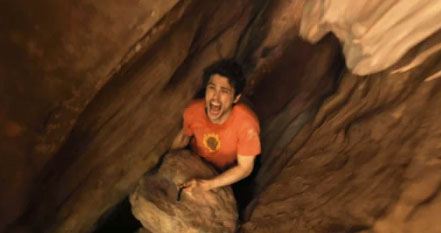
I see a lot of movies for my day gig at Plugged In. But, alas, I cannot see everything. So as much as I\’d like to tell you about the spiritual themes of Oz: The Great and Powerful, the only thing I can definitively say about the movie is that it stars James Franco. I’m hoping it ends a bit differently than the last James Franco movie I reviewed.
\”A little help here?\”
But while I haven\’t seen the new, Disneyfied Ozfest out in theaters yet, I do have fond recollections of the first one. So, in a retro homage, I thought I\’d talk about the great lessons—good or bad, spiritual or otherwise—that I\’ve taken from 1939\’s Wizard of Oz.
10. Nature is bad. Despite all the green we see here, The Wizard of Oz just hates the environment. Trees throw apples at Dorothy. Poppies put her to sleep. A tornado rips her away from her loving family. Her best friends are mostly environmental subjugators: The Scarecrow’s only job is to frighten poor, innocent birds. The Tin Man is a manifestation of Oz\’s thriving timber industry, perhaps. And while the presence of a lion in Oz might make the Sierra Club give a smile, he is a Cowardly Lion. When he\’s acting like most lions do in nature—growling and threatening and all—Dorothy smacks him on the nose, domesticating him immediately. And let\’s not forget that the Emerald City looks as if it\’s made entirely of plastic.
9. Leash laws are good. Sure, Toto\’s cute and all. But if Dorothy had just kept better control of her yippy mutt, Miss Gulch (the Kansas doppelganger of the Wicked Witch) would\’ve never been bitten and Dorothy could\’ve spent the rest of the movie in the root cellar with Auntie Em. (And really, can we blame Miss Gulch for being a little miffed getting bit by Toto? I think not. If Toto was a Rottweiler, the movie might\’ve gone in an entirely different direction.) And lest we think this a one-time occurrence, let\’ remember that just when Dorothy\’s set to get the heck out of Oz via balloon, Toto leaps out of the basket to chase a cat, nearly spoiling Dorothy\’s return to Kansas. Lucky she had those magic slippers. Oh, and speaking of which …
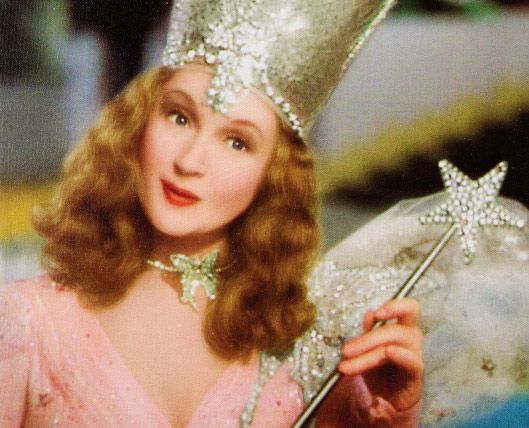
8. Never trust a witch. All due respect to Harry Potter and all, witches are a duplicitous lot. Naturally, we expect nefarious behavior from the Wicked Witch of the West. But Glinda the \”good\” witch seems, at times, just as bad. Consider: When the Wicked Witch seems a bit put out that her sister was crushed by a falling house, Glinda shows not the least bit of sympathy and instead gives the departed’s precious ruby slippers to a complete stranger instead of the next of kin. (What, they\’re not even going to consult the will?) The move not only ticks off the Wicked Witch something awful, but it immediately puts Dorothy\’s life in obvious jeopardy—and then Glinda sends Dorothy skipping down the yellow brick road by herself. (Considering in Frank Baum\’s original book Dorothy is all of 9 years old, you\’d think Oz\’s department of social services would have some stern words for Glinda on that score.) And then, after many harrowing adventures in which Dorothy\’s nearly killed, Glinda tells her that she could\’ve gotten home via those stupid ruby slippers all along. Is Glinda some sort of sadist?
7. Steer clear of flying monkeys. Have you seen those things? \’Nuff said.
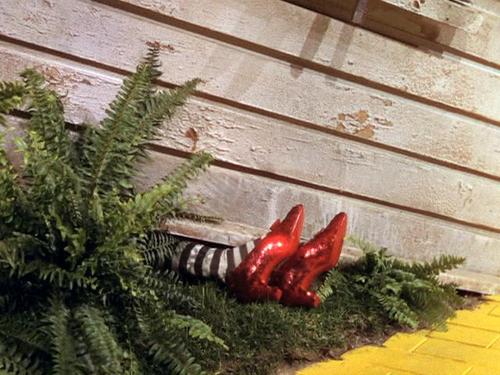
6. Miracles can look like accidents. And frankly, accidents can look like miracles. When Dorothy\’s house lands on the Wicked Witch of the East, the munchkins are apoplectic with joy. Dorothy insists that the whole thing was an accident. She didn\’t mean to set her casa down on anyone. But when you look at the situation from the munchkins\’ point of view, the whole thing must feel fairly miraculous. I mean, how often does a house just land on your own worst enemy? If a Kansas farmhouse tumbled from the sky in the middle of a New England/Denver football game and caused Tom Brady to throw an interception, I’d be inclined to point to the happening as evidence that God’s a Bronco fan. But is it proof? Absent a mailing sticker reading, “This miracle was brought to you by God,” probably not. Belief does not come easy to us these days. And that can be pretty frustrating.
5. Death is a tricky thing. Most of Oz seems to go to the Miracle Max school of mortality—that there’s a difference between all the way dead and mostly dead. Though the Wicked Witch of the East was crushed by a house, she’s not officially dubbed toast until the coroner tells us that \”She\’s not only merely dead, she\’s really most sincerely dead!\” And I’d imagine that if the Wicked Witch of the West had done anything less than melt in front of our very eyes, there might’ve been some doubt whether she might find enough life to come back for a sequel.
4. Stay on the road, yellow brick or otherwise. Bad things happen, we learn, when you leave the road—even if the road vanishes under a blanket of poppies. That cautionary warning is sounded regularly through eons of literature. The road represents safety and, more importantly, direction. Go off the road, and who knows? You could be snagged by flying monkeys. It’s a resonant metaphor for me obviously, since I’m prone use the cliche “walk of faith” far more often than I should, and even the name of my blog conveys a sense of road or pathway (be it a bit indistinct). Maybe it’s because I have a bad sense of spiritual direction at times. I’m prone to wander. And if I don’t have a yellow brick road to guide me, I’m in danger of getting lost.
3. Don\’t be fooled by appearances. Near the beginning of the movie, Glinda tells us that “only bad witches are ugly.” But we know that Glinda has some issues, and I think the rest of the land of Oz isn’t so caught up on looks. Lions typically look ferocious, but the one we meet is a wuss. Tin men supposedly have no heart, but our Tin Man would likely cry during Hallmark commercials. The Wicked Witch’s soldiers look awfully evil, but they turn out to be pretty nice blokes. This is a pretty obvious but important lesson for most of us—living in a society where image counts for so much and in a Christian subculture that places so much emphasis on some (I think) pretty superficial things. This is a good reminder to, before we start casting dispersions on someone’s soul or relationship with God, it might be a good idea to get to know ‘em a bit. 
2. Friends are in our lives for a reason. Dorothy is very appreciative of the help she gets from Scarecrow and the Tin Man and the Cowardly Lion. And since they did save her life and all, that makes sense. “Oh, you\’re the best friends anybody ever had,” she says. “And it\’s funny, but I feel as if I\’ve known you all the time.” We learn later, of course, that they all bear striking resemblance to folks she knows back in Kansas, and perhaps Oz was just the product of a bump on the head. But for me, there’s a deeper significance to this admission of Dorothy’s. See, when I look at the people in my own life, it seems they often arrived just when I needed a friend—and that type of friend—the most. Now, that’s not to say I knew them from some weird, spiritual version of Kansas: I’m not saying that at all. But just like Dorothy’s fevered brain may have stuck some characters along her journey to help her, it sometimes feels as though that God placed people in my life to help me. And maybe, if I’m lucky, God is using me the same way in other people’s lives, too.
1. What we really need, God will provide. The journey to the Emerald City proved to be a big waste of time, in a way—given that everyone had what they wanted all along. Scarecrow was pretty smart. Tin Man was pretty soft-hearted. The Cowardly Lion was surprisingly brave. Even Dorothy had home within her reach the whole time. (Thanks a lot, Glinda!) In the same way, I think that God has blessed us with attributes that best serve both our needs and His ultimate purpose for us. He’s given us gifts that he doesn’t want us to squander. And even when we’re feeling overmatched by the world, God has given us the tools to soldier on and—with His help–push through. “God is faithful,” we read in 1Corinthians 10:13. “He will not let you be tempted beyond what you can bear.” The road might not always be easy. But it is navigable. And in the end, it leads Home.
And as Dorothy tells us, there’s no place like it.

Running on Faith: Aches and Pains

My daughter and I are now in the teeth of our marathon training—the point in time where we start talking about blister mitigation, tote our CamelBaks around and wonder whether we should bring snacks. (I\’d like to take nachos, but they\’d be a bit messy.)
It\’s also when I figured we\’d be faced with a decision: Would we be able to continue?
Emily\’s always liked running—more than me, truth be told—and she\’s already run a couple of 13-plus-mile half marathons. But lately, she’s been struggling with one of her knees. 
Note the girl only has two of them, and both are fairly critical to running 26 miles. And while we weren\’t worried about her doing any real structural damage to the joint—her doctor said the area around it was just sorta \”irritated\” and \”inflamed\” (like me during rush hour)—I didn\’t want her suffering during our runs. Or, at least, not yet. Let’s face it: Most marathoners deal with some aches and pains when they run, but I didn\’t want my daughter to be miserable before her time. And on some of our longer runs, Emily’s been running a little like a well-conditioned Quasimodo.
But now, it seems as though her knee’s getting better—thanks in part to Em stretching the thing out whenever possible. She takes ibuprofen the second we head out to cut down on swelling. When I take one of my (frequent) bathroom breaks, she keeps the knee moving so it won’t stiffen up.
And, as I said, it seems to be paying off. We cruised through a 12-mile run without Quasimodo showing up for more than a half a mile of it. It’s feeling better, she says—and her left leg (the one without the injured knee) didn’t get nearly as tired as it sometimes gets, which means her right leg must be working a little bit harder.
Part of long-distance running, I think, is figuring out how to handle a bit of pain. We deal with the aches that come with running 26 miles—from stinging feet and aching backs to blisters and chafing. You learn to listen to your body: Is it screaming or just merely whining? Sometimes, your body absolutely tells you you should stop—before you do some serious long-term damage. But sometimes, like Emily’s knee, it’s just grouchy. It’s tired of putting up with all those miles, and understandably so. But if you can persevere and push through, your body sometimes decides to stop grousing and chip in a little more.
In our lives and our journeys of faith, we experience pain, too. Sometimes, the pain can be the product of really serious stuff: Loss. Heartbreak. Sickness. A crisis in the family or at work. When we suffer pain like this, we can’t go on as if nothing had happened. We’ve got to stop. We’ve got to heal.
But sometimes, the pain can be just part of life—irritants from a broken world that get into our joints and make it hard to push on.
I think that pain manifests itself a little differently for each of us, and it can come from loads of different places. We grow frustrated, disenfranchised. When it comes to spirituality, we lose sight of Christ and focus instead on all the fallible Christians and the imperfect trappings of Christianity. We get mad at our pastor or struggle with hypocrisy (be it ours or someone else’s). We grow intolerant at our own apparent inadequacies or bridle under its restrictions. Somewhere along the line, many of us Christians find that being Christian just hurts sometimes. And it’s tempting to just stop … because we hate the pain and we understand that that hurt won’t just go away. It’ll be with us, at some level, with every step.
But if we persevere, we find we can manage it. Just understanding the pain is bound to be there, actually, goes a long way toward accepting it. We stretch—not our knees, but our brains and our souls. The more limber they are, the more effectively we can sort through our issues intellectually—and more generous our souls can be with the shortfalls we see. 
This is the unsexy part of faith—the work of the thing. We can talk all we want about our relationship with God, but we sometimes conveniently forget that successful relationships take work. And that sometimes, through no fault of God’s, they can be painful.
And yet, we know it’s worth it. It’s worth the work, worth pushing through pain. It’s better to go forward than move back. Because in the end, we’ll see the object of all of our hard work … and it’ll all be worth it.

Jack the Giant Slayer: A Giant Leap

There are two basic ways to \”interpret\” story: You can try to decipher what the storyteller (be they writer or moviemaker or whatever) intentionally put there. You can determine what you, yourself, get from it.

Both have value, and both, of course, often go hand in hand. When a storyteller explicitly tells you the moral of The Three Little Pigs, most folks ain\’t gonna start mulling postmodern, Freudian interpretations of  \”chinny-chin-chin.\” Steven Spielberg\’s Lincoln is meant to give us a picture of a courageous, surprisingly complex man who bent a few rules to realize a much greater good. And you know, that\’s pretty much what most of the folks who saw Lincoln came away with.

But sometimes, we can get added value by drawing out some themes or \”messages\” unintended by the storyteller.

Take, for instance, the newly released Jack the Giant Slayer.

The movie kinda sorta follows the old fairy tale most of us are familiar with–with a few twists here and there. Jack trades his horse for a handful of magic beans. As I write in my Plugged In review:

It\’s really the most impractical trade imaginable, given that the monk [who gives Jack the beans] cautions Jack to keep the legumes far away from water. That sorta nixes the idea of Jack planting them, eating them or even setting them on the edge of the local wave pool while he goes for swim. But Jack—a trusting sort of lad—accepts the beans anyway.

 His significantly more cynical uncle (with whom Jack lives) is horrified at the trade. And in a fit of anger, he flings the beans across their hovel, where one slips through a crack in the floor. We can\’t buy thatch for the roof with beans! He hollers. And he stomps off. 

Shortly thereafter, a storm descends upon the kingdom, water spilling through all those unthatched holes in Jack\’s roof. And wouldn\’t you know it, Princess Isabelle, running away from an unjust marriage and to some grand adventure, runs right into Jack\’s house—just before a rivulet of water touches that magical bean underneath the floorboards. Before you can say \”Fee! Fi! Fo! Fum!\” Jack\’s house shoots straight up to the land of the giants with Isabelle in tow.  

This, of course, thrills the giants to no end. After all, it\’s not every day a princess comes over for dinner. 

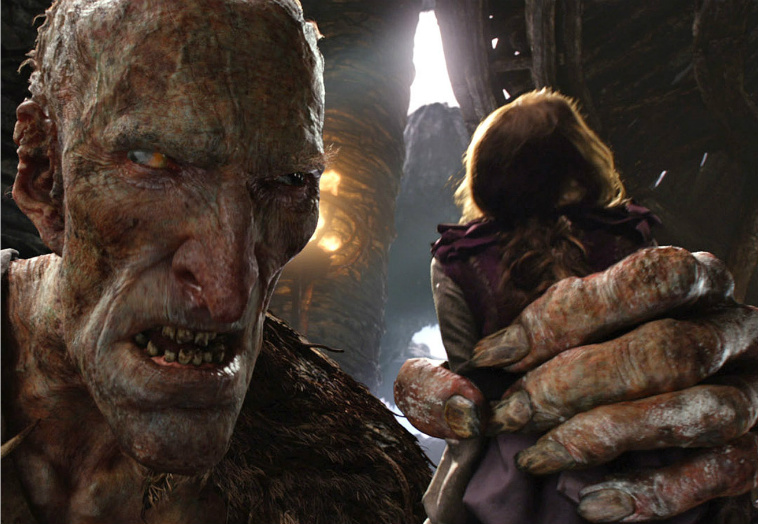
These giants are horrific dudes who belch and fart and pick their noses. The whole giant kingdom looks like the worst frat house you could imagine. And to make matters worse, the giants just love to chow down on human flesh.

Thankfully in ages past, humankind made a crown that could control the giants. And while an evil guy named Roderick tries to use the crown for his own unsavory plot, the headgear eventually–when used wisely–saves mankind.

Admittedly, I have no idea what sort of \”moral\” or \”message\” Jack\’s makers might\’ve been trying to give us. Don\’t let your vegetable gardens get overgrown, perhaps? Move to Arizona, where clouds would hardly ever hide floating countries populated by giants? Be wary of folks with two heads?

But there is a deeper message that one can draw out of here (if one really has to because one hasn\’t written a blog post all week).

Say we looked at the giants not as giants, but as humankind\’s more animalistic natures–the monsters lurking in each of us. They are real and powerful and can, at times, overwhelm us. Maybe sometimes our more civilized instincts try to push these impulses away, to where when we\’re in our right minds, they may feel almost imaginary. But they\’re never that far away. Just a push (via an overactive beanstalk, perhaps), and they\’ll invade. And if we don\’t master them, they can destroy us.

But we do have power over them–not a magic crown that rests on our heads, but what rests inside them. Sometimes, when intellect and reason is decoupled from our core values, as it was in Roderick\’s case, it can actually harness those horrific impulses and make them ever-more dangerous. But when we have purpose and principle to go along with our reason, these giants of ours can be subdued.

Let me offer a spoiler warning right now, because the kicker, for me, comes at the end.

When Jack finally subjugates the giants and becomes king, he hides the magic crown in plain sight. He has the thing adorned with the trappings of traditional, European royalty–including crosses and other symbols of Christian faith. It\’s important to note that throughout the movie, we see and hear repeated references to God and religion–our Babel-like desire to scale the beanstalk to heaven, the black magic of the beans–suggesting that Jack\’s world is one in which faith is taken seriously. The crown becomes not just a symbol of reason, but of religion, and how the two work together to help us become better people.

A stretch? Yeah, perhaps. Again, I doubt the filmmakers had anything like this in mind when they made the movie. But it\’s a fair one, don\’t you think?